Foundations of Classical Physics
Kinematics
The Language of Motion
Kinematics is the branch of physics that describes motion. It focuses purely on the how—how an object's position changes over time—without getting into the why, which involves forces. To start, we need to be precise with our language. In everyday conversation, we might use "distance" and "displacement" interchangeably, but in physics, they're distinct.
Displacement
noun
The change in an object's position. It is a vector quantity, meaning it has both magnitude (how far) and direction.
Similarly, we distinguish between speed and velocity. Speed is just a number (a scalar), like 60 miles per hour. Velocity is a vector; it includes direction. 60 mph north is a velocity. A car driving on a circular track at a constant speed is continuously accelerating. Why? Because its direction is always changing, which means its velocity is changing. Acceleration is defined as the rate of change of velocity.
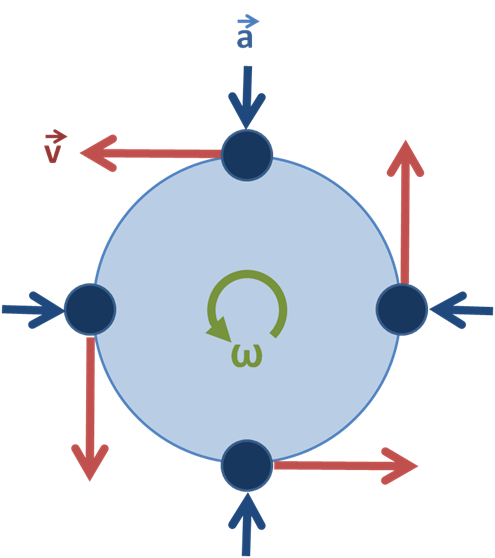
This might seem like a small detail, but it's crucial. Acceleration can mean speeding up, slowing down, or simply changing direction.
Motion with Constant Acceleration
Things get interesting when acceleration is constant. This is a common scenario—think of an object in freefall near the Earth's surface (ignoring air resistance). For these situations, we have a set of powerful equations, often called the kinematic equations, that link our key variables: displacement (), initial velocity (), final velocity (), acceleration (), and time ().
This first equation is a direct definition of constant acceleration. The other equations are derived from it.
This one is particularly useful when you don't know the final velocity.
These three equations are the core toolkit for solving any problem involving constant acceleration in one dimension.
Projectile Motion
Let's apply these ideas to two dimensions. Projectile motion describes the path of an object thrown or launched into the air, subject only to the acceleration of gravity. A key insight is to separate the motion into horizontal (x-axis) and vertical (y-axis) components. This simplifies the problem dramatically.
Here's the breakdown:
- Horizontal Motion: Ignoring air resistance, there are no horizontal forces. This means horizontal acceleration is zero (). The horizontal velocity is constant throughout the flight.
- Vertical Motion: Gravity acts downward, so the vertical acceleration is constant and equal to , the acceleration due to gravity (approximately downward).
By treating the x and y motions independently, we can use our one-dimensional kinematic equations for each.
| Component | Acceleration | Velocity | Displacement |
|---|---|---|---|
| Horizontal (x) | |||
| Vertical (y) |
The one variable that links the two components is time, . The time it takes for the projectile to travel horizontally is the same time it spends rising and falling vertically.
A car travels at a constant 50 km/h around a perfectly circular track. Which of the following statements is true?
In physics, what is the key difference between speed and velocity?
Understanding these principles allows us to predict the trajectory of a ball, the range of a cannon, or the path of a diver jumping off a cliff. It is the foundation for describing a vast range of motion in the world around us.