Foundations of Classical Mechanics
Kinematics
How Things Move
Kinematics is the branch of physics that describes motion. It doesn't worry about what causes the motion—things like forces or energy. It's purely about the numbers: where an object is, how fast it's going, and how its speed is changing. To get started, we need to be precise about a few key ideas.
Displacement
noun
The change in an object's position. It is a vector quantity, meaning it has both magnitude (how far) and direction.
Displacement isn't just the distance traveled; it’s your final position relative to your starting point. Imagine you walk a full circle and end up exactly where you started. You've walked a certain distance, but your displacement is zero.
Velocity is the rate at which your displacement changes. It’s not the same as speed. Speed just tells you how fast you're going, while velocity tells you how fast you're going and in what direction. A car traveling at 60 mph has a speed, but a car traveling at 60 mph north has a velocity.
Finally, acceleration is the rate at which velocity changes. You're accelerating if you speed up, slow down, or change direction. Slamming on the brakes is a form of acceleration (often called deceleration), and so is taking a turn in your car, even if your speed stays the same.
Constant Acceleration
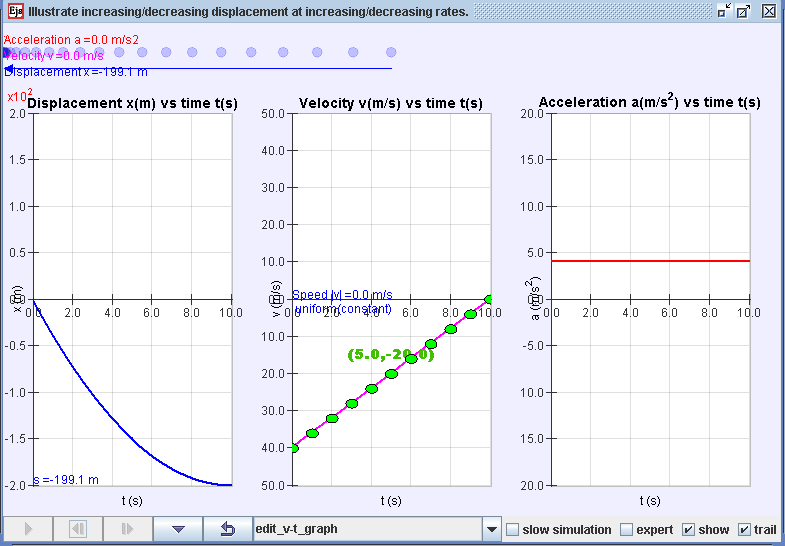
Analyzing motion can get complicated if the acceleration is always changing. Luckily, many common situations involve constant acceleration. The most famous example is an object in free fall near the Earth's surface. Ignoring air resistance, its velocity increases downwards at a steady rate.
For any motion with constant acceleration, we can use a set of simple equations to relate displacement, velocity, acceleration, and time. These are the kinematic equations.
In these equations: • is the displacement • is the initial velocity • is the final velocity • is the constant acceleration • is the time interval
This first equation calculates the final velocity based on the initial velocity, acceleration, and time.
This one finds the displacement when you know the initial velocity, acceleration, and time.
This last equation is useful when you don't know the time. It connects final velocity, initial velocity, acceleration, and displacement.
Motion in Two Dimensions
Things don't always move in a straight line. Consider a ball thrown into the air. It moves both forward and upward, tracing an arc. This is projectile motion, and it's a perfect example of two-dimensional kinematics.
The key to solving these problems is to break the motion into two separate, independent parts: a horizontal part and a vertical part. The motion in one direction doesn't affect the motion in the other.
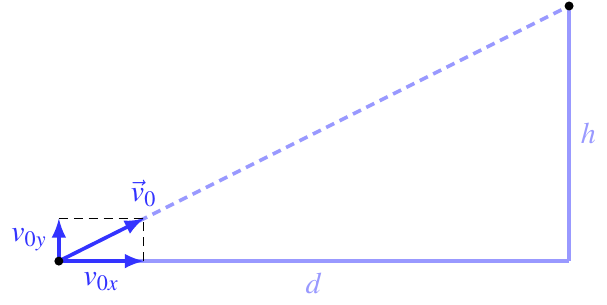
For a typical projectile, once it's launched, the only significant acceleration is gravity, which acts straight down. This means:
- Horizontal motion: The acceleration is zero (). The object moves with a constant horizontal velocity.
- Vertical motion: The acceleration is constant and directed downwards (, where ). This is a standard constant acceleration problem.
You can use the kinematic equations separately for each direction. The time of flight, , is the crucial link that connects the two.
Relative Motion
How you describe motion depends on your point of view, or your frame of reference. If you're on a train moving at 50 mph and you throw a ball forward at 10 mph, you see the ball moving at 10 mph. But someone standing on the ground outside sees the ball moving at 60 mph (50 mph from the train + 10 mph from your throw).
This is the concept of relative motion. Velocities add and subtract depending on the reference frames. The frame of reference is the coordinate system from which you are observing the motion.
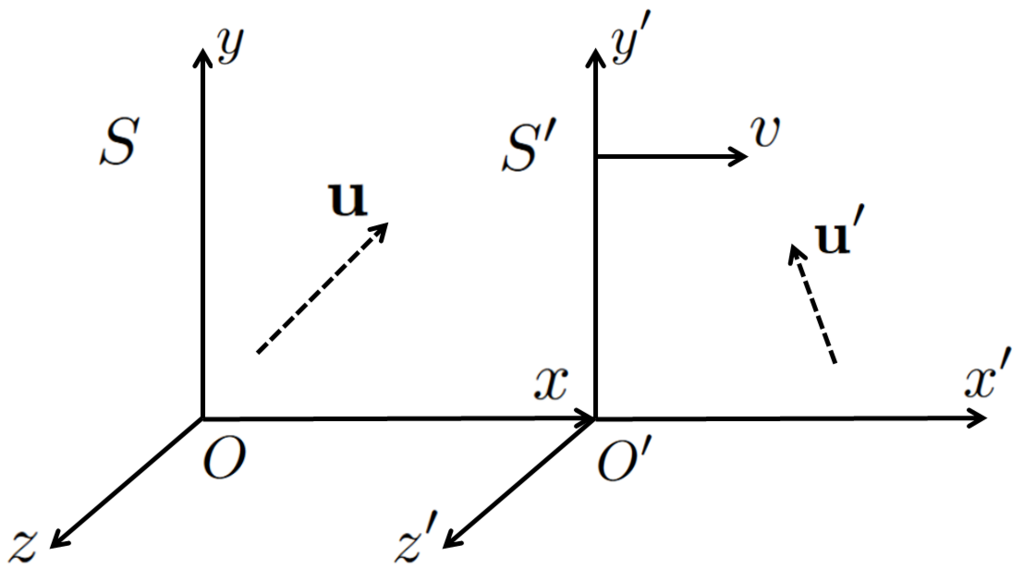
To analyze relative motion, we use vector addition. Let's say the velocity of object A relative to a stationary frame C is . And the velocity of object B relative to object A is . The velocity of B relative to C is the sum:
Think of the train example: C is the ground, A is the train, and B is the ball. The velocity of the ball relative to the ground is the velocity of the ball relative to the train plus the velocity of the train relative to the ground.
This principle works in two dimensions as well, like a boat crossing a river with a current. The boat's velocity relative to the water combines with the water's velocity relative to the riverbank to determine the boat's actual path.
Now, let's test your understanding of these core ideas.
A runner completes one full lap around a 400-meter circular track, ending exactly where they started. What is their total displacement for the lap?
Which of the following scenarios describes an object that is accelerating?
By breaking down motion into these components, we can describe and predict the path of almost any object, from a thrown baseball to a planet orbiting a star.