Foundations of Classical Mechanics
Newton's Laws
The Laws of Motion
Before Isaac Newton, our understanding of why things move was a bit muddled. People saw objects slow down and stop, and assumed that the natural state of everything was to be at rest. Newton turned this idea on its head. In his groundbreaking work, Principia Mathematica, he laid out three simple laws that govern the motion of everything from a thrown baseball to the planets orbiting the sun.
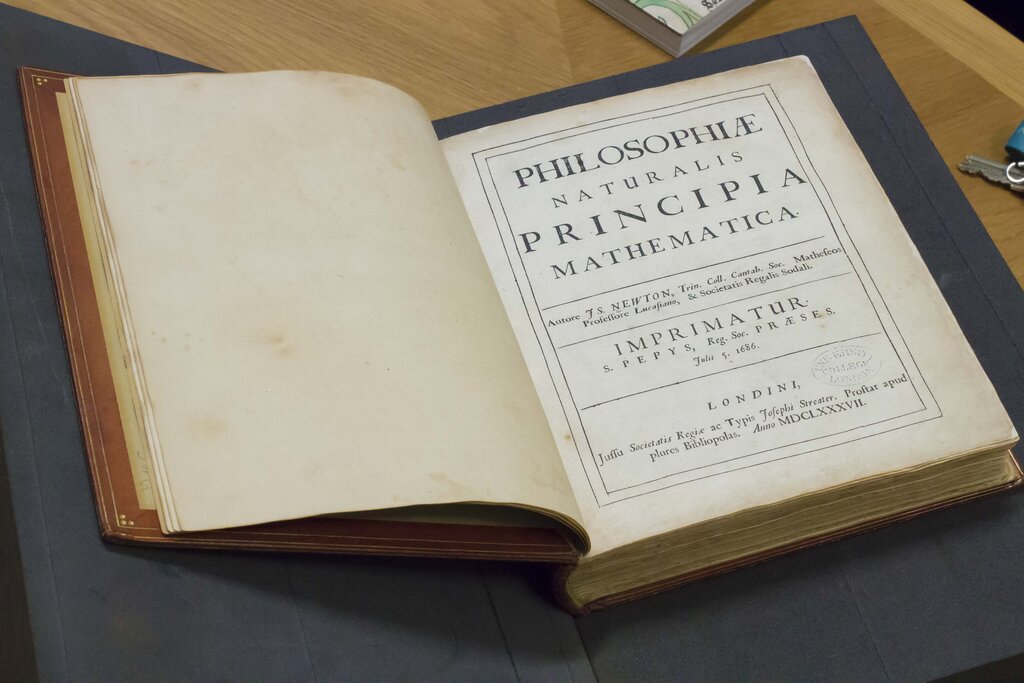
These laws are the foundation of classical mechanics. They provide a clear framework for understanding the relationship between an object and the forces acting upon it. Let's look at each one.
The First Law: Inertia
Newton's first law is about what happens when no forces are at play. It states that an object will keep doing whatever it's already doing. If it's sitting still, it will stay still. If it's moving, it will continue moving in a straight line at a constant speed.
An object at rest stays at rest and an object in motion stays in motion with the same speed and in the same direction unless acted upon by an unbalanced force.
This tendency to resist changes in motion is called inertia. The more mass an object has, the more inertia it has. It’s why it's harder to get a heavy train moving than a bicycle, and also why it's much harder to stop the train once it's in motion.
You feel inertia all the time. When a bus suddenly accelerates, you feel pressed back into your seat. Your body wants to stay at rest, but the bus is moving forward without you. When the bus stops, you lurch forward because your body wants to continue moving.
The Second Law: Force and Acceleration
The first law describes what happens when there's no force. The second law explains what happens when there is a force. It connects force, mass, and acceleration in a beautifully simple equation.
Imagine pushing an empty shopping cart. A small push sends it rolling easily. Now, imagine that cart is full of heavy groceries. You have to push much harder to get it moving at the same speed. That's the second law in action. The force needed to accelerate an object is directly proportional to its mass.
The acceleration of an object is directly proportional to the net force acting on it and inversely proportional to its mass.
This relationship gives us one of the most famous equations in physics.
This formula tells us exactly how much an object's motion will change when a force is applied. If you know any two of the variables, you can calculate the third. It's the mathematical engine behind classical mechanics.
The Third Law: Action and Reaction
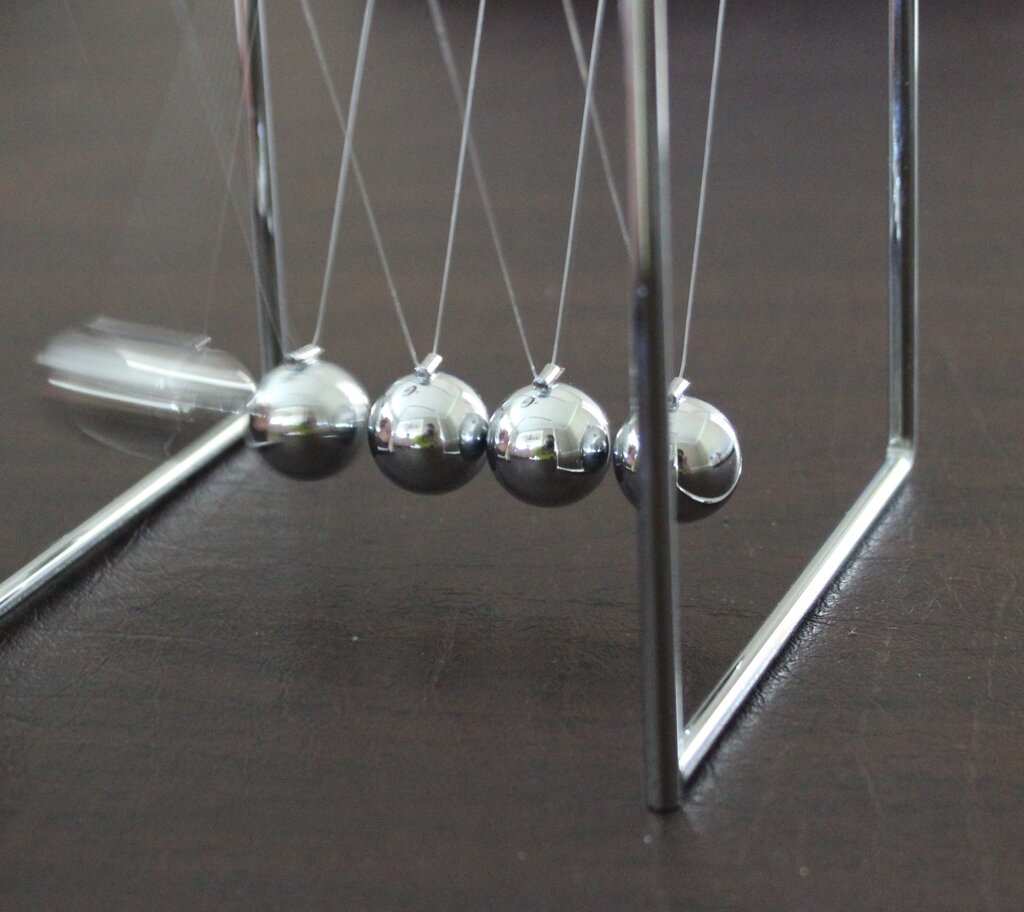
Newton's third law reveals a fundamental symmetry in the universe: forces always come in pairs. You can't push on something without it pushing back on you.
When you stand on the floor, your body exerts a downward force on it (your weight). At the same time, the floor exerts an equal and opposite upward force on your feet. If it didn't, you'd fall right through. These paired forces are called action and reaction.
For every action, there is an equal and opposite reaction.
This law explains how rockets work. A rocket pushes hot gas downwards (the action). The gas, in turn, pushes the rocket upwards (the reaction), propelling it into space. It's also why a cannon recoils when it fires a cannonball. The cannon pushes the ball forward, and the ball pushes the cannon backward.

It's important to remember that the action and reaction forces act on different objects. The rocket pushes on the gas, and the gas pushes on the rocket. They don't cancel each other out because they aren't acting on the same body.
Let's check your understanding of these fundamental laws.
Which of Newton's laws is also known as the Law of Inertia?
Imagine you push two objects on a frictionless surface with the exact same amount of force. Object A has a mass of 5 kg, and Object B has a mass of 10 kg. Which statement is true?