Foundations of Catholic Theology
Introduction to Catholic Theology
One God in Three Persons
At the heart of Catholic theology is a core belief: there is one God. This isn't just a starting point; it's the foundation for everything else. But this simple statement unfolds into a beautiful and profound mystery.
Catholics believe that the one God exists as three distinct persons: the Father, the Son (Jesus Christ), and the Holy Spirit. This concept is called the Holy Trinity. It’s not about believing in three gods. Instead, it’s about one divine being who is a communion of three persons. Each person is fully God, but they are not the same as one another.
At the heart of Catholicism is the belief in one God who exists in three persons: the Father, the Son (Jesus Christ), and the Holy Spirit.
Think of it this way: The Father is often associated with creation, the Son with redemption, and the Holy Spirit with sanctification—making things holy. Yet, all three persons were involved in all these acts. They are inseparable in what they are and what they do, but distinct in their relationship to one another.
This is one of the central mysteries of the faith. It can't be fully grasped by the human mind, but it can be explored and understood through a diagram known as the Shield of the Trinity.
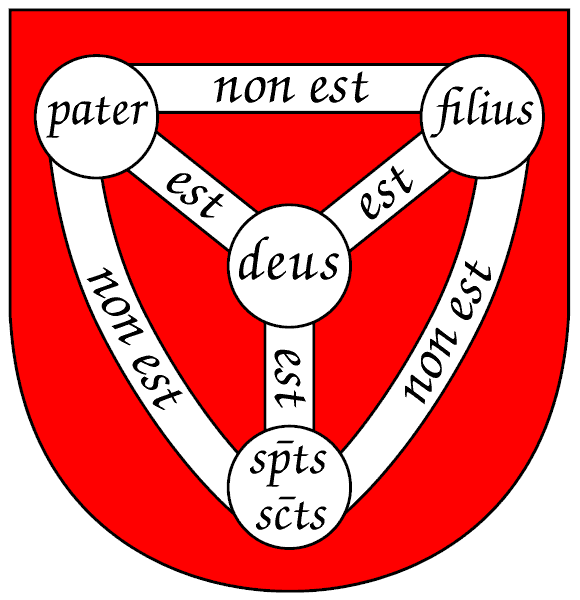
The diagram shows that the Father, Son, and Holy Spirit are each God, but they are not each other. It’s a visual way to hold the two truths—God’s oneness and threeness—in balance.
The Nature of God
Beyond being a Trinity, God has several key attributes that describe His nature. These qualities belong to the one God, and therefore to the Father, Son, and Holy Spirit equally.
omnipotent
adjective
Having unlimited power; able to do anything.
God's power is absolute. This doesn't mean God does things that are logically impossible or contrary to His own nature, like creating a square circle or being unloving. Rather, it means that God's power is sufficient to do anything that is consistent with His character and will.
omniscient
adjective
Knowing everything.
God possesses perfect knowledge. He knows all things—actual and possible—at once. This includes our deepest thoughts and feelings. His knowledge isn't learned or discovered; it is complete and eternal.
omnipresent
adjective
Present everywhere at the same time.
God is not confined by space or time. He is fully present in every place, sustaining everything that exists. This doesn’t mean God is the universe; rather, the universe exists within His presence.
Finally, and most importantly, God is love. This isn't just something God does; it's who He is. The constant, self-giving love between the Father, Son, and Holy Spirit is the very essence of God's being. All of God's other attributes are guided by His loving nature.
Creation and Providence
Flowing from God's nature is His relationship with the world. Catholic theology teaches that God created the universe ex nihilo, which is Latin for "out of nothing."
out of nothing
This means God didn't use any pre-existing materials to form the cosmos. He simply willed it into being. Creation was a free act of love, not something God was compelled to do. The universe is not a part of God, nor is it an accident; it is a deliberate and good gift from its Creator.
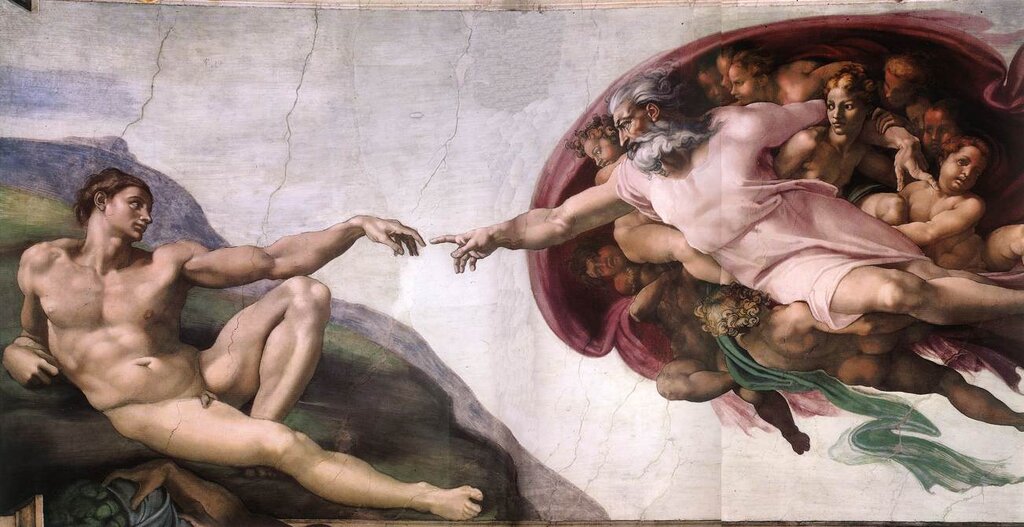
God's involvement didn't stop at the moment of creation. He continues to care for and guide His creation through what is called divine providence. This is the belief that God has a plan for the world and actively works to bring it about.
Providence doesn't mean that every event is rigidly predetermined or that human free will is an illusion. Instead, it's the confident trust that God can work through all things—even human choices and historical events—to achieve His ultimate purpose for the good of all.
Let's check your understanding of these core concepts.
According to Catholic belief, what is the Holy Trinity?
The Latin term ex nihilo, used to describe God's act of creation, means...
These foundational beliefs about the nature of God, creation, and providence shape the entire Catholic worldview.