Foundations of Business Concepts
Introduction to Supply and Demand
The Heartbeat of a Market
At its core, an economy is just a collection of people making decisions. Two of the most important decisions are what to sell and what to buy. These two forces, supply and demand, are the foundation of how markets work. They determine the price of everything from a cup of coffee to a new car.
Demand
noun
The amount of a good or service that consumers are willing and able to purchase at various prices during a specific period.
Think of demand as the buyer's side of the story. It isn’t just about wanting something; you also have to be able to pay for it. If you'd love a private jet but can't afford one, you don't contribute to the demand for private jets.
Supply
noun
The amount of a good or service that producers are willing and able to sell at various prices during a specific period.
Supply is the seller's side. It's the amount of a product that businesses make available for sale. A bakery might be willing to bake 100 loaves of bread if they can sell them for $5 each, but maybe only 50 if the price drops to $3.
The Laws of the Market
Supply and demand each follow a simple, intuitive rule.
The Law of Demand states that, all else being equal, when the price of a product falls, the quantity people demand will rise. When the price rises, the quantity demanded will fall. This is an inverse relationship. It makes sense: we're more likely to buy more of something when it's on sale.
The Law of Supply works the other way. It states that when the price of a product rises, the quantity businesses are willing to supply will rise. When the price falls, the quantity supplied will also fall. This is a direct relationship. Sellers are more motivated to produce and sell when they can get a higher price for their goods.
In short: People buy more at lower prices, and businesses sell more at higher prices.
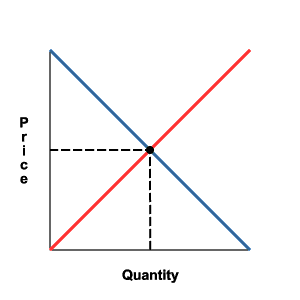
Economists visualize these laws using curves on a graph. The demand curve slopes downward, and the supply curve slopes upward. Price is always on the vertical axis, and quantity is on the horizontal axis.
Finding the Sweet Spot
So, what happens when these two forces meet? The point where the supply and demand curves cross is called the market equilibrium. This is the price at which the quantity buyers want to buy is exactly equal to the quantity sellers want to sell. It’s the market's natural balancing point.
The price at this point is the equilibrium price, and the quantity is the equilibrium quantity.
If the price is above the equilibrium, sellers will want to sell more than buyers want to buy. This creates a surplus, or excess supply. To sell their extra inventory, sellers will lower their prices, moving the market back toward equilibrium.
If the price is below the equilibrium, buyers will want to buy more than sellers are willing to sell. This creates a shortage, or excess demand. With too many buyers chasing too few goods, sellers can raise their prices, which also moves the market back toward equilibrium.
When Things Change
The market doesn't stay in one place forever. Things happen that can change the amount people want to buy or sell at any given price. When this occurs, the entire supply or demand curve shifts to a new position. It's crucial to remember that a change in the price of the good itself causes movement along the curve, not a shift of the curve.
Changes in price do NOT shift the supply or demand curves. They cause movement along the curves. Only the determinants we've discussed cause shifts!
What causes a shift in demand? Several factors:
- Income: When people's incomes rise, they can afford to buy more of most goods (a rightward shift).
- Tastes and Preferences: A new health trend or a successful advertising campaign can make a product more popular (rightward shift).
- Price of Related Goods: If the price of a substitute (like tea) goes up, demand for coffee might increase. If the price of a complement (like sugar) goes up, demand for coffee might decrease.
- Expectations: If you expect a product's price to rise next week, you might buy more of it today.
- Number of Buyers: More people in a market means more potential customers.

And what causes a shift in supply?
- Input Prices: If the cost of raw materials, like coffee beans, goes up, it becomes more expensive to produce coffee, and supply decreases (a leftward shift).
- Technology: An improvement in technology can make production cheaper and more efficient, increasing supply (rightward shift).
- Number of Sellers: If new coffee shops open in town, the total supply of coffee increases.
- Expectations: If producers expect prices to be higher in the future, they might hold back some of their current supply to sell later.
Each of these shifts creates a new equilibrium price and quantity. By understanding these forces, we can begin to predict how events like a change in weather, a new invention, or a shift in popular opinion can affect the prices we pay every day.
Ready to check your understanding?
According to the Law of Demand, what happens to the quantity demanded of a product when its price increases, assuming all other factors remain constant?
A widespread frost damages the coffee bean crop. How will this event most likely affect the market for coffee?