Foundations of Atomic Structure and Elements
Atomic Structure
Inside the Atom
Everything around you, from the air you breathe to the screen you're reading this on, is made of atoms. They are the fundamental building blocks of matter. But what are atoms themselves made of? It turns out they are composed of even smaller, or subatomic, particles: protons, neutrons, and electrons.
Atoms are composed of three fundamental subatomic particles:
Understanding these three particles is the first step to understanding all of chemistry. Let's look at each one.
Protons and Neutrons
Imagine the very center of an atom. This dense core is called the nucleus, and it's where we find protons and neutrons packed tightly together.
proton
noun
A subatomic particle with a positive electric charge, found within the atomic nucleus.
Protons define what an element is. For example, an atom with one proton is always a hydrogen atom. An atom with six protons is always a carbon atom. The charge of a single proton is considered the fundamental unit of positive charge, which we write as +1.
neutron
noun
A subatomic particle with no electric charge (it's neutral), found within the atomic nucleus.
Neutrons, as their name suggests, are neutral. They have no charge. Their main job is to add mass and help hold the nucleus together. Protons and neutrons have almost the same mass, which we define as one atomic mass unit (amu).
Electrons
If the nucleus is the atom's core, electrons are what surround it. They don't sit still; they zip around the nucleus in a region called the electron cloud.
electron
noun
A subatomic particle with a negative electric charge, found in the space surrounding the atomic nucleus.
Electrons have a negative charge of -1, which is equal in magnitude but opposite to the charge of a proton. This balance is important. In a neutral atom, the number of positive protons in the nucleus is perfectly balanced by the same number of negative electrons orbiting it, making the atom's overall charge zero.
Compared to protons and neutrons, electrons are incredibly tiny. Their mass is so small (about 1/1836th of a proton) that it's often ignored when calculating the total mass of an atom.
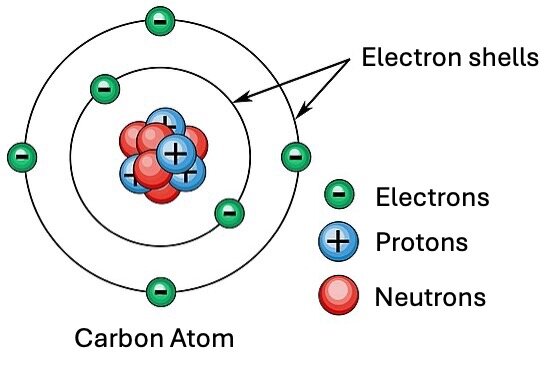
The arrangement of these particles gives an atom its structure: a small, dense, positively charged nucleus at the center, surrounded by a large, diffuse cloud of negatively charged electrons.
Particle Properties Summary
Here's a quick summary of the three subatomic particles.
| Particle | Location | Relative Charge | Relative Mass (amu) |
|---|---|---|---|
| Proton | Nucleus | +1 | ~1 |
| Neutron | Nucleus | 0 | ~1 |
| Electron | Outside Nucleus | -1 | ~1/1836 (negligible) |
With these building blocks in place, you're ready to explore how they combine to form all the different elements in the universe. Now, let's test your knowledge.
Which two subatomic particles are found within the atom's nucleus?
An atom has an overall neutral charge. If it contains 8 protons in its nucleus, how many electrons does it have?