Foundations of Atomic Bonding and Molecular Forces
Atomic Building Blocks
Inside the Atom
Everything you can see and touch is made of atoms. They are the fundamental building blocks of matter. For a long time, people thought atoms were the smallest possible things, solid and indivisible. But we now know they are made of even smaller particles.
An atom is mostly empty space. At its center is a tiny, dense core called the nucleus. Far from this nucleus, much smaller particles called electrons zip around. You can think of it like a miniature solar system. The nucleus is the sun, and the electrons are like planets in distant orbits. The vast distances between the nucleus and its electrons are what make up most of an atom's volume.
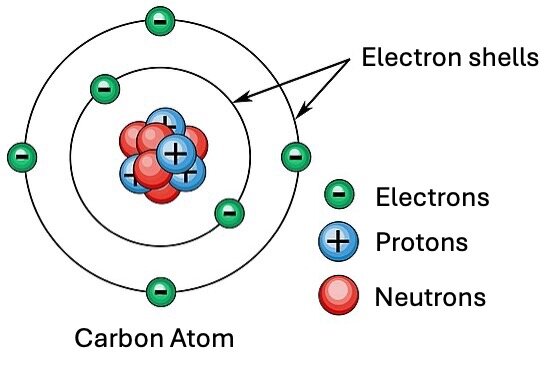
Meet the Particles
Atoms are composed of three main types of subatomic particles: protons, neutrons, and electrons. Their properties and arrangement determine the characteristics of every element.
Proton
noun
A subatomic particle with a positive electrical charge, found within the atom's nucleus. The number of protons determines the element's identity.
Protons are key players. The number of protons in an atom's nucleus is its unique identifier. An atom with one proton is always hydrogen. An atom with six protons is always carbon. Change the number of protons, and you change the element entirely.
Neutron
noun
A subatomic particle with no electrical charge (it's neutral), found within the atom's nucleus. Neutrons add mass and contribute to nuclear stability.
Neutrons are the protons' roommates in the nucleus. They have about the same mass as protons but carry no charge. Think of them as the glue that helps hold the nucleus together. The positively charged protons would otherwise repel each other and fly apart.
Electron
noun
A subatomic particle with a negative electrical charge that moves in the space surrounding the nucleus. Electrons are much smaller and lighter than protons or neutrons.
Electrons are the lightweights of the atom, with almost no mass compared to protons and neutrons. They carry a negative charge that is exactly opposite to the positive charge of a proton. In a neutral atom, the number of electrons equals the number of protons, so the positive and negative charges cancel each other out.
Atomic Numbers
To keep track of atoms, scientists use two important numbers: the atomic number and the mass number. These numbers tell you exactly what an atom is made of.
The atomic number (Z) is the number of protons in an atom's nucleus. This is the single most important number for an element, as it defines what the element is.
For example, every atom with 6 protons is a carbon atom, so carbon's atomic number is 6. Every atom with 92 protons is a uranium atom, so its atomic number is 92. You can find the atomic number for every element on the periodic table.
The mass number (A) is the total count of protons and neutrons in the nucleus. It's called the mass number because these two particles account for almost all of an atom's mass.
So, if a carbon atom has 6 protons and 6 neutrons, its atomic number is 6 and its mass number is 12. If a gold atom has 79 protons and 118 neutrons, its atomic number is 79 and its mass number is 197.
Now you know the basic components that make up every atom in the universe. Let's check your understanding.
What is the dense core at the center of an atom called?
Which subatomic particle has a negative charge?
Understanding these atomic building blocks is the first step in exploring the world of chemistry.