Foundations of Artificial Intelligence
AI Foundations
The Layers of AI
Artificial Intelligence (AI), Machine Learning (ML), and Deep Learning (DL) are often used interchangeably, but they represent a hierarchy of concepts. Think of them as nested dolls. AI is the outermost doll, the broad field of creating intelligent machines. Inside it is ML, a specific approach to achieving AI. And inside ML is DL, a specialized technique for implementing machine learning.
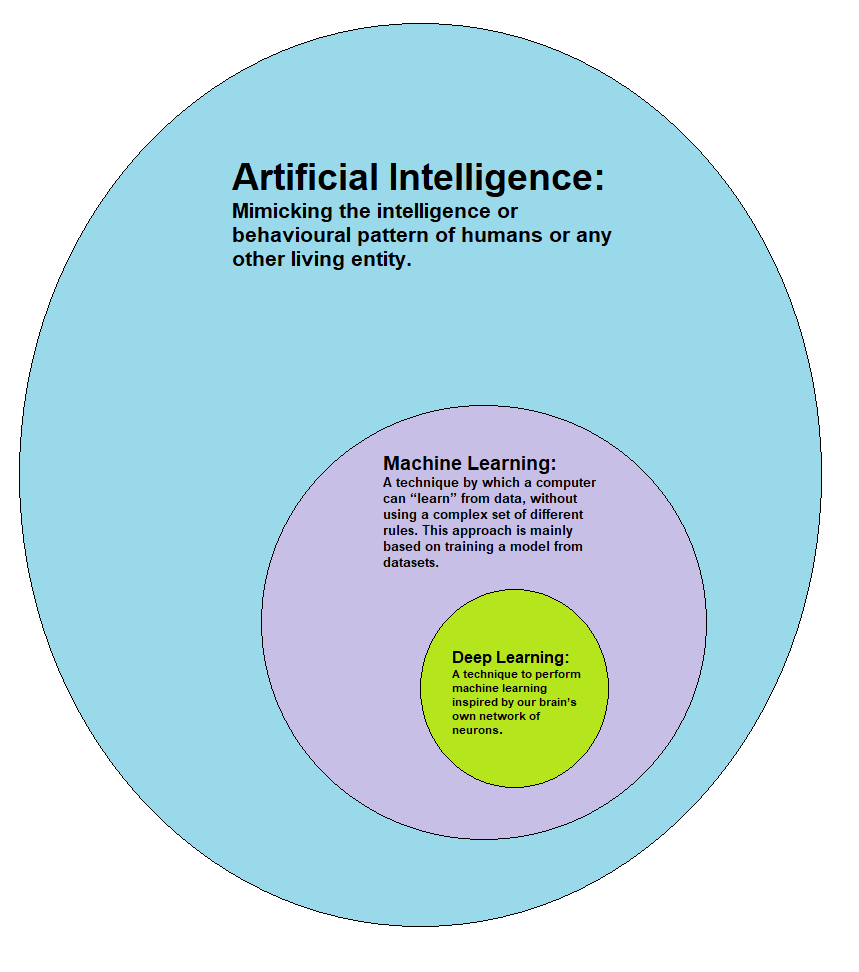
This structure isn't just academic. It shows an evolution of ideas. Early AI relied on handcrafted rules. Machine Learning introduced the ability to learn rules from data automatically. Deep Learning took this a step further by using complex, multi-layered neural networks to learn from vast amounts of data, discovering intricate patterns that would be nearly impossible to define by hand.
Machine Learning's Core Task
At its heart, machine learning is about pattern recognition. It's the process of training an algorithm on a set of data, allowing it to identify patterns, and then using those learned patterns to make predictions or decisions about new, unseen data. This is a fundamental shift from traditional programming, where a developer explicitly writes every rule the computer must follow.
Instead of being told what to do, an ML model learns what to do by analyzing examples. This ability to generalize from data is what makes it so powerful.
Whether it's a supervised model learning from labeled examples (like identifying spam emails based on a dataset of previously marked spam) or an unsupervised model finding hidden structures in unlabeled data (like grouping customers into market segments), the goal is the same: to turn data into insight and action.
Neural Networks and Deep Learning
Deep learning is a specific, and very powerful, type of machine learning. Its engine is the artificial neural network.
Neural Network
noun
A computational model inspired by the structure and function of the human brain's biological neural networks. It consists of interconnected nodes, or 'neurons,' organized in layers.
A simple neural network might have just three layers: an input layer that receives data, one 'hidden' layer that processes it, and an output layer that produces the final result. The term "deep" in deep learning signifies the use of neural networks with many hidden layers—sometimes hundreds or even thousands. Each layer learns to detect progressively more complex features in the data.
For example, in image recognition, the first layer might learn to identify simple edges and colors. The next layer might combine those edges to recognize shapes like eyes or noses. Subsequent layers combine those shapes to identify faces. This hierarchical feature learning is what allows deep learning models to achieve state-of-the-art performance on complex tasks like computer vision and natural language processing.
The three concepts are tightly interwoven. Deep learning is a technique for implementing machine learning. Machine learning is a major branch of artificial intelligence. You can't have deep learning without the principles of machine learning, and machine learning is a cornerstone of modern AI.
Which statement best describes the relationship between Artificial Intelligence (AI), Machine Learning (ML), and Deep Learning (DL)?
What is the core idea that distinguishes Machine Learning from traditional programming?
Understanding these foundational layers is the first step toward exploring the diverse world of AI methodologies.