Foundations of Artificial Intelligence
Introduction to Artificial Intelligence
What Is Artificial Intelligence?
Artificial Intelligence is the science and engineering of making intelligent machines. That's the textbook answer. A more helpful way to think about it is teaching a computer to think, learn, and solve problems in a way that mimics human intelligence. It’s not about creating a conscious robot from a movie. Instead, it’s about building systems that can perform tasks that normally require a human touch, like recognizing a face, understanding speech, or playing a game of chess.
Artificial Intelligence
noun
A field of computer science dedicated to creating systems capable of performing tasks that typically require human intelligence, such as visual perception, speech recognition, decision-making, and translation.
At its core, AI is about pattern recognition and decision-making. Imagine you're teaching a toddler to identify a cat. You don't write a long list of rules describing pointy ears, whiskers, and a tail. You just show them pictures of cats. After seeing enough examples, the toddler learns the general pattern of a cat. AI works in a very similar way, but on a massive scale.
A Quick Trip Through Time
The idea of intelligent machines has been around for centuries, from ancient myths to early science fiction. But the actual scientific field of AI is much younger. It officially kicked off in the summer of 1956 at a workshop at Dartmouth College, where the term "Artificial Intelligence" was first coined. The early years were full of excitement and bold predictions. Researchers built programs that could solve algebra problems and prove theorems in logic. But progress wasn't a straight line.
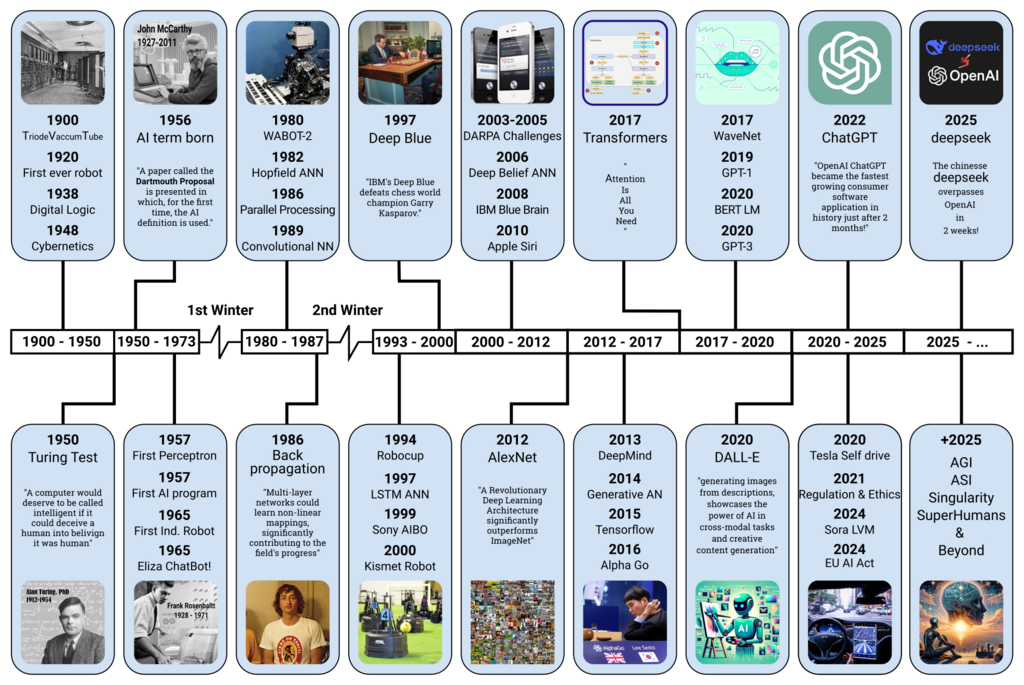
The field went through several "AI winters," periods where funding dried up and public interest waned because progress was slower than promised. The challenges were immense. Computers lacked the processing power and, just as importantly, the data needed to learn effectively. That all changed in the 21st century with the explosion of the internet and huge advances in computer hardware. Suddenly, AI had the two things it needed most: vast amounts of data to learn from and the power to process it all.
Two Flavors of AI
When people talk about AI, they are often mixing up two very different concepts: Narrow AI and General AI.
Artificial Narrow Intelligence (ANI) is the only kind of AI we have today. It's designed to perform a single, specific task very well. It might be better and faster than a human at that one thing, but it can't do anything else. Your spam filter, a chess-playing computer, a language translation app, and a self-driving car are all examples of Narrow AI. They are incredibly useful specialists.
Artificial General Intelligence (AGI) is the stuff of science fiction. This is a hypothetical AI with the ability to understand, learn, and apply its intelligence to solve any problem, much like a human being. An AGI wouldn't just play chess; it could also write a poem, compose music, or have a meaningful conversation about philosophy. Building an AGI is the ultimate goal for many researchers, but it remains a distant and incredibly complex challenge.
| Feature | Narrow AI (ANI) | General AI (AGI) |
|---|---|---|
| Scope | Performs a single, specific task. | Can perform any intellectual task a human can. |
| Examples | Spam filters, voice assistants, game AI. | HAL 9000, The Terminator, Data from Star Trek. |
| Status | Exists and is widely used today. | Theoretical and does not yet exist. |
The Building Blocks
So how do we build AI, especially the Narrow AI that's all around us? The most important engine driving modern AI is Machine Learning (ML). Instead of giving the computer a set of hard-coded rules to follow, machine learning allows the system to learn directly from data. It's the difference between telling a computer how to find spam and just showing it millions of emails and letting it figure out the patterns of spam for itself.
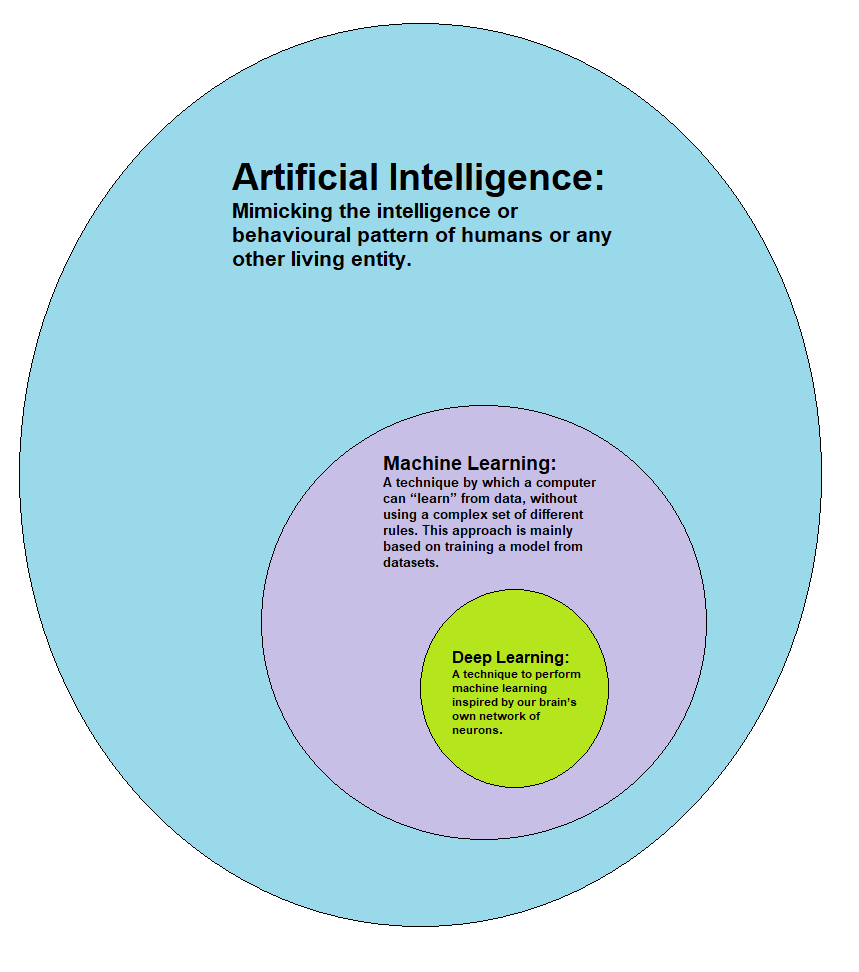
Within machine learning, there is a powerful technique called Neural Networks. Inspired by the structure of the human brain, neural networks are systems of interconnected nodes, or "neurons," that process information in layers. Each layer learns to recognize more complex patterns. For example, in an image recognition system, the first layer might learn to spot simple edges and colors. The next layer might combine those to recognize shapes like eyes and noses. A deeper layer could then combine those shapes to recognize a face. When a neural network has many layers, it's called Deep Learning, which is the technology behind today's most advanced AI systems, from voice assistants to medical imaging analysis.
According to the text, what is a helpful way to think about the core of Artificial Intelligence?
The term 'Artificial Intelligence' was first coined at a famous workshop that took place in 1956 at which institution?
These core ideas—teaching machines to learn from data using brain-inspired structures—form the foundation of the AI revolution we see today.