Foundations of Artificial Intelligence
Introduction to Artificial Intelligence
What Is Artificial Intelligence?
Artificial Intelligence (AI) is the science of making machines that can think and learn like humans. It's a broad field in computer science focused on creating systems that can perform tasks that typically require human intelligence. This includes things like understanding language, recognizing images, making decisions, and solving problems.
Think of it this way: if traditional programming is about giving a computer a strict set of instructions to follow, AI is about giving a computer the ability to develop its own instructions.
AI isn't a single technology. It's an umbrella term that covers many different methods and subfields. You've probably heard of some of them, like Machine Learning and Deep Learning. Machine Learning is a subset of AI that allows systems to learn from data, while Deep Learning is a further subset of Machine Learning that uses complex, multi-layered neural networks inspired by the human brain.
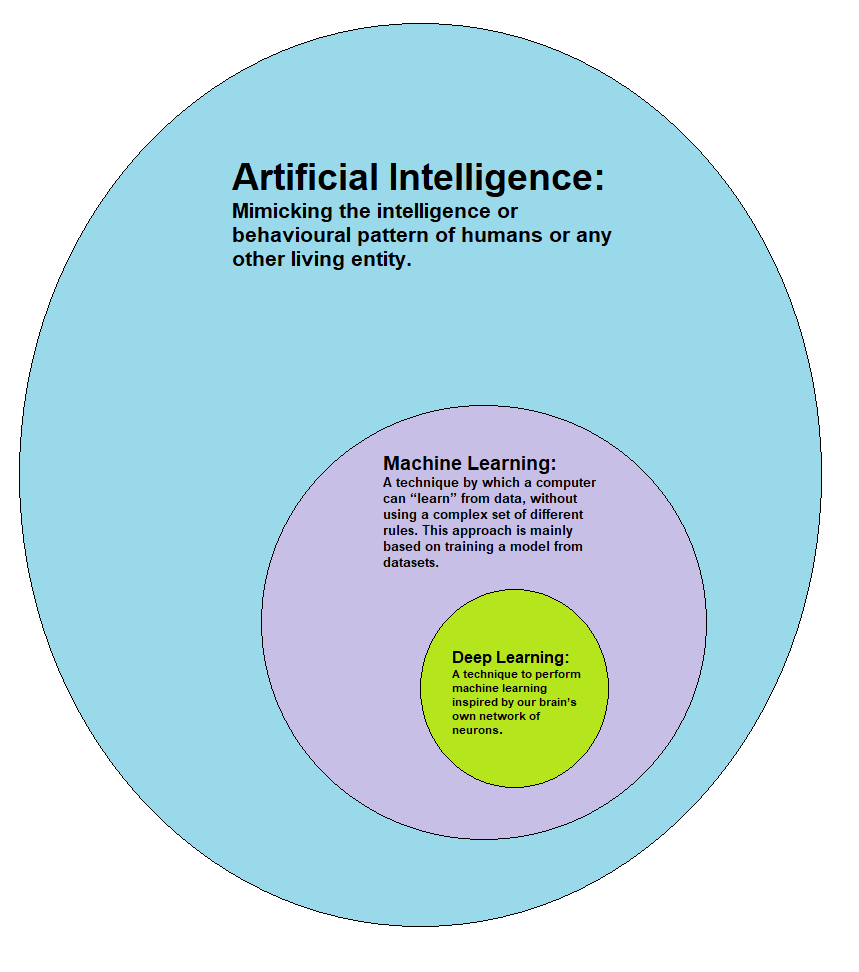
Two Flavors of AI
When people talk about AI, they're usually referring to one of two distinct types: Narrow AI and General AI. Understanding the difference is key to understanding where the technology is today and where it might be headed.
Artificial Narrow Intelligence
noun
Also known as Weak AI, it is a type of artificial intelligence that is trained to perform a specific or limited task. It operates within a pre-defined range and cannot perform tasks beyond its field.
All the AI we use today is Narrow AI. From the recommendation engine that suggests movies for you to the software that recognizes your face to unlock your phone, these systems are specialists. They can be incredibly powerful and outperform humans at their specific tasks, but they can't step outside of them. A chess-playing AI can't start recommending music, for instance.
Artificial General Intelligence
noun
Also known as Strong AI, it is a theoretical form of artificial intelligence where a machine would have an intellect comparable to a human's. It would possess the capacity to understand, learn, and apply its intelligence to solve any problem.
Artificial General Intelligence (AGI) is the stuff of science fiction, for now. This is the idea of a machine with the same general cognitive abilities as a human. It could learn any intellectual task that a human being can. Building an AGI is the ultimate goal for many in the field, but it remains a distant and incredibly complex challenge.
| Feature | Narrow AI (Weak AI) | General AI (Strong AI) |
|---|---|---|
| Scope | Performs a single, specific task | Can perform any intellectual task a human can |
| Examples | Voice assistants, image recognition, spam filters | C-3PO from Star Wars (hypothetical) |
| Current Status | Widely used and exists today | Theoretical, does not yet exist |
A Brief History
The idea of intelligent machines has been around for centuries, but the modern field of AI truly began in the mid-20th century. The term "artificial intelligence" was officially coined in 1956 at a conference at Dartmouth College. This event brought together the founding fathers of AI and established it as a formal academic discipline.
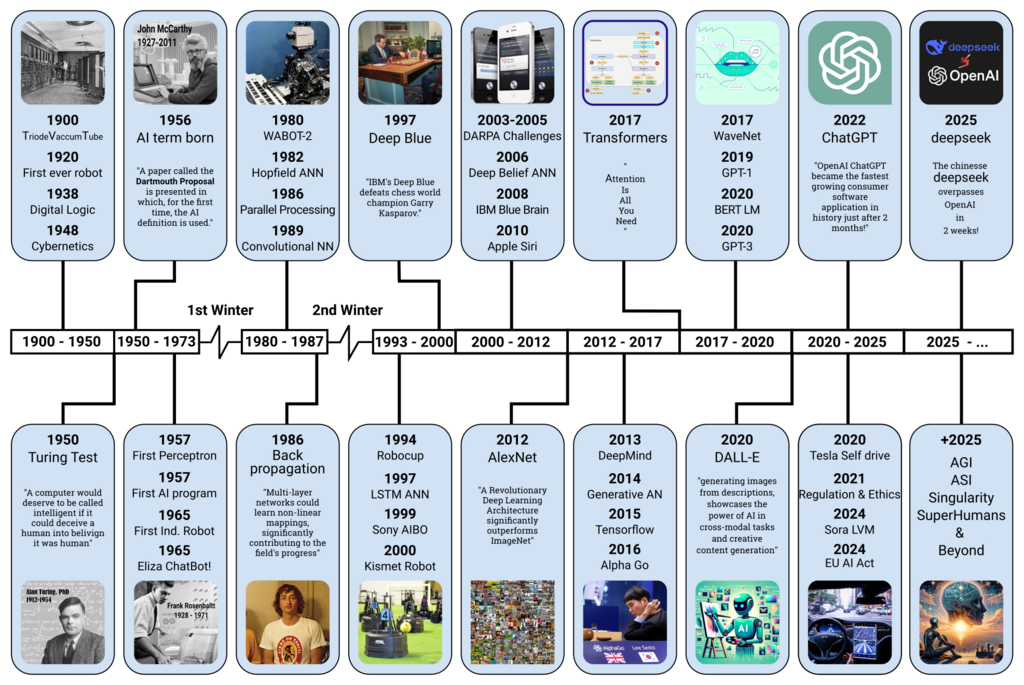
The early years were filled with optimism. Researchers developed programs that could solve algebra problems, prove theorems, and speak simple English. However, the initial excitement outpaced the available computer power and data. This led to periods known as "AI winters," when funding dried up and progress slowed.
Things began to change in the 1990s and 2000s with the rise of the internet, which generated vast amounts of data, and the development of much faster computers. These two factors—big data and powerful computation—fueled a renaissance in AI, particularly in the field of machine learning, leading to the rapid advancements we see today.
Why AI Matters Now
AI is no longer just a subject of academic research; it's a transformative force in our world. It powers search engines, translates languages in real-time, helps doctors diagnose diseases, and enables self-driving cars. Its significance lies in its ability to automate complex tasks, find patterns in data that humans can't see, and create new possibilities in nearly every industry.
Understanding the basics of AI is becoming as essential as knowing how to use a computer. It's the technology that will define the coming decades.
By learning its fundamental concepts, you're better equipped to understand the technologies shaping your life and to think critically about their impact on society. This foundation is the first step toward exploring the more advanced and specialized areas of this fascinating field.
Which statement accurately describes the type of AI commonly used in today's technology, such as smartphone assistants and recommendation engines?
What is the correct hierarchical relationship between Artificial Intelligence (AI), Machine Learning (ML), and Deep Learning (DL)?
Now that you have a grasp of the basics, you're ready to dive deeper into the specific types of AI and how they work.