Foundations of Artificial Intelligence
Introduction to AI
What Is AI?
At its core, Artificial Intelligence is about creating machines or systems that can perform tasks that typically require human intelligence. Think of it less as building a synthetic brain and more as designing a tool that can perceive its surroundings, reason through problems, and take actions to achieve a specific goal.
This could be as simple as a spam filter recognizing junk email or as complex as a car driving itself through city traffic. The common thread is the ability to process information and make a decision.
Artificial Intelligence
noun
A field of computer science dedicated to creating systems that can perform tasks that normally require human intelligence, such as visual perception, speech recognition, decision-making, and language translation.
A Brief History
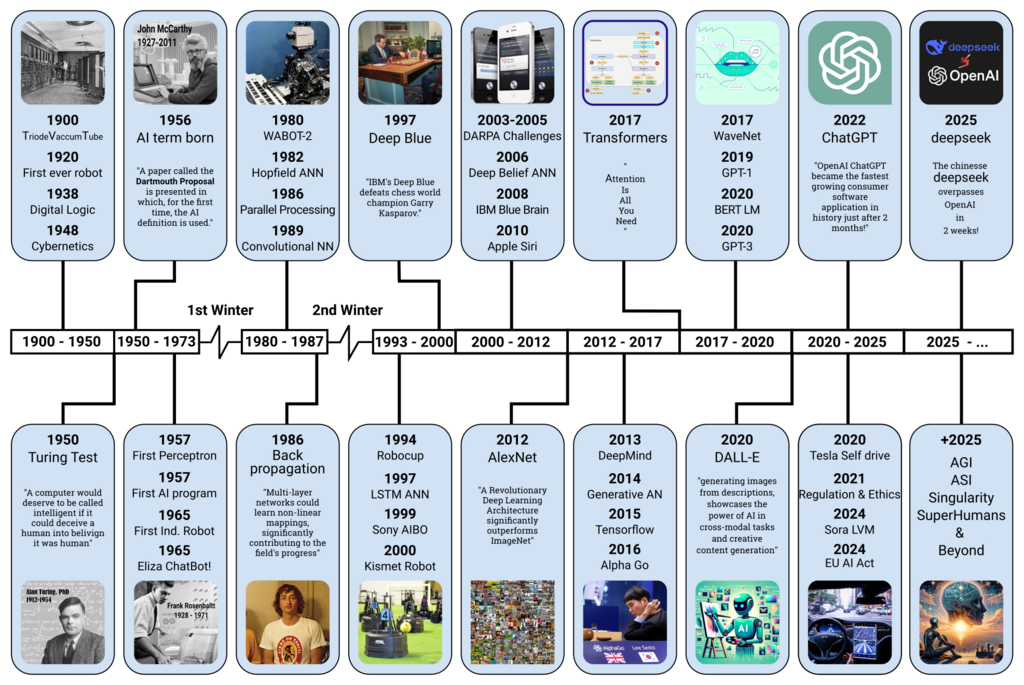
The idea of intelligent machines has been around for centuries, but the formal field of AI research began in the 1950s. A pivotal moment was the Dartmouth Workshop in 1956, where the term "Artificial Intelligence" was officially coined. Early researchers were incredibly optimistic, predicting that machines with human-like intelligence were just a few decades away.
Progress wasn't always a straight line. The field experienced periods of reduced funding and interest, known as "AI winters," when the technology couldn't live up to the hype. However, breakthroughs in computing power and the availability of massive amounts of data have led to the rapid advancements we see today.
Three Types of AI
AI isn't a single entity. It's a broad field with different levels of capability. The most common way to categorize AI is by its ability to replicate human intelligence. This gives us three distinct types.
| Type | Capability | Status |
|---|---|---|
| Narrow AI (ANI) | Performs a single, specific task | Exists today |
| General AI (AGI) | Matches human intellectual ability | Hypothetical |
| Super AI (ASI) | Surpasses human intelligence | Hypothetical |
All the AI we use today is Narrow AI, also known as Weak AI. It’s designed to be very good at one specific thing. The AI that recommends movies, translates languages, or plays chess is narrow. It can't suddenly decide to learn a new skill outside its programming.
General AI is the next step, and it's the stuff of science fiction for now. An AGI would be a machine with the ability to understand, learn, and apply knowledge across a wide range of tasks at a human level. It could solve a complex math problem, write a poem, and then learn how to cook a meal, all with the same underlying intelligence.
Beyond that is Super AI, a hypothetical form of intelligence that would far surpass that of the brightest human minds in virtually every field, from scientific creativity to general wisdom.
Agents and Environments
A fundamental concept in AI is the idea of an intelligent agent. An agent is anything that can perceive its environment through sensors and act upon that environment through actuators. You, a human, are an agent. Your eyes and ears are sensors, and your hands and legs are actuators.
For an AI, the agent could be a software program. Its "environment" might be the internet, a chess board, or a patient's medical data. Its "sensors" could be data inputs or a camera feed, and its "actuators" might be displaying an ad, making a move in a game, or flagging a potential health issue.
This simple loop of perceiving, thinking, and acting is the basic model for all intelligent agents, from a thermostat that senses room temperature to a sophisticated AI exploring another planet. The goal of AI development is to make the "thinking" part of this loop more effective, rational, and, well, intelligent.
Understanding these fundamentals—the definition, history, types, and the agent-environment model—provides a solid foundation for exploring the more complex aspects of how AI actually works.
What is the fundamental goal of Artificial Intelligence as described in the text?
The type of AI that can understand, learn, and apply knowledge across a wide range of tasks at a human level, but does not yet exist, is known as ______.