Foundations of Artificial Intelligence
Introduction to Artificial Intelligence
What is Artificial Intelligence?
At its core, artificial intelligence is about creating machines that can think, learn, and solve problems like a human. It's a broad field of computer science focused on simulating intelligent behavior in computers. This doesn't just mean making a machine that can calculate faster than a person; it means giving it the ability to reason, perceive, and interact with the world.
This introduction to this special issue discusses artificial intelligence (AI), commonly defined as “a system’s ability to interpret external data correctly, to learn from such data, and to use those learnings to achieve specific goals and tasks through flexible adaptation.”
Think about how you learn to ride a bike. You don't just follow a strict set of instructions. You try, you fall, you adjust your balance, and you get better over time. AI aims to give machines a similar capacity for flexible adaptation. The ultimate goal is to build systems that can tackle complex tasks that usually require human intellect, from understanding language to recognizing objects in a photo.
intelligence
noun
The ability to acquire and apply knowledge and skills.
A Quick Trip Through Time
The dream of creating artificial beings is ancient, appearing in myths and stories for centuries. But the scientific journey of AI began in the mid-20th century. In 1956, a group of researchers gathered at Dartmouth College and officially coined the term "artificial intelligence," kicking off the field as a formal area of study.
The early years were filled with optimism. Researchers created programs that could solve algebra problems and prove theorems. But progress was slower than expected. The complexity of creating true intelligence led to periods of reduced funding and interest, known as "AI winters."
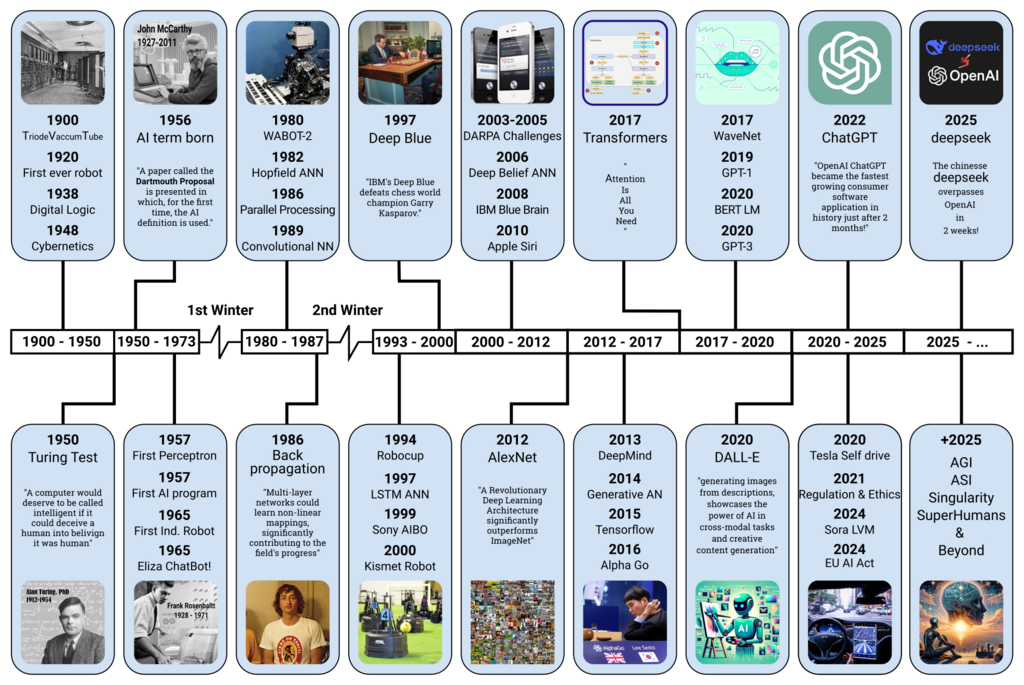
Things started to heat up again in the 1990s and 2000s with the rise of machine learning and access to vast amounts of data and powerful computers. A major turning point came in 1997 when IBM's Deep Blue supercomputer defeated world chess champion Garry Kasparov. More recently, breakthroughs in an area called deep learning have powered the rapid advances we see today, from voice assistants to sophisticated image recognition.
Why AI Matters Today
Artificial intelligence is no longer just a concept from science fiction. It's a powerful tool that is reshaping industries and changing how we live and work. Its significance comes from its ability to automate complex tasks, analyze huge datasets to find patterns, and make predictions with increasing accuracy. This has practical applications in almost every field imaginable.
| Field | Application of AI |
|---|---|
| Healthcare | Analyzing medical images to detect diseases earlier. |
| Transportation | Developing self-driving cars and optimizing traffic flow. |
| Entertainment | Recommending movies, music, and shows you might like. |
| Finance | Detecting fraudulent transactions and automating trading. |
| Customer Service | Using chatbots to answer questions and resolve issues. |
| Science | Analyzing massive datasets to speed up research and discovery. |
From the spam filter in your email to the navigation app on your phone, AI is working behind the scenes. It's helping doctors diagnose illnesses, farmers grow more food, and scientists tackle climate change. Understanding the basics of AI is becoming essential for navigating our increasingly digital world.
What is the primary goal of artificial intelligence?
The term "artificial intelligence" was officially coined at a conference held at which institution?