Foundations of Artificial Intelligence
Introduction to Artificial Intelligence
What Is Artificial Intelligence?
Artificial Intelligence, or AI, is a field of computer science focused on creating machines that can perform tasks that typically require human intelligence. Think of it as teaching a computer to reason, learn from experience, and solve problems on its own.
At its core, AI aims to simulate the cognitive functions we use every day: learning, understanding language, recognizing objects, and making decisions. Instead of being explicitly programmed for every single step of a task, an AI system is designed to identify patterns and make predictions based on data.
The goal isn't just to make a machine follow instructions, but to give it the ability to adapt and respond to new, unseen situations.
The Family Tree of AI
The term AI is a broad umbrella that covers many different methods and technologies. Two of the most important subsets are Machine Learning and Deep Learning. It's helpful to think of them as nested concepts, where each one is a more specialized version of the last.
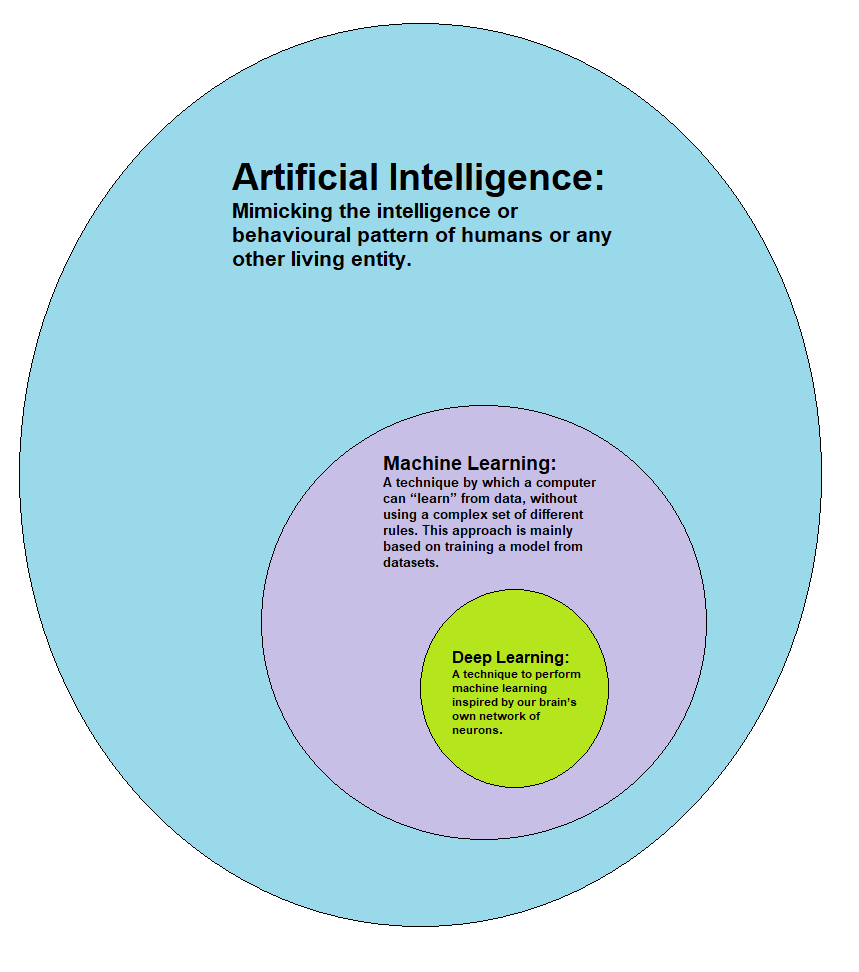
We'll explore these and other branches of AI, but first, let's look at how we got here.
A Brief History of AI
The dream of creating intelligent machines is ancient, but the formal field of AI research began in the 1950s. The journey has been a series of breakthroughs, setbacks, and incredible leaps forward.
Early excitement was followed by periods known as "AI winters," when progress stalled and funding dried up. However, the last few decades have seen an explosion in AI development, largely driven by two key factors: the availability of massive amounts of data and the development of powerful computers that can process it all.

The Branches of AI
AI isn't just one thing; it's a collection of specialized subfields, each focused on a different aspect of intelligence.
Machine Learning
noun
A subset of AI where systems learn directly from data to find patterns and make decisions without being explicitly programmed for the task.
Think of it as learning by example. You show a machine thousands of pictures of cats, and it eventually learns to recognize a cat on its own.
Deep Learning
noun
A specialized type of machine learning that uses multi-layered neural networks, inspired by the structure of the human brain, to learn from vast amounts of data.
Two other major subfields focus on how AI interacts with the world in a more human-like way.
| Subfield | Focus | Example |
|---|---|---|
| Natural Language Processing (NLP) | Enabling computers to understand, interpret, and generate human language. | Language translation apps, chatbots. |
| Computer Vision | Allowing machines to interpret and understand visual information from the world. | Facial recognition, self-driving cars. |
Narrow vs. General AI
Finally, it's important to distinguish between the AI we have today and the AI often seen in science fiction. All the examples we've discussed so far fall into the category of Artificial Narrow Intelligence (ANI). ANI is designed to perform a single, specific task, like playing chess, identifying faces, or recommending music. It can be incredibly powerful at its one job, but it can't operate outside of its designated purpose.
The AI that can beat the world's best chess player can't tell you how to boil an egg or recognize a song.
The other type is Artificial General Intelligence (AGI). This is a hypothetical form of AI that would possess the ability to understand, learn, and apply its intelligence to solve any problem, much like a human being. AGI is the long-term goal for many researchers, but it remains a theoretical concept for now.
What is the primary goal of Artificial Intelligence?
Which statement best describes the relationship between AI, Machine Learning (ML), and Deep Learning (DL)?
This overview provides the basic building blocks for understanding the world of AI. As we continue, we'll dive deeper into how these different technologies work and what they can do.