Foundations of Artificial Intelligence
Introduction to Artificial Intelligence
What Is Artificial Intelligence?
At its core, artificial intelligence is the science of making machines smart. It’s about creating computer systems that can perform tasks that typically require human intelligence, like learning from experience, solving problems, understanding language, and making decisions.
Think of it this way: We're trying to build a machine that doesn't just follow instructions, but can actually think, adapt, and act on its own.
Artificial Intelligence
noun
A field of computer science dedicated to creating systems that can perform tasks requiring human intelligence, such as learning, reasoning, problem-solving, and perception.
This doesn't mean creating a conscious robot like you see in movies. Most AI today is designed for specific tasks. Your email's spam filter, the recommendation engine on a streaming service, and the navigation app on your phone are all powered by AI. They are very good at one particular job.
A Quick Trip Through Time
The idea of intelligent machines has been around for centuries, but AI as a formal field of study began in the 1950s. Early researchers were optimistic, believing they could create human-level intelligence within a few decades. They developed programs that could solve algebra problems and play checkers at a respectable level.
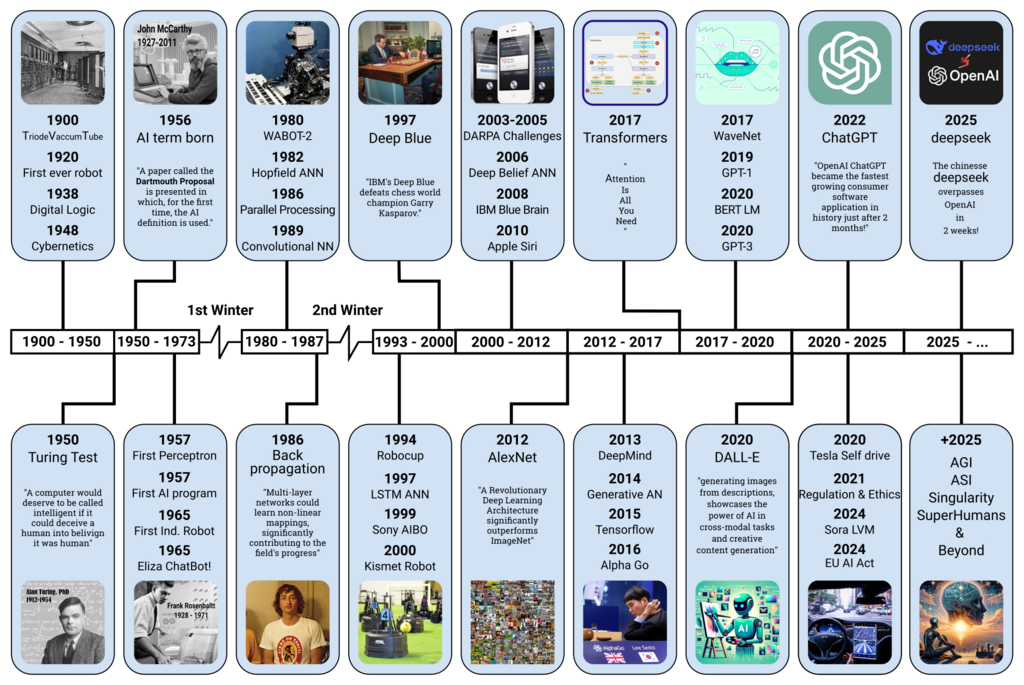
Progress wasn't always a straight line. The field went through several “AI winters,” periods when funding dried up because the technology couldn't live up to its initial hype. However, advances in computing power and the availability of massive amounts of data in the 21st century have led to the incredible boom we see today.
Two Flavors of AI
Historically, researchers have taken two main approaches to building intelligent systems. Think of them as teaching a computer in two different ways: giving it a rulebook versus letting it learn from examples.
The first approach is called Symbolic AI. It’s based on the idea that human intelligence can be broken down into a set of rules and logical steps. If you can define all the rules for a task, you can program a machine to do it.
An early chess program is a classic example. It was programmed with the rules of chess and strategies for how to play. It didn't "learn" chess; it executed the logic it was given.
The second approach is Computational AI, which includes machine learning and deep learning. Instead of hard-coding rules, you give the computer a huge amount of data and let it figure out the patterns on its own. It learns by example, much like a child learns to distinguish a cat from a dog by seeing many pictures of both.
| Approach | How It Works | Best For... |
|---|---|---|
| Symbolic AI | Uses explicit rules and logic programmed by humans. | Problems with clear, definable rules, like grammar checking or tax calculation. |
| Computational AI | Learns patterns from large datasets without explicit rules. | Complex problems where rules are hard to define, like image recognition or speech translation. |
Today, computational AI dominates the field, powering most of the AI applications we interact with daily.
AI Is Everywhere
Artificial intelligence is no longer a futuristic concept; it's a practical tool transforming industries. Here are just a few examples:
From helping doctors analyze medical scans to enabling farmers to monitor crop health, AI's applications are broad and growing every day. This is just the beginning of understanding what's possible.
Ready to check your understanding? Let's see what you've learned.
What is the core concept of artificial intelligence?
The periods in AI history characterized by reduced funding and interest due to unfulfilled promises are known as what?
Understanding these core concepts is the first step. As you continue, you'll see how these ideas form the building blocks for the powerful AI tools that are shaping our world.