Foundations of Artificial Intelligence
Introduction to AI
What is Artificial Intelligence?
Artificial intelligence is the theory and development of computer systems that can perform tasks that normally require human intelligence. This includes things like visual perception, speech recognition, decision-making, and translation between languages.
At its core, AI is not about creating a mechanical human. It's about building machines that can learn from data, identify patterns, and make decisions with minimal human intervention. The term was coined in 1956 at a workshop at Dartmouth College, which is considered the birthplace of AI as a field. Early research explored problem-solving and symbolic methods. While initial excitement was high, progress was slow, leading to periods of reduced funding known as "AI winters."
However, advances in computing power and the availability of vast amounts of data have led to a resurgence. Today, AI is a broad field with many different approaches and applications, fundamentally changing how we interact with technology.
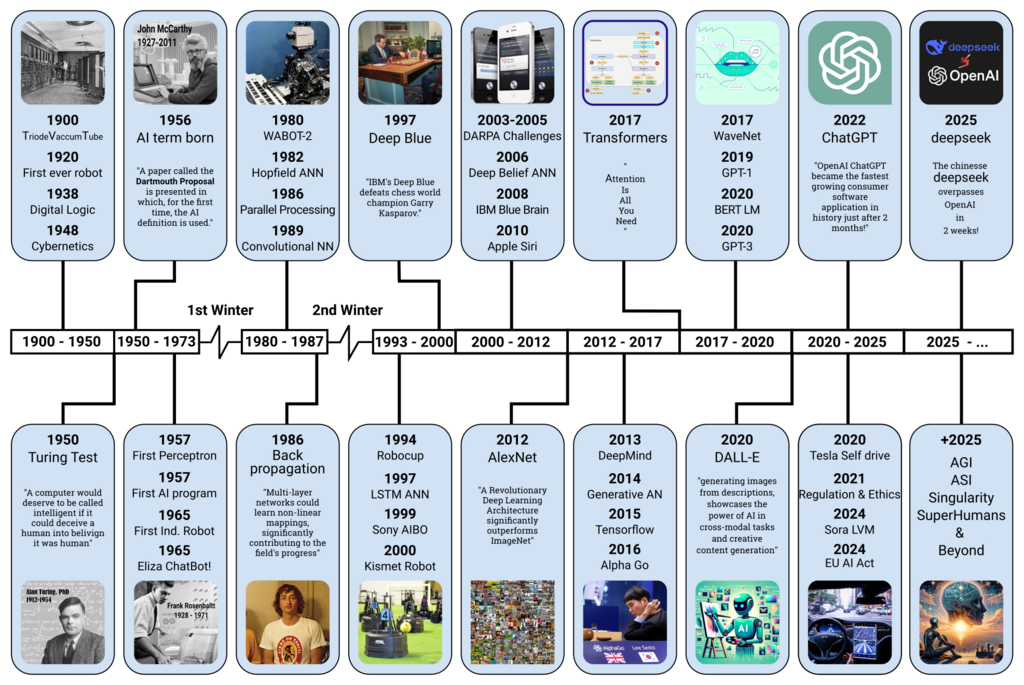
The journey of AI is marked by a shift from rule-based systems, where humans explicitly wrote the rules for every possible situation, to systems that can learn on their own. This evolution is key to understanding the two main categories of AI that exist today.
Narrow vs. General AI
Not all AI is created equal. The AI we encounter in our daily lives is very different from the intelligent robots we see in science fiction. This distinction is captured by the concepts of Narrow and General AI.
Artificial Narrow Intelligence (ANI) is designed to perform a single, specific task. Artificial General Intelligence (AGI) is a theoretical form of AI that would possess the ability to understand, learn, and apply its intelligence to solve any problem.
Every AI application you use today is a form of ANI. Your spam filter, a chess-playing computer, a language translation app—they are all masters of one domain. A chess program can't recommend a movie, and a spam filter can't drive a car. They operate within a pre-defined range and cannot perform tasks beyond their programming.
AGI, on the other hand, remains hypothetical. It would be a machine with the cognitive abilities of a human, capable of reasoning, problem-solving, and abstract thinking across many different fields. It could learn a new skill just as a human does, by reading a book or watching a video. Achieving AGI is the long-term goal for many researchers, but it presents enormous technical and ethical challenges.
The path from ANI to AGI isn't clear. Some experts believe it's centuries away, while others think it could happen in our lifetimes. A third category, Artificial Superintelligence (ASI), refers to an intellect much smarter than the best human brains in practically every field. For now, our focus remains on developing and refining Narrow AI.
The Building Blocks of AI
How does an AI system actually work? While the specifics can be incredibly complex, most modern AI systems share three core components: data, algorithms, and computing power.
Algorithm
noun
A set of rules or instructions given to an AI model, computer, or other problem-solving machine to help it learn on its own.
Data is the lifeblood of AI. It's the information that AI systems learn from. This could be anything: images of cats for an image recognition system, text from books for a language model, or sales numbers for a forecasting tool. The more high-quality, relevant data an AI has, the better it becomes at its task. Without data, an algorithm has nothing to learn from.
Algorithms are the brains of the operation. They are the mathematical processes that find patterns and make predictions from the data. Machine learning, a subset of AI, is a collection of these algorithms that allow computers to learn without being explicitly programmed. Think of an algorithm as a recipe and the data as the ingredients. The algorithm tells the system how to process the data to produce a useful output.
Computing Power provides the muscle. Training an AI model, especially a complex one, requires immense computational resources. The development of specialized hardware, like Graphics Processing Units (GPUs), has been a major catalyst for the recent boom in AI capabilities. These chips can perform the vast number of calculations needed for machine learning much more efficiently than traditional processors.
This introduction to this special issue discusses artificial intelligence (AI), commonly defined as “a system’s ability to interpret external data correctly, to learn from such data, and to use those learnings to achieve specific goals and tasks through flexible adaptation.”
These three components—data, algorithms, and computing power—work together in a cycle. More data allows for more complex algorithms, which in turn require more computing power. This synergy is what drives progress in the field.
Now that you have a grasp of the fundamentals, let's test your knowledge.
What is the primary goal of Artificial Intelligence as described in its modern context?
A self-driving car's navigation system, which excels at driving but cannot compose music, is an example of which type of AI?
Understanding these foundational ideas is the first step in navigating the world of artificial intelligence.