Foundations of Artificial Intelligence
Introduction to Artificial Intelligence
What Is Artificial Intelligence?
At its core, artificial intelligence is about creating machines that can perform tasks that typically require human intelligence. Think about problem-solving, making decisions, understanding language, or even learning from experience. The main goal isn't just to mimic human actions, but to create systems that can reason, adapt, and operate autonomously to achieve specific objectives.
AI gives a system the ability to correctly interpret data, learn from it, and use those learnings to accomplish specific goals through flexible adaptation.
This broad field brings together ideas from computer science, psychology, philosophy, and many other disciplines. It’s not one single technology, but a collection of approaches and tools designed to make machines smarter and more capable.
A Brief History of AI
The dream of creating artificial beings is ancient, appearing in myths and legends long before computers existed. However, the scientific pursuit of AI began in the mid-20th century. A key moment was the 1956 Dartmouth Workshop, where the term "artificial intelligence" was officially coined, and the field was established as a formal area of research.
Early pioneers were incredibly optimistic. They developed programs that could solve algebra problems, prove geometric theorems, and speak simple English. This initial excitement, known as the "golden years" of AI, led to bold predictions about creating human-level intelligence within a few decades.
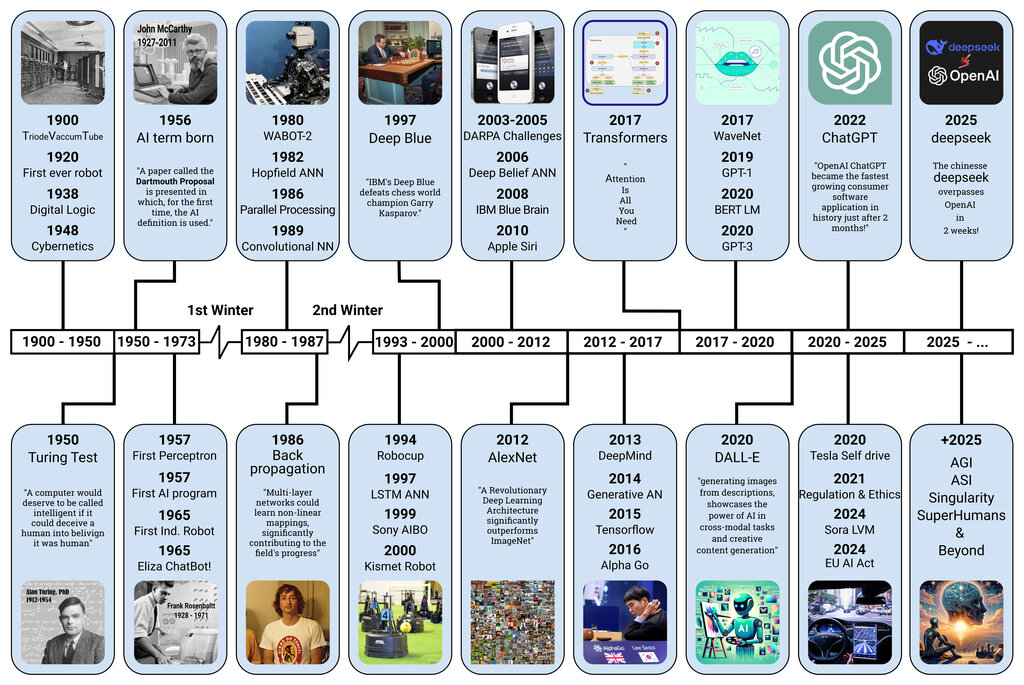
But the challenges proved to be much harder than expected. The limited computing power of the time and the sheer complexity of human cognition stalled progress. This led to a period in the 1970s and 80s called the "AI winter," when funding dried up and public interest waned.
Things began to change in the 1990s. The rise of the internet, massive increases in computing power, and the availability of huge datasets created fertile ground for a comeback. A major turning point came in 1997 when IBM's Deep Blue supercomputer defeated world chess champion Garry Kasparov. This event demonstrated that machines could tackle complex problems once thought to be the exclusive domain of human intellect.
Intelligent Agents
To understand how AI works in practice, it's helpful to think about the concept of an intelligent agent. An agent is anything that can observe its environment and then take actions to achieve a goal. It’s a simple but powerful idea that forms the foundation of most AI systems.
agent
noun
A system that perceives its environment through sensors and acts upon that environment through actuators.
An agent operates in a continuous loop: it perceives, it thinks, and it acts.
-
Perception: The agent gathers information about its surroundings using sensors. For a robot, sensors could be cameras and microphones. For a chatbot, the sensor is the text input it receives from a user.
-
Action: Based on its perceptions and programming, the agent performs an action using actuators. A robot's actuators are its motors and limbs. A chatbot's actuator is its ability to generate and display text.
Even a simple thermostat is a basic agent. It senses the room's temperature (perception) and turns the heating or cooling system on or off (action) to maintain a desired temperature.
Modern AI systems are far more complex, but they all operate on this fundamental principle of perceiving the world and acting to achieve goals. From recommending movies to navigating autonomous vehicles, intelligent agents are the engines driving AI's impact on our world.
What is the primary goal of artificial intelligence?
What significant event marked the official beginning of AI as a formal research field?
This foundational understanding of what AI is, where it came from, and the concept of intelligent agents sets the stage for exploring its more advanced applications.