Foundations of Applied Artificial Intelligence
Machine Learning Foundations
From Explicit Rules to Learned Patterns
In traditional programming, engineers write the rules. If a pressure sensor reads above a certain threshold, a valve opens. If a temperature sensor drops, a heater turns on. This is a deterministic system. The same input always produces the same output because the logic is explicitly coded line by line.
This approach, sometimes called , is powerful and reliable for tasks with clear, definable rules. But what happens when the rules are too complex to write down? Consider identifying a microscopic crack in a jet engine turbine blade from a video feed. The number of variables, like lighting conditions, blade angle, and crack shape, is enormous. Writing an IF-THEN statement for every possibility is impractical.
This is where machine learning introduces a new paradigm. Instead of writing rules, we provide the computer with data, lots of it, and let it learn the patterns itself. We show it thousands of images of cracked blades and thousands of images of intact ones. The model builds a probabilistic understanding of what constitutes a crack, one that can handle ambiguity and variation. This shift from hand-coded logic to learned models is the essence of .
Instead of programming the logic, you program the goal by providing data and a loss function.
The Machine Learning Lifecycle
Developing a machine learning model isn't a one-time event; it's a continuous cycle. This process ensures that models remain accurate, relevant, and effective as new data becomes available and business needs evolve.
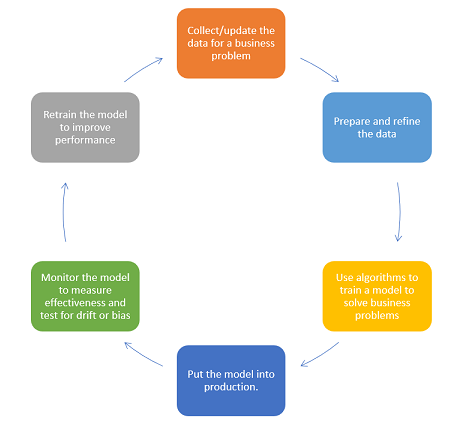
The lifecycle has several key stages:
- Data Collection & Preparation: Raw data from sensors, logs, or databases is gathered. This data is then cleaned, normalized, and formatted. This step often involves , where domain experts select and transform the most relevant input variables for the model.
- Model Training: The prepared data is used to train the model. The algorithm iterates through the data, adjusting its internal parameters to minimize the difference between its predictions and the actual outcomes.
- Deployment: Once the model performs well on test data, it's integrated into a production environment. This could be a factory control system, a web application, or a mobile app.
- Monitoring & Retraining: The model's performance is continuously monitored in the real world. Over time, its accuracy might degrade due to changes in the underlying data patterns, a phenomenon known as model drift. When this happens, the model is retrained on new data to maintain its effectiveness.
Training, Inference, and Generalization
The two primary phases of a model's existence are training and inference. Training is the computationally intensive process of learning from the dataset. It can take hours or even weeks on powerful hardware. Inference, on the other hand, is the process of using the trained model to make a prediction on new, live data. This needs to be fast and efficient.
The ultimate goal of training is generalization. A model generalizes well if it can make accurate predictions on data it has never seen before. It's easy to build a model that simply memorizes the training data, but such a model is useless in practice. It has learned the noise, not the signal. This failure to generalize is called overfitting.
The green line captures the underlying trend of the data, allowing it to predict new points accurately. The red line, in its attempt to be perfect on the training data, would make wild and incorrect predictions for any new point that doesn't fall exactly on its path.
In an industrial setting, this principle is critical. A model for predictive maintenance on a factory robot must recognize wear-and-tear patterns from sensor data (vibration, temperature, power consumption). If it only memorizes the exact patterns from its training data, it will fail to flag a new, slightly different pattern that still indicates an impending failure. A well-generalized model, however, learns the fundamental signatures of mechanical stress and can reliably predict failures in novel situations, saving millions in downtime and repairs.
Time to check your understanding of these foundational concepts.
What is the fundamental difference between the programming paradigms referred to as "Software 1.0" and "Software 2.0"?
A machine learning model designed to detect cracks in turbine blades performs with 99% accuracy on its training data, but only 55% accuracy on new images from the factory floor. This is a classic example of:
This shift from deterministic logic to probabilistic models is a fundamental change in how we build complex systems. By understanding the lifecycle and the goal of generalization, you can begin to see how machine learning unlocks solutions to problems that were once unsolvable.