Foundations of Algebraic Geometry
Affine Varieties
Shapes from Equations
In mathematics, we often use equations to describe shapes. A simple line on a graph can be written as an equation like . A circle can be described by . These shapes are the collection of all points that make the equation true.
Algebraic geometry takes this idea and runs with it. The fundamental objects we study are called affine varieties. An affine variety is simply the set of all solutions to a system of polynomial equations.
Affine Variety
noun
The set of all points that are common solutions to a system of one or more polynomial equations.
Let's break that down. A polynomial is just an expression with variables and coefficients, like $3x^2 - 5xy + 2$. A system of polynomial equations is just a list of them that we want to solve simultaneously. The set of all points that satisfy all the equations in the system forms the affine variety.
We don't have to stick to two dimensions. We can have equations with variables $x, y, z$ to describe surfaces in 3D space, or even more variables for higher-dimensional spaces that we can't easily visualize.
Building with Varieties
Affine varieties have some neat properties. For instance, what happens if we combine two varieties? Let's say we have a variety defined by a set of polynomials , and another variety defined by a set of polynomials .
The union of these two varieties, , includes all the points that are in or in (or both). This union is also an affine variety. It's defined by the set of all possible products of a polynomial from and a polynomial from .
The intersection of the two varieties, , includes only the points that are in both and . This is also an affine variety. It’s defined by simply combining the two lists of polynomials, and , into one big list.
The union and intersection of any two affine varieties are also affine varieties. This means we can combine or slice them to create new ones.
An interesting edge case is the empty set. Can the set of solutions to a system of polynomial equations be empty? Absolutely. For example, the equations and have no common solution. So, the empty set is a valid affine variety. What about the entire space itself, like the whole 2D plane? That's also a variety, defined by the polynomial equation , which is true for all points.
The Algebra Behind the Shape
So far, we've focused on the geometric shape—the variety. But algebraic geometry is about the connection between algebra and geometry. This connection is made through something called the coordinate ring.
Imagine you have an affine variety, like the circle . We can think about all the possible polynomial functions we could evaluate on the points of this circle. These functions form an algebraic structure called a ring.
However, some different-looking polynomials will behave identically on the circle. For instance, the function is always equal to for any point on our circle. The function is also, obviously, always . So, on the variety, and are the same function. We consider two polynomials to be equivalent if they have the same value at every point on the variety.
The coordinate ring of a variety is the set of all polynomial functions restricted to that variety. It captures all the algebraic information about the geometric shape.
Let be a variety in -dimensional space defined by the polynomials . The coordinate ring, denoted , consists of all polynomial functions on . This ring is created by taking all possible polynomials in variables and then identifying any two polynomials that are the same on .
This might seem abstract, but it's a powerful idea. By studying the algebraic properties of the coordinate ring, we can learn things about the geometric properties of the variety. A smooth, connected curve will have a different kind of coordinate ring than two lines that cross. This duality is the heart of algebraic geometry.
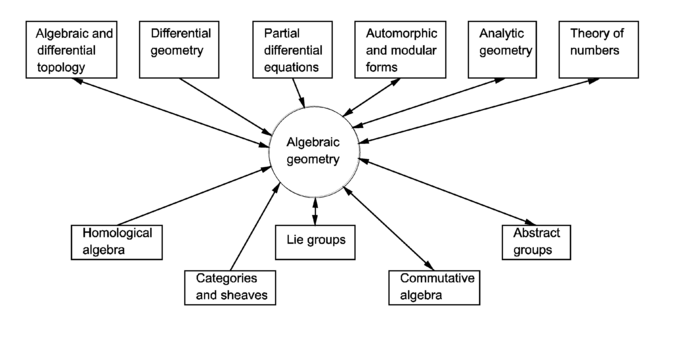
This link allows us to translate hard geometry problems into algebra problems, which can sometimes be easier to solve, and vice-versa. We're not just looking at a shape; we're studying the entire system of functions that live on it.