Foundations of AI Training
Introduction to AI Training
How AI Learns
Artificial intelligence doesn't come into the world fully formed. Just like a person, it has to learn. This learning process is called “training,” and it’s how an AI model goes from a blank slate to a powerful tool that can identify images, translate languages, or even write code.
The core idea is simple: we show the AI a massive amount of information, called training data, and teach it to recognize patterns. Think of it like teaching a child to identify a cat. You don’t list out rules like “has pointy ears, whiskers, and a tail.” Instead, you show them many different pictures of cats until they just get it. AI training works in a very similar way, but on a much larger scale.
The Training Pipeline
Developing an AI model is a structured process, often called a pipeline. It begins with a clear goal, like wanting to build an AI that can tell if a customer review is positive or negative. The first step is to gather data—in this case, thousands of customer reviews that have already been labeled as positive or negative.
This labeled data is fed to the AI model. The model makes a prediction for each review and compares its guess to the actual label. If it guesses wrong, it adjusts its internal logic to do better next time. This cycle of guessing, checking, and adjusting is repeated millions of times.
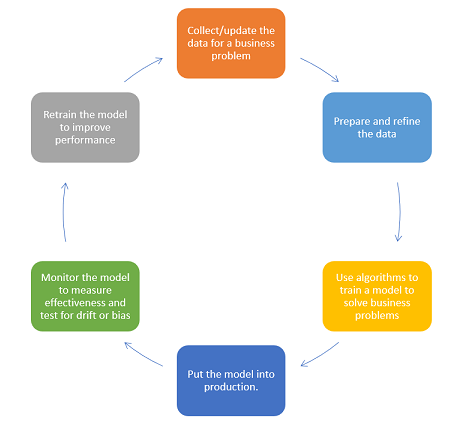
This process is iterative. An AI model is never really “finished.” After the initial training, it’s deployed into the real world, where it encounters new data. Engineers monitor its performance to see if it’s still accurate. Over time, the model is retrained with fresh data to keep it up-to-date and effective. This ensures the AI adapts to new patterns, slang, or customer behaviors.
Data Quality is Key
The single most important ingredient in AI training is the data itself. A model is only as good as the data it learns from. This concept is often summarized as “garbage in, garbage out.”
If we want to train an AI to identify different types of vehicles, but our dataset only contains pictures of red sports cars, the model will struggle to recognize a blue truck or a white minivan. The data needs to be not only accurate but also diverse and representative of the real-world scenarios the AI will face.
Poor quality data leads to poor quality AI. A successful model depends on clean, relevant, and unbiased information.
Ensuring data quality involves carefully collecting, cleaning, and labeling the information before training even begins. This foundational step prevents biases and inaccuracies from being baked into the model, making the final AI tool more reliable and fair.
The Role of Algorithms
If data is the ingredient, the algorithm is the recipe. An algorithm is a set of mathematical rules and statistical methods that guides how the AI model learns from the data. It defines the process of finding patterns, making decisions, and adjusting based on errors.
Different tasks require different algorithms. An algorithm designed for translating text would be different from one used to detect fraud in financial transactions. Choosing the right algorithm is crucial for building an effective model. Data scientists select a learning algorithm that best fits the problem they're trying to solve and the type of data they have.
Let's test what you've learned about the basics of AI training.
What is the primary purpose of “training” an AI model?
An AI model is trained to identify dog breeds, but its training data only consists of Golden Retrievers and Poodles. What is the most likely outcome when this model is shown a picture of a Chihuahua?
Training is the fundamental process that transforms raw data and algorithms into a capable AI. By understanding this iterative cycle, you can better appreciate how the AI tools we use every day come to be.