Foundations of AI and Project Development
Introduction to Artificial Intelligence
What Is Artificial Intelligence?
Artificial Intelligence, or AI, is about creating computer systems that can perform tasks that normally require human intelligence. This includes things like learning from experience, understanding language, recognizing objects, making decisions, and solving problems.
Instead of being explicitly programmed for every single task, an AI system is designed to learn and adapt. Think of it less like a simple calculator that only follows rigid instructions and more like a student that can absorb information and apply it to new situations.
The core goal of AI is to build machines that can think, reason, and learn, much like humans do.
AI isn't a single technology, but a broad field of study with many different branches and approaches. Some AI systems are designed for very specific tasks, like playing chess or identifying spam emails, while others are built to be more general-purpose assistants.
A Quick Trip Through Time
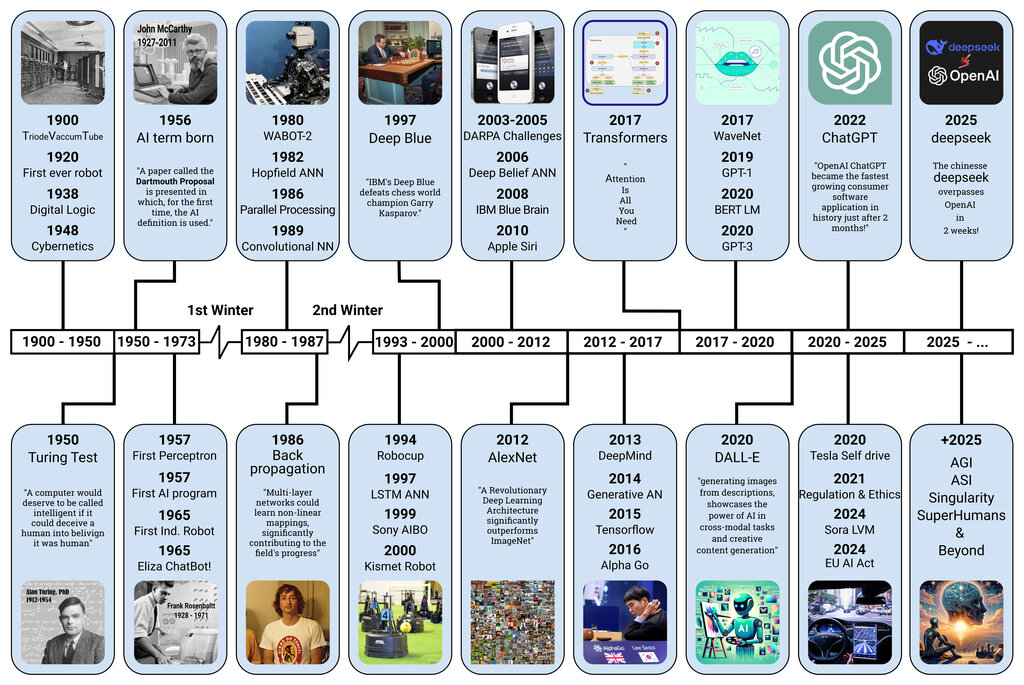
The dream of creating intelligent machines has been around for centuries, but the modern field of AI officially began in the summer of 1956. A group of researchers gathered at Dartmouth College for a workshop where they coined the term "artificial intelligence" and laid out the field's ambitious goals.
The early years were filled with excitement and bold predictions. While progress was made, the complexity of creating true intelligence led to periods known as "AI winters," when funding and interest waned. However, recent breakthroughs, fueled by massive amounts of data and powerful computers, have brought AI back to the forefront, leading to the rapid advancements we see today.
The Flavors of AI
AI is a big umbrella covering several specialized subfields. Understanding these helps clarify what people mean when they talk about "AI."
Machine Learning (ML) is a subset of AI that gives computers the ability to learn from data without being explicitly programmed. Instead of writing rules, developers feed an algorithm vast amounts of data, and the algorithm learns to identify patterns and make predictions. For example, a spam filter learns to recognize junk mail by analyzing thousands of examples of spam and non-spam emails.
Deep Learning (DL) is a specialized type of machine learning that uses complex, multi-layered structures called neural networks, which are loosely inspired by the human brain. Deep learning excels at finding intricate patterns in large datasets, making it the powerhouse behind many recent AI breakthroughs, like advanced image recognition and natural-sounding text-to-speech.
Natural Language Processing (NLP) focuses on the interaction between computers and human language. The goal of NLP is to enable machines to understand, interpret, and generate human language in a valuable way. This is the technology behind digital assistants like Siri and Alexa, as well as translation services like Google Translate.
Computer Vision is another subfield that aims to give computers the ability to "see" and interpret the visual world. It involves processing and analyzing images and videos to identify objects, faces, and activities. Computer vision is used in everything from facial recognition on your phone to systems that help self-driving cars navigate roads.
AI in the Wild
AI is no longer just a concept from science fiction; it's a practical tool that's being used across many industries to solve real-world problems. Here are just a few examples of how AI is making an impact today.
| Industry | Application of AI |
|---|---|
| Healthcare | Analyzing medical images like X-rays and MRIs to detect diseases earlier and more accurately. |
| Finance | Detecting fraudulent credit card transactions in real-time by identifying unusual spending patterns. |
| Entertainment | Powering recommendation engines on services like Netflix and Spotify to suggest movies and music you might like. |
| Transportation | Enabling self-driving cars to perceive their environment and make driving decisions. |
| Retail | Using chatbots to provide 24/7 customer service and answer common questions. |
These applications demonstrate the versatility of AI. By learning from data and automating complex tasks, AI systems are helping to improve efficiency, accuracy, and convenience in our daily lives.
Ready to test your knowledge? This quiz will help you check your understanding of the core concepts of AI.
What is the primary goal of Artificial Intelligence?
Which subfield of AI is specifically designed to help computers "see" and interpret the visual world?
As you can see, AI is a vast and fascinating field. With a solid grasp of these foundational ideas, you're ready to explore its more specialized areas.