Foundations of AI and Augmented Intelligence
Introduction to AI
What Is AI?
Artificial Intelligence is the science of making machines that can think and act like humans. The goal is to create systems that can perform tasks that typically require human intelligence, such as learning, reasoning, problem-solving, and understanding language.
Artificial Intelligence
noun
A field of computer science dedicated to creating systems that can perform tasks that normally require human intelligence.
At its core, AI tries to replicate or simulate human intelligence in machines. This can range from something as simple as a program that plays chess to complex systems that can pilot an aircraft or diagnose diseases. It's not about creating a conscious robot from a sci-fi movie; it's about building tools that can process information and make decisions in an intelligent way.
A Brief History
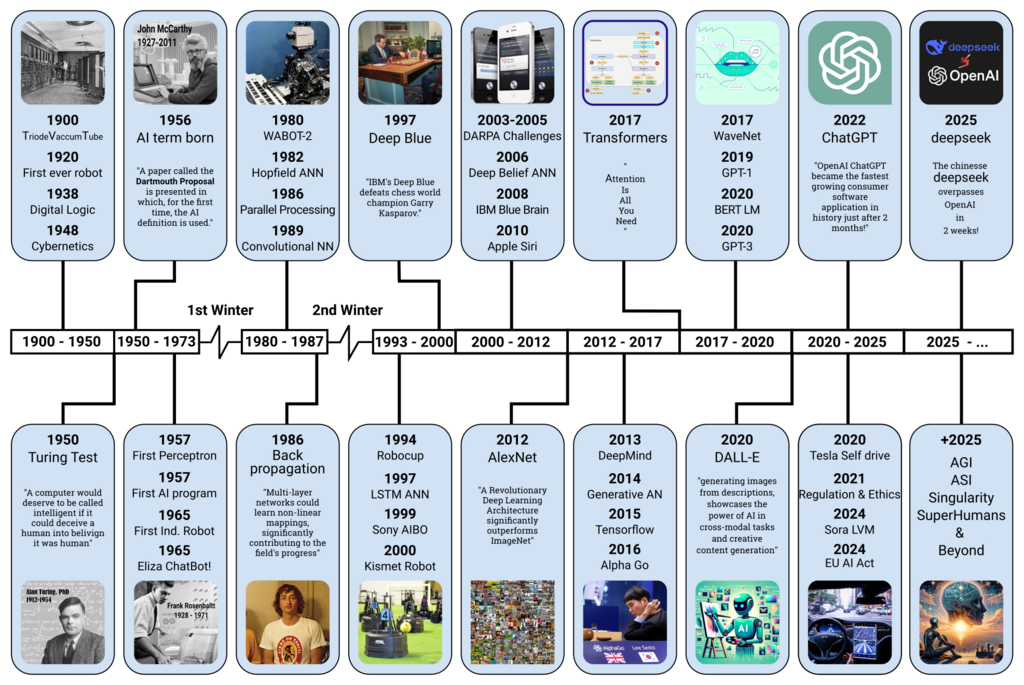
The idea of intelligent machines has been around for centuries, but the modern field of AI began to take shape in the mid-20th century. One of the first key milestones was Alan Turing's work in the 1950s. He proposed the "Turing Test" as a way to determine if a machine could exhibit intelligent behavior indistinguishable from that of a human.
The term "artificial intelligence" was officially coined in 1956 at the Dartmouth Workshop. This event brought together the founding fathers of AI and marked the birth of the field as a formal area of research. Early enthusiasm was high, but progress was slow. The limited computing power and data available led to periods known as "AI winters," where funding and interest dried up.
The cycles of hype and disappointment, known as AI summers and winters, defined much of AI's early history.
Things began to change dramatically in the 21st century. The explosion of the internet created massive amounts of data, and advancements in computer hardware provided the processing power needed to analyze it. This combination fueled the rise of machine learning and deep learning, leading to the powerful AI systems we see today.
Why AI Matters
AI is more than just a technological curiosity; it's a transformative force that is reshaping industries and daily life. Its importance lies in its ability to automate complex tasks, discover patterns in vast datasets, and solve problems that are beyond the scope of human capability.
In healthcare, AI helps doctors diagnose diseases earlier and more accurately. In finance, it detects fraudulent transactions and manages investments. It powers the recommendation engines on streaming services, the navigation apps on our phones, and the customer service chatbots on websites. By taking on repetitive or data-intensive work, AI frees up humans to focus on more creative and strategic challenges.
Artificial intelligence (AI) is a wide-ranging tool that enables people to rethink how we integrate information, analyze data, and use the resulting insights to improve decision making—and already it is transforming every walk of life.
The impact of AI is broad and continues to grow. Understanding its foundational concepts is the first step toward navigating a world where intelligent machines are becoming increasingly integrated into our society.
Ready to test your knowledge? Let's see what you've learned about the fundamentals of AI.
What is the primary goal of Artificial Intelligence?
What was the purpose of the 'Turing Test' as proposed by Alan Turing?
This introduction gives you a starting point for understanding what AI is, where it came from, and why it's such a significant technology in our world today.