Foundations of AI Agents
Introduction to AI Agents
What Is an AI Agent?
You're already familiar with the basics of AI, like machine learning models that can classify images or generate text. An AI agent takes this a step further. It isn't just a program that follows a fixed set of instructions; it's a system designed to operate autonomously within an environment to achieve specific goals.
Think of an agent as an entity that perceives its environment through sensors and acts upon that environment through actuators.
This core loop—perceive, think, act—is what separates an agent from a simple script. A script to rename 1,000 files does exactly what it's told. An AI agent, on the other hand, might be tasked with a broader goal, like "organize my vacation photos." It would need to perceive the files, understand their content (dates, locations, people), decide on a logical folder structure, and then act by creating folders and moving the files. It makes decisions and adapts.
This ability to act independently makes agents a crucial concept in AI. They represent the shift from building systems that can answer questions to building systems that can get things done.
Agents in the Wild
AI agents are not just theoretical. They are already integrated into many technologies you use daily.
-
Smart Assistants: Voice assistants like Siri or Google Assistant are agents. They perceive your spoken command (sensor), process it to understand your intent (decision-making), and then perform a task like playing a song or searching the web (actuator).
-
E-commerce and Customer Service: When you interact with a chatbot on a shopping website, you're dealing with an agent. It perceives your typed questions, decides on the most relevant information or product, and acts by providing a response.
-
Autonomous Vehicles: A self-driving car is a highly sophisticated physical agent. It uses cameras, LiDAR, and other sensors to perceive the road, traffic, and pedestrians. Its onboard computer makes complex decisions about speed and direction, and it acts by controlling the steering, acceleration, and braking.
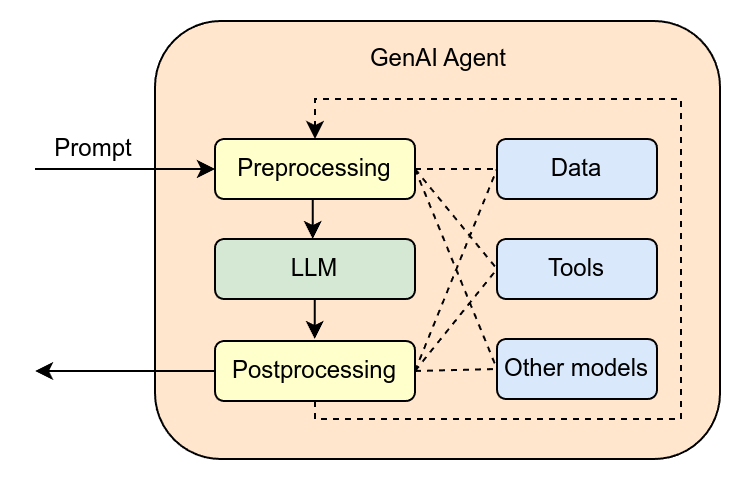
At the core of many modern agents is a Large Language Model (LLM), which acts as the reasoning engine or "brain." The LLM processes the inputs, breaks down a goal into steps, and decides which actions to take. This has dramatically expanded the potential for agents to handle complex, nuanced tasks that were previously impossible for automated systems.
Why Agents Matter
The rise of AI agents is significant because it marks a fundamental shift in how we interact with technology. Instead of giving computers explicit, step-by-step commands, we can give them goals. This opens the door to solving problems that are too complex or dynamic for traditional programming.
Imagine an agent tasked with planning a complex international trip. It could handle everything from finding the best flights and accommodations to booking dinner reservations and creating an itinerary, all while adapting to unexpected changes like a flight delay. This level of autonomous problem-solving is the ultimate promise of AI agents.
What is the core difference between an AI agent and a simple computer script?
Which of the following best describes the 'perceive, think, act' loop?
By understanding agents, you grasp the direction AI is heading: towards more capable, autonomous systems that can act as partners in solving real-world challenges.