Foundations of Agentic AI and Multi-Agent Alignment
Introduction to AI Agents
What Is an AI Agent?
An AI agent is a software program that can act on its own to achieve a goal. Think of it like a smart assistant that doesn't need constant instructions. It observes its surroundings, decides what to do, and then takes action.
Imagine a smart thermostat. It senses the room's temperature, decides whether it's too hot or cold based on your settings, and then acts by turning the heat or air conditioning on or off. That's a simple agent at work.
These agents aren't just in our homes. They are the building blocks for many intelligent systems, from the chatbot that helps you with an online order to the complex software that manages a power grid.
An AI agent is a program or system that can perceive its environment, process information, and take actions to achieve a specific goal.
The Agent's Toolkit
Every AI agent, no matter how simple or complex, operates using a three-step cycle: perception, decision-making, and action. This loop allows it to interact with its environment intelligently.
1. Perception: This is how an agent gathers information. For a physical robot, this might involve cameras, microphones, or touch sensors. For a software agent, perception could mean reading data from a database, tracking mouse clicks on a website, or analyzing text from a user's message.
2. Decision-Making: This is the agent's "brain." After perceiving its environment, the agent processes that information to decide on the best course of action. This decision is guided by its programming and its ultimate goal. A spam filter, for example, analyzes an incoming email (perception) and decides if it matches the patterns of junk mail (decision).
3. Action: Once a decision is made, the agent acts. The action changes the environment in some way. The spam filter moves the email to the junk folder (action). A self-driving car turns the steering wheel. A chatbot sends a reply.
Agents in the Wild
AI agents are already a part of our daily lives, often working behind the scenes. Their applications span nearly every industry.
| Sector | Example Application |
|---|---|
| Customer Service | AI chatbots answer common questions on websites, freeing up human agents for more complex issues. |
| Healthcare | Agents analyze medical scans like X-rays or MRIs to help doctors detect diseases earlier. |
| Finance | Algorithmic trading agents monitor market data and execute trades automatically based on pre-set rules. |
| Entertainment | Recommendation engines on streaming services act as agents, perceiving your viewing history to suggest new content. |
| Navigation | GPS apps use agents to perceive real-time traffic, decide the fastest route, and provide directions. |
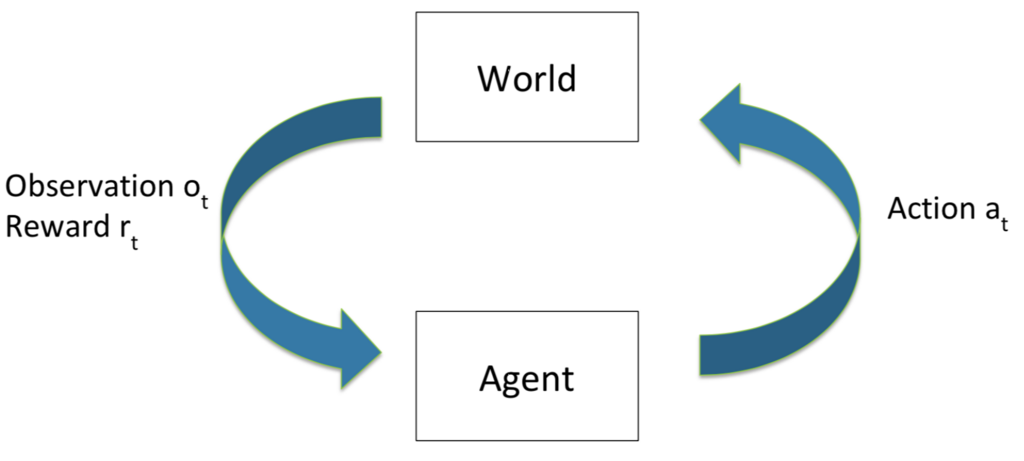
By understanding this basic cycle of perceiving, deciding, and acting, you have the key to how all AI agents operate, from the simplest thermostat to the most advanced autonomous systems.
What is the primary characteristic of an AI agent?
Which of the following correctly lists the three steps of an AI agent's operational cycle in the right order?