Foundations and Philosophy of Martial Arts
Striking Systems Mechanics
Power from the Ground Up
Effective striking isn't just about arm or leg strength; it's a full-body effort. Power starts from the floor and travels up through the body in a sequence called the . Think of it like cracking a whip. The energy begins at the handle (your feet), flows up the whip (your body), and culminates in a powerful snap at the tip (your fist or shin).
The Muay Thai roundhouse kick is a perfect example. A fighter doesn't just swing their leg. They pivot on the ball of their standing foot, which initiates a powerful rotation of the hips. This hip rotation is the engine of the kick. As the hips turn, they pull the torso and shoulder around, which then slings the kicking leg into the target. The goal is to transfer the entire body's momentum into the strike, using the shin as the point of impact. This is fundamentally different from 'snap' kicks seen in arts like Taekwondo, which rely more on rapid knee extension.
The Eight-Limbed Arsenal
Muay Thai is called "the art of eight limbs" for a reason. It incorporates fists, feet, shins, elbows, and knees as weapons. The inclusion of elbows and knees fundamentally changes the fight, especially at close range within the clinch.
Inside a clinch, where punches lose their power and kicks are impossible, elbows and knees become devastating tools. An elbow strike doesn't need much space to generate incredible cutting power, as it uses the rotation of the shoulder and torso over a very short distance. Knees, driven by a powerful hip thrust, can target the body and head with force, often used to break an opponent's posture and will.
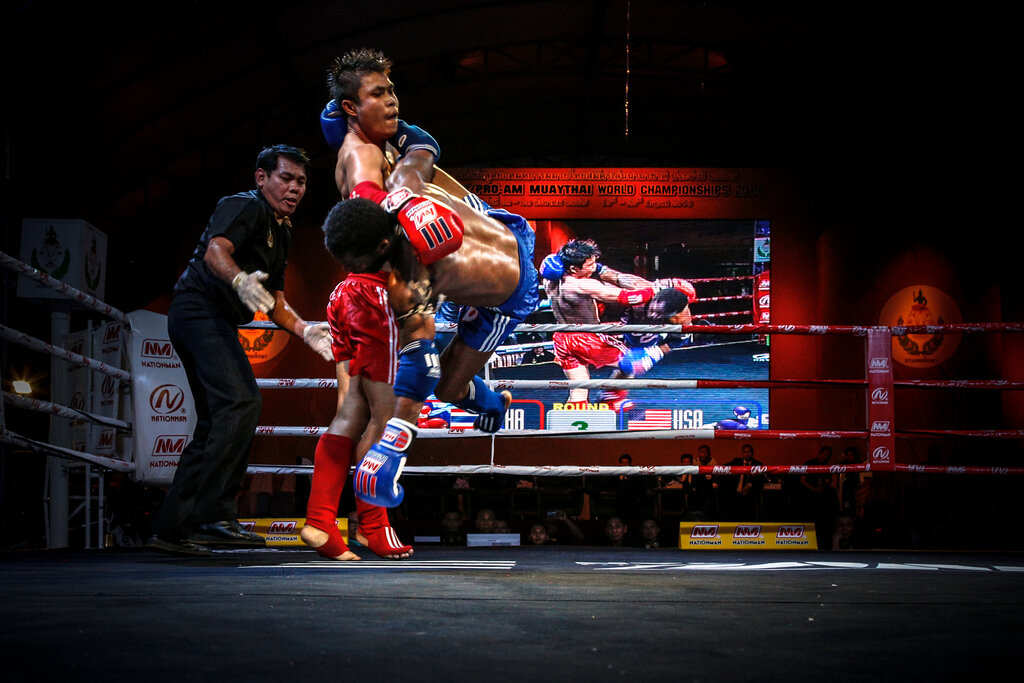
This close-range arsenal is a key differentiator from purely pugilistic arts like Western Boxing or kick-focused styles.
Guarding the Gates
A fighter's guard is dictated by the threats they face. The high, tight guard of Western Boxing is designed to defend against punches to the head and allow for rapid-fire counter-punching. It’s a highly specialised defence for a specific ruleset.
In contrast, Muay Thai utilises a . Here, the hands are held further out and more open. This posture isn't lazy; it's a multi-purpose tool. It helps to parry kicks, measure distance, and obscure the opponent's vision. Most importantly, it serves as the entry point to the clinch, allowing a fighter to control their opponent's head and arms to set up those devastating close-range weapons. Styles like often use a hybrid guard, blending the high guard of boxing with a readiness to defend against low kicks.
| Feature | Western Boxing Guard | Muay Thai Long-Guard |
|---|---|---|
| Primary Goal | Defend head from punches | Control distance, defend all limbs |
| Hand Position | High and tight to the chin | Extended and open |
| Weight Dist. | Heavier on back foot, mobile | More centered, ready to check kicks |
| Strategic Focus | High-volume punching, head movement | Clinch entry, single power strikes |
This leads to a difference in weight distribution. A boxer is often light on their feet, ready to move in and out to land combinations. A Muay Thai fighter's stance is more square and firmly planted. This solid base allows them to absorb the impact of low kicks by "checking" them with their shin, and it provides the stability needed to unleash powerful, single-shot roundhouse kicks without losing balance. It's a trade-off: mobility and volume versus stability and singular power.
Let's check your understanding of these striking systems.
What is the primary source of power for a traditional Muay Thai roundhouse kick?
Why are elbows and knees considered such effective weapons in the clinch?
Understanding these mechanical and strategic differences is key to appreciating why fighters from different backgrounds approach combat in such distinct ways. Each system is a highly refined solution to a specific set of problems.