Foundations and Mechanics of Global Martial Arts
Striking Dynamics
The Body as a Whip
A powerful strike doesn't start in the fist or the foot. It starts from the ground. Think of your body as a whip. The handle is your connection to the floor, and the tip is the striking surface. To make the whip crack, you don't just flick your wrist; you initiate a wave of energy that travels from the handle all the way to the tip, accelerating as it goes. This is the core principle of the in martial arts.
Every powerful movement, from a boxer's knockout punch to a Taekwondo artist's spinning kick, is a sequence of activations. It begins with your feet gripping the ground, generating force. This force travels up through your ankles, knees, and hips. Your core then acts as a transmission, transferring this energy through your torso and shoulders, and finally, channeling it into your arm or leg. Each link in the chain adds momentum, resulting in a strike that carries the force of your entire body, not just a single limb.
Lines vs. Circles
Striking arts generally generate power in two distinct ways: through linear, explosive force or through circular, rotational momentum. Neither is inherently better; they are simply different physical solutions to the problem of hitting a target effectively.
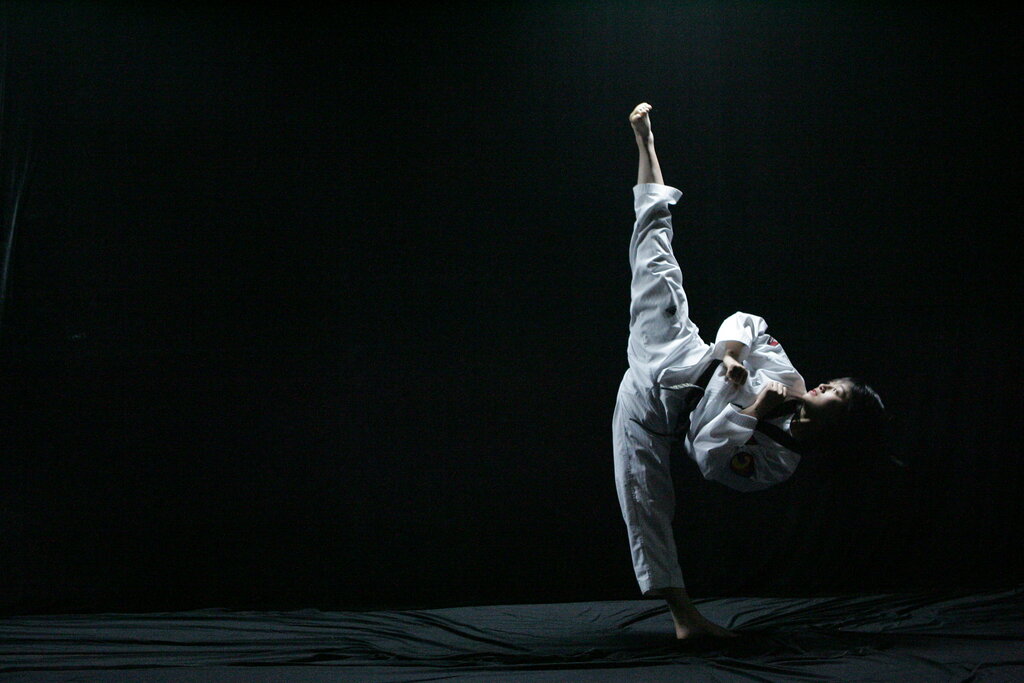
Arts like Karate and Taekwondo often favor linear power. Think of a snap kick. It relies on rapid knee and hip extension, creating a straight, piston-like motion. The goal is to generate maximum velocity over a very short time, creating a massive impulse (). This creates a sharp, penetrating impact. The power is explosive and direct, but the commitment of the hips is often less total than in rotational strikes.
Conversely, styles like Western Boxing and are masters of rotational power. A boxer's cross isn't just an arm punch; it's a full-body rotation. The power begins with the back foot pushing off the ground, causing the hips and torso to rotate violently. This rotation generates torque, which is transferred to the shoulder and finally unleashed through the arm. Similarly, a Muay Thai roundhouse kick uses the entire body's rotation around the supporting leg to create a devastating arc of power, turning the shin into a baseball bat.
This difference creates a trade-off. Linear strikes are often faster to execute and harder to see coming. Rotational strikes take longer to develop but typically generate more overall power due to the recruitment of larger muscle groups and the principles of momentum.
Impact and Stability
Generating power is only half the battle. The other half is delivering it effectively and without compromising your own position. The physics of impact is surprisingly simple: pressure equals force divided by area (). To maximize damage, a striker aims to concentrate all that generated force onto the smallest possible surface area. This is why boxers use the front two knuckles and why many martial arts teach strikes with the elbow tip or the ball of the foot. A smaller point of contact creates higher pressure, increasing the strike's effectiveness.
A strike with 200 pounds of force delivered over the surface of an open palm is a push. The same force delivered by a knuckle is a knockout.
Finally, every offensive action creates an equal and opposite reaction. When you throw a powerful strike, you are momentarily vulnerable. A key element of technique is maintaining stability and throughout the motion. A wide, stable stance makes it easier to generate force from the ground but can limit mobility. A narrower, more mobile stance allows for quicker footwork but offers a less stable platform for power generation. Master strikers constantly manage this trade-off, adjusting their stance and balance to deliver maximum force while leaving minimal openings for a counter-attack.
Let's test your understanding of these dynamics.
According to the concept of the kinetic chain, where does the power for a strong strike originate?
A martial art that heavily emphasizes rotational power, using the whole body's rotation to generate force, is:
Understanding these biomechanical principles is the first step in moving from simply executing techniques to truly understanding the science behind stand-up combat.