Foundations and Frontiers of Artificial Intelligence
AI Foundations
Defining Intelligence
Artificial Intelligence is the field dedicated to creating machines that can perform tasks typically requiring human intelligence. This ranges from simple pattern recognition to complex problem-solving and creative endeavors. The goal isn't just to mimic human thought, but to build systems that can reason, learn, and adapt.
At its core, AI operates on a spectrum. On one end, we have Artificial Narrow Intelligence (ANI), which excels at a single, specific task. Think of a chess program or a spam filter. On the other end is the theoretical concept of Artificial General Intelligence (AGI), a machine with the ability to understand, learn, and apply knowledge across a wide range of tasks, much like a human.
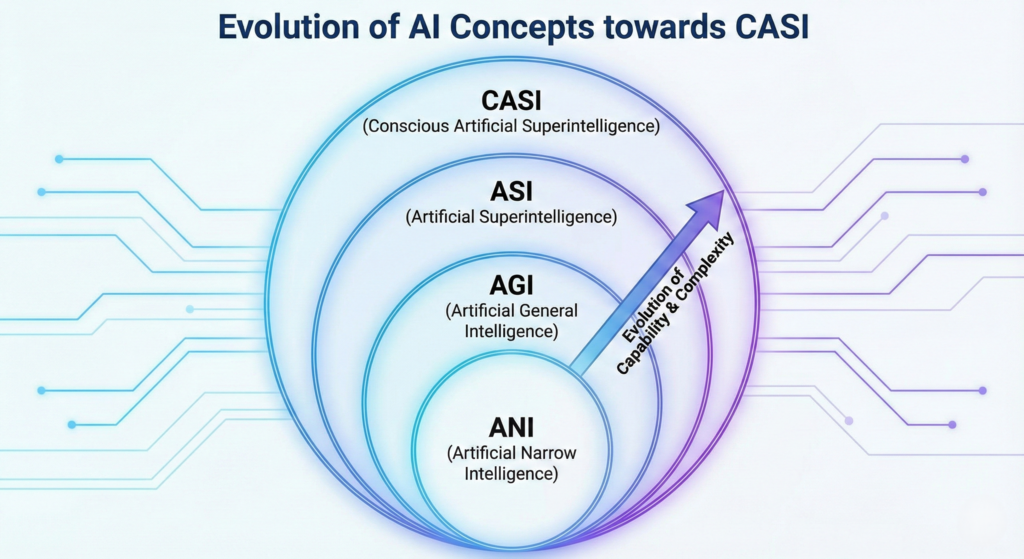
Most of what we interact with today is ANI. The journey from these specialized systems to the broader vision of AGI is a story of evolving techniques, increasing computational power, and a deeper understanding of intelligence itself.
A Journey Through Time
The formal pursuit of AI began in the summer of 1956 at the Dartmouth Workshop, where the term was officially coined. Early research was fueled by optimism, with pioneers believing that a machine as intelligent as a human was only a generation away. This era focused heavily on symbolic AI, attempting to codify human knowledge into explicit rules and logical statements.
However, the initial ambition quickly ran into the limits of technology. The complexity of real-world problems proved too much for the available computing power and theoretical models. This led to periods known as "AI winters," where funding dried up and progress slowed. Enthusiasm waned as promises went unfulfilled.

The field re-emerged with the rise of machine learning in the 1990s and 2000s. Instead of being explicitly programmed, systems could now learn patterns directly from data. This shift was powered by the explosion of the internet, which provided vast datasets, and Moore's Law, which delivered the necessary processing power. Landmark events, like IBM's Deep Blue defeating chess champion Garry Kasparov in 1997, demonstrated the power of this new approach.
The modern AI boom began in the 2010s, driven by a subfield of machine learning called deep learning. With massive datasets and powerful graphics processing units (GPUs), neural networks with many layers could solve problems previously thought impossible, from image recognition to natural language understanding.
The Evolution of AI Technology
The technologies powering AI have evolved significantly, moving from rigid, rule-based logic to flexible, data-driven learning.
Early AI relied on Expert Systems. These were large databases of hand-crafted if-then rules created by domain experts. While effective for well-defined problems like medical diagnosis in a narrow context, they were brittle. They couldn't handle uncertainty or learn new rules on their own.
Machine Learning (ML) represented a fundamental paradigm shift. Instead of being programmed with rules, ML models are trained on data. They learn to make predictions or decisions by identifying patterns in the examples they are shown. This approach is more robust and can be applied to a wider range of problems where the rules are not easily defined.
Deep Learning is a type of machine learning that uses multi-layered neural networks, inspired by the structure of the human brain. These "deep" networks allow the model to learn complex, hierarchical patterns from vast amounts of data. This is the technology behind breakthroughs in computer vision, speech recognition, and more recently, generative AI.
Today, Generative AI marks another leap. Built on deep learning architectures like transformers, these models don't just classify or predict—they create new content. From text and images to code and music, generative models learn the underlying patterns of their training data so well that they can produce novel, coherent outputs.
What is the primary goal of the field of Artificial Intelligence?
An AI that can translate languages, write poetry, and analyze medical scans with human-like proficiency across all domains would be considered:
This journey from symbolic logic to generative models highlights a core theme in AI's history: a continuous move toward systems that are more autonomous, flexible, and capable of handling the ambiguity of the real world.