Foundational Physics Reimagined
Classical Mechanics
The Language of Motion
Classical mechanics is the physics of the world we can see and touch. It describes how a baseball flies through the air, how planets orbit the sun, and how a car turns a corner. It all starts with a simple goal: if we know where something is and what's pushing or pulling on it, can we predict where it will be in the future? To do this, we need two sets of tools: kinematics and dynamics.
Kinematics is the part of mechanics that describes motion without worrying about what causes it. It’s the language of position, velocity, and acceleration.
- Position () is simply where an object is.
- Velocity () is how fast its position is changing.
- Acceleration () is how fast its velocity is changing.
These three ideas are deeply connected through calculus. Velocity is the derivative of position with respect to time, and acceleration is the derivative of velocity.
This means if you know an object's position over time, you can figure out its velocity and acceleration. More powerfully, if you know an object's acceleration, you can work backward using integration to find its velocity and position. That’s where dynamics comes in. Dynamics explains why things accelerate, and the answer is forces.
Newton's Foundational Laws
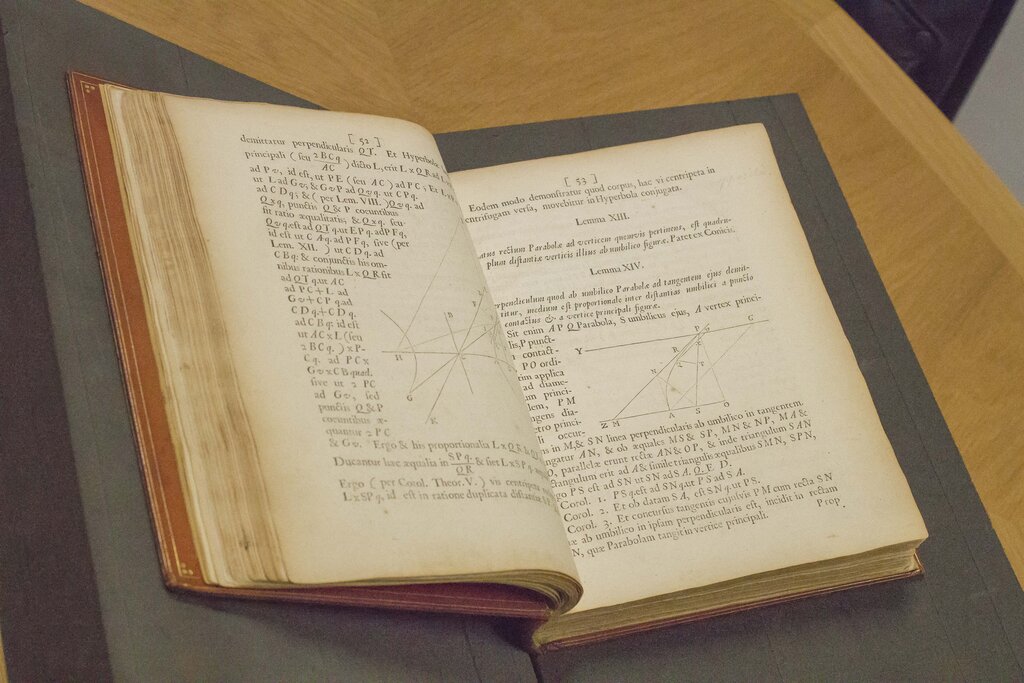
Isaac Newton laid down the three fundamental laws that form the bedrock of dynamics. They connect the concepts of force, mass, and motion.
First Law: The Law of Inertia. An object will stay at rest or in uniform motion in a straight line unless a net external force acts on it. This simply means things tend to keep doing what they’re already doing. A hockey puck gliding on frictionless ice will keep gliding forever. To change its motion, you need to apply a force.
Second Law: Force Equals Mass Times Acceleration. This is the most famous equation in classical mechanics. It tells us that the acceleration of an object is directly proportional to the net force applied to it and inversely proportional to its mass. Heavier objects require more force to accelerate at the same rate as lighter ones.
Think about pushing a shopping cart. An empty cart is easy to get moving (low mass, low force needed). A full cart requires a much harder push to achieve the same acceleration (high mass, high force needed).
Third Law: Action and Reaction. For every action, there is an equal and opposite reaction. This law can be tricky. It doesn't mean the effects of the forces are the same, but that forces always come in pairs. When you push on a wall, the wall pushes back on you with the same amount of force. A rocket works by pushing hot gas out of its engine (action), and the gas pushes the rocket forward (reaction).
The Currencies of Motion
Forces and acceleration are great, but sometimes it's easier to analyze motion using two other concepts: energy and momentum. These are like different currencies for describing the state of a system. Just like you can describe a value in dollars or euros, you can describe motion with forces or with energy and momentum. The best part is that under the right conditions, these quantities are conserved.
Momentum
noun
A measure of an object's motion, defined as the product of its mass and velocity.
Momentum () is often described as "mass in motion." It's a vector quantity, meaning it has both magnitude and direction.
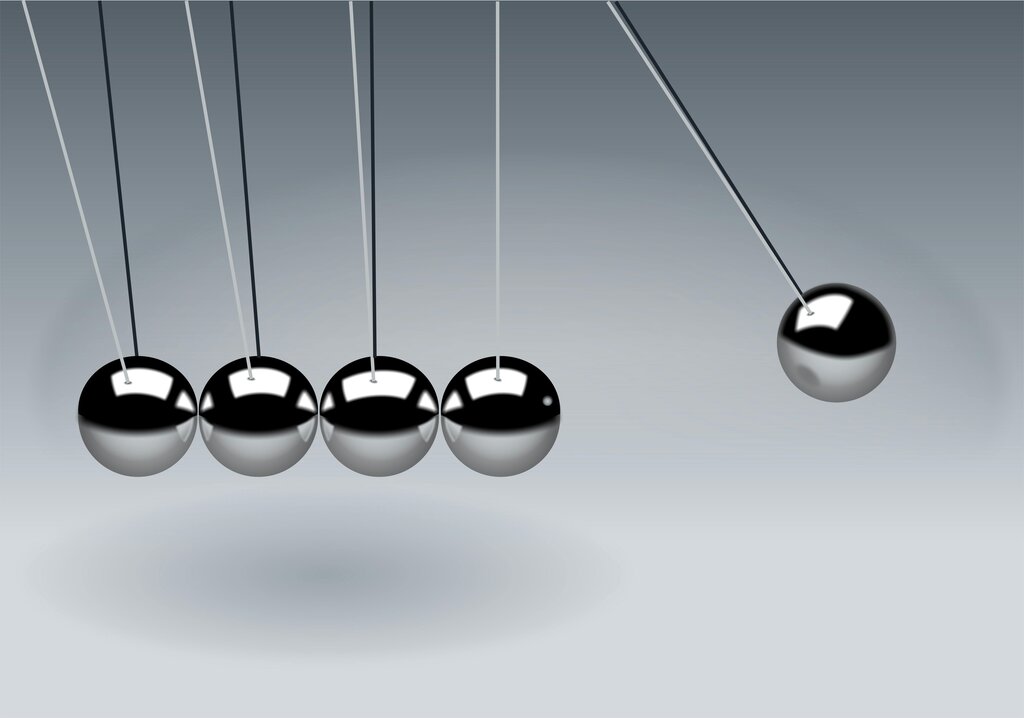
The law of Conservation of Momentum states that the total momentum of a closed system (one with no external forces acting on it) remains constant. This is why when one billiard ball hits another, the momentum lost by the first ball is gained by the second. The total momentum of all the balls before and after the collision is the same.
Energy is a bit different. It's the capacity to do work. The two main types in mechanics are:
- Kinetic Energy (): The energy of motion.
- Potential Energy (): Stored energy due to an object's position or configuration, like the energy stored in a stretched spring or in an object held high above the ground.
The Conservation of Energy principle tells us that the total energy of an isolated system is constant. Energy can change forms—from potential to kinetic and back again—but it is never lost. A pendulum, for example, has maximum potential energy at the top of its swing and maximum kinetic energy at the bottom.
Going in Circles
So far, we've mostly talked about motion in a straight line (linear motion). But what about things that spin or revolve, like a spinning top or a planet in orbit? This is the realm of rotational motion.
We can describe rotational motion using analogues to our linear concepts. Instead of position, we use angle (). Instead of velocity, we have angular velocity (, how fast the angle is changing). And instead of acceleration, we have angular acceleration ().
| Linear Motion | Rotational Motion | Relationship |
|---|---|---|
| Position () | Angle () | |
| Velocity () | Angular Velocity () | |
| Acceleration () | Angular Acceleration () | |
| Mass () | Moment of Inertia () | |
| Force () | Torque () | |
| Momentum () | Angular Momentum () |
Just as force causes linear acceleration, torque causes angular acceleration. Torque is a twisting force. Think about opening a door: you apply a force on the handle, which is far from the hinges. This creates a torque that makes the door rotate.
The rotational equivalent of mass is the moment of inertia (), which measures an object's resistance to changes in its rotation. It depends not just on mass, but on how that mass is distributed relative to the axis of rotation. An ice skater spinning with their arms out has a large moment of inertia. When they pull their arms in, their moment of inertia decreases, and to conserve angular momentum, their angular velocity increases—they spin faster.
This is a direct result of the Conservation of Angular Momentum. In a closed system, the total angular momentum remains constant. The skater pulls their arms in, decreasing their moment of inertia (), so their angular velocity () must increase to keep the product the same.
These principles—from linear motion to rotation, governed by fundamental laws of conservation—allow us to model and predict the behavior of an incredible range of systems, from the simple to the cosmic.
In kinematics, what is the relationship between an object's velocity () and its position ()?
According to Newton's Second Law (), if you apply the same net force to two objects, one with mass and one with mass , how will their accelerations compare?