Foundational Concepts Explained
Introduction to Epistemology
What Do You Really Know?
Think about something you're absolutely sure of. Maybe it's that the sky is blue, or that 2 + 2 = 4, or even just your own name. Now, ask yourself a simple question: How do you know?
This question is the starting point for a whole branch of philosophy called epistemology. It's the study of knowledge itself. Epistemology doesn't just ask what we know, but it digs deeper into how we know it, what makes a belief justified, and what the limits of our knowledge might be.
Epistemology
noun
The branch of philosophy concerned with the theory of knowledge, including its nature, sources, and limits.
The Classic Recipe for Knowledge
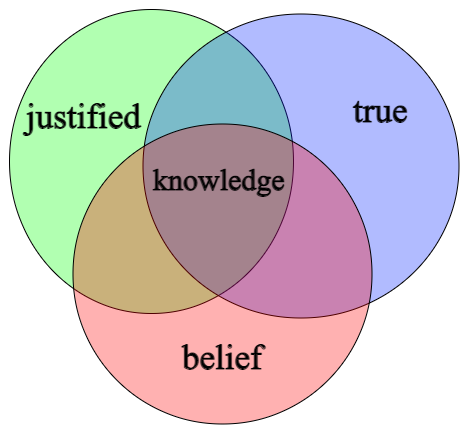
For centuries, philosophers have tried to pin down a precise definition of knowledge. The most famous and enduring model suggests that knowledge has three key ingredients: belief, truth, and justification. Think of it as a recipe. If you're missing one ingredient, you don't have knowledge.
First, you must believe it. If you don't think something is true, you can't really claim to know it. Belief is the personal component, the internal state of holding something to be the case.
Second, it must be true. This seems obvious, but it's crucial. You can't know that the Earth is flat, because it isn't. Knowledge must align with reality, independent of what you or anyone else believes.
Third, your belief must be justified. You need a good reason to believe it. If you guess the winning lottery numbers, you believed they would win, and they truly did win. But did you know they would win? Most philosophers would say no, because your belief was based on a lucky guess, not solid justification.
Knowledge is often defined as Justified True Belief (JTB).
Where Knowledge Comes From
If justification is so important, where do we get it? Philosophers generally point to a few key sources of knowledge.
One is perception. We learn about the world through our five senses. You know it's raining because you see the water falling, hear it on the roof, and feel it on your skin. This direct sensory experience is a powerful source of justification for our beliefs about the physical world.
Another is reason. Some things we know not through our senses, but through logic and deduction. You know that if all humans are mortal, and Socrates is a human, then Socrates must be mortal. You don't need to observe Socrates's death to know this; you can arrive at this knowledge through pure reason. Mathematical truths also fall into this category.
Finally, there's testimony. We accept a huge amount of information because others have told us. You know your own birthday because your parents told you. You know about historical events because you read about them in books. We rely on the testimony of experts, friends, and trusted sources for much of what we consider knowledge.
How do you decide whose testimony to trust? That's a key epistemological question.
These sources often work together. An expert (testimony) might show you data from an experiment (perception) and explain the logical conclusions (reason).
This brings us to a major debate in epistemology: which source is the most fundamental? This question divides philosophers into two main camps: empiricists and rationalists.
| Theory | Primary Source of Knowledge | Core Idea |
|---|---|---|
| Empiricism | Sensory Experience | All knowledge ultimately comes from our senses. We are born as a "blank slate." |
| Rationalism | Reason and Logic | The mind can grasp truths directly, without needing sensory input. |
Empiricists argue that we are born as blank slates (a concept known as tabula rasa), and all our knowledge is built up from sensory experiences. Rationalists, on the other hand, argue that reason is the primary source of knowledge. They believe some truths are so fundamental that we can know them through intellect alone.
Can We Be Sure?
Thinking about knowledge can lead to some unsettling questions. How can we be sure our senses aren't deceiving us? How do we know we're not living in a dream or a complex simulation? This line of questioning leads to skepticism, the view that we might not have any certain knowledge at all.
A skeptic might challenge whether our justifications are ever truly good enough. While radical skepticism can be hard to argue against, most people operate with a more practical approach.
This is where fallibilism comes in. Fallibilism is the idea that our beliefs, even our most well-justified ones, could turn out to be wrong. It's a more moderate position than skepticism. It accepts that we can have justified beliefs that count as knowledge, but it also acknowledges that we are human and can make mistakes.
Fallibilism is a cornerstone of the scientific method. Scientists propose hypotheses based on evidence, but they are always open to the possibility that new evidence will come along and prove them wrong. It suggests that our quest for knowledge is an ongoing process of refining our beliefs, rather than arriving at an absolute, final truth.
Now, let's test your understanding of these foundational ideas.
According to the traditional philosophical model, what are the three essential components of knowledge?
A friend tells you a stock will double its value. You invest, and it does. You had a belief, and it turned out to be true. Why might this not qualify as knowledge?
Epistemology challenges us to think critically about what we know and how we know it. By understanding these concepts, you have the tools to examine your own beliefs more carefully and evaluate the claims of others.