Foundational Accounting Principles
Double Entry Mechanics
The Equation That Always Balances
At the heart of all accounting is a simple, powerful rule: the accounting equation. You already know its basic form: Assets = Liabilities + Equity. Everything a company owns is financed by either borrowing from others or through the owners' investment. This equation must always remain in balance, no matter what financial event occurs.
To make this equation practical for day-to-day bookkeeping, we need to expand it. Equity isn't just a single number; it changes over time. It increases when the business earns income and decreases when it incurs expenses or when the owner takes money out (drawings). So, we can expand the equity portion.
With a bit of algebra, we can rearrange this equation to group all the elements that are increased by a debit on one side and all those increased by a credit on the other. This gives us the foundation for the rules of double-entry bookkeeping.
The Rules of Debit and Credit
Every transaction affects at least two accounts. To keep the accounting equation balanced, we use a system of debits and credits. A debit simply means an entry on the left side of an account, and a credit means an entry on the right side. Whether a debit or a credit increases or decreases an account's balance depends on the type of account.
For every debit, there must be an equal and corresponding credit. The total debits for any transaction must always equal the total credits.
Remembering which is which can be tricky. A popular mnemonic to master this is DEAD CLIC
| DEAD | To Increase | To Decrease | Normal Balance |
|---|---|---|---|
| Debit | Drawings | Credit | Debit |
| Expenses | Debit | Credit | Debit |
| Assets | Debit | Credit | Debit |
| CLIC | To Increase | To Decrease | Normal Balance |
|---|---|---|---|
| Credit | Liabilities | Debit | Credit |
| Income | Credit | Debit | Credit |
| Capital | Credit | Debit | Credit |
From Events to Entries
Accountants don't just invent these entries. Every transaction is triggered by a real-world event and is supported by a . This is the original record containing the details of a business transaction. It could be a sales invoice, a purchase receipt, a bank statement, or a cheque. These documents are the proof that a transaction occurred and provide the necessary details for recording it.
Once you have the source document, you can create a journal entry. This is the first official record of a transaction in the accounting system. Think of it as a diary of the business's financial activities, written in the language of debits and credits.
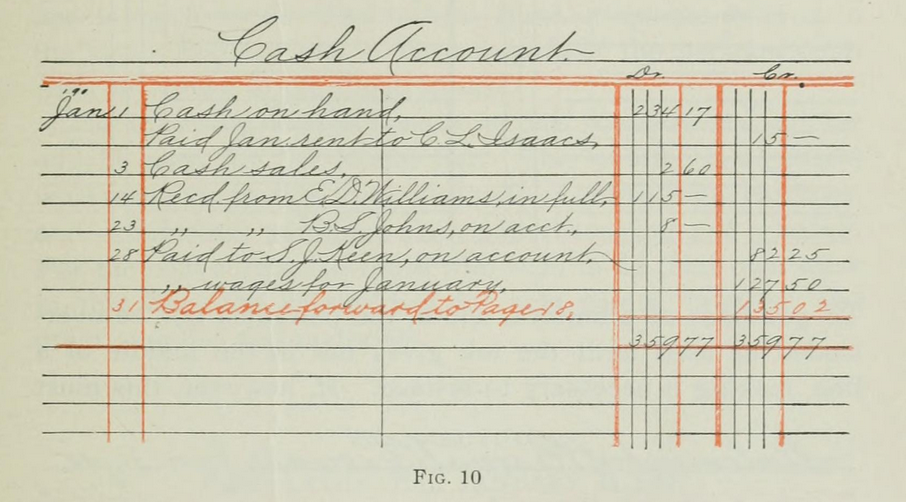
A standard general journal entry includes:
- The date of the transaction.
- The account(s) to be debited, listed first.
- The account(s) to be credited, listed below the debits and slightly indented.
- A short description of the transaction.
Let's say a business, 'Creative Solutions Ltd.', buys a new computer for £1,500 cash on 25th October.
| Date | Account | Debit (£) | Credit (£) |
|---|---|---|---|
| Oct 25 | Office Equipment (Asset) | 1,500 | |
| Cash (Asset) | 1,500 | ||
| To record purchase of new computer |
Here's the logic: The business gained an asset, 'Office Equipment', which increases with a debit. It also gave up an asset, 'Cash', which decreases with a credit. The debits (£1,500) equal the credits (£1,500), so the equation stays balanced.
Compound Journal Entries
Not all transactions are so simple. A compound journal entry is one that affects more than two accounts. For example, a business might purchase equipment by paying some cash upfront and taking out a loan for the rest.
Imagine 'Creative Solutions Ltd.' buys a 3D printer for £5,000 on 28th October. They pay £2,000 in cash and take out a short-term loan for the remaining £3,000.
| Date | Account | Debit (£) | Credit (£) |
|---|---|---|---|
| Oct 28 | Office Equipment (Asset) | 5,000 | |
| Cash (Asset) | 2,000 | ||
| Loan Payable (Liability) | 3,000 | ||
| To record purchase of printer with cash and loan |
In this case, one asset ('Office Equipment') increases. Another asset ('Cash') decreases, and a liability ('Loan Payable') increases. The total debits (£5,000) still equal the total credits (£2,000 + £3,000), keeping everything in balance.
What is the fundamental accounting equation?
According to the DEAD CLIC mnemonic, which of the following accounts are increased with a debit?
By mastering these rules, you can accurately record any business transaction, ensuring the financial records are a true and fair reflection of the company's activities.