Fortran Programming Fundamentals
Introduction to Fortran
The Original Speed Demon
In the 1950s, programming a computer was a painful process. Scientists and engineers had to write instructions in low-level assembly language, a tedious and error-prone task far removed from the mathematical formulas they were trying to solve. A team at IBM, led by John Backus, knew there had to be a better way.
Their solution, released in 1957, was Fortran. The name stands for Formula Translation System, and it did exactly that. It was the first widely used high-level programming language, designed to let scientists express mathematical calculations in a way that felt natural.
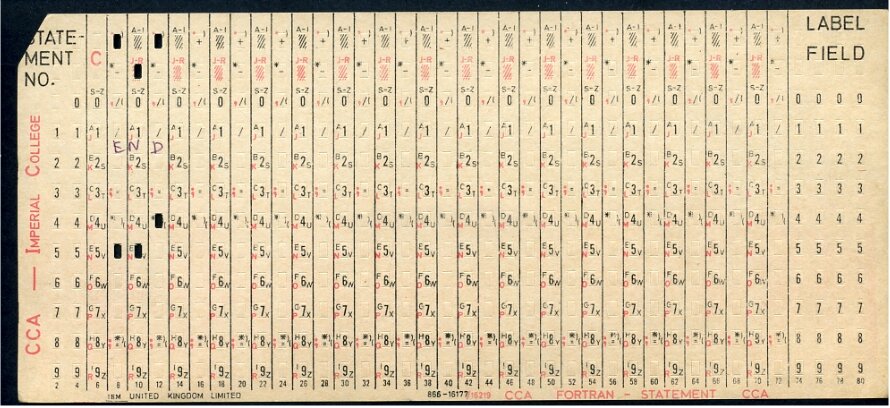
The core philosophy of Fortran was, and still is, speed. The primary goal was to generate machine code that was as fast and efficient as what a skilled human programmer could write by hand. This focus on performance for numerical computation made it an instant success in the scientific and engineering communities. For the first time, experts in fields like physics and chemistry could program computers themselves without needing to become assembly language specialists.
Fortran's design prioritized one thing above all else: making complex math problems run as fast as possible on a computer.
Constant Evolution
Fortran didn't stand still. Over the decades, it has evolved through a series of standards, each adding new features and modernizing the language. While the early versions laid the groundwork, later standards transformed Fortran into a powerful, modern tool.
| Standard | Key Developments |
|---|---|
| FORTRAN (1957) | The first version, focused on translating mathematical formulas. |
| FORTRAN IV | Became a standard, widely adopted version for many years. |
| FORTRAN 77 | Introduced structured programming concepts like IF-THEN-ELSE blocks. |
| Fortran 90/95 | A major leap forward. Introduced free-form source code, modules, and powerful array operations. |
| Fortran 2003/2008 | Added object-oriented programming features and better interoperability with the C language. |
| Fortran 2018/2023 | Continues to add features for parallel computing and high-performance applications. |
Notice the change in capitalization from FORTRAN to Fortran around 1990. This signaled the language's modernization from its historical roots to a more contemporary structure.
An Enduring Legacy
Fortran's impact is hard to overstate. It proved that high-level languages could be practical and efficient, paving the way for all the languages that followed. Its focus on numerical work made it the cornerstone of computational science.
Today, Fortran is a dominant force in high-performance computing (HPC). It's used to run massive simulations on the world's fastest supercomputers. Applications include:
- Weather forecasting and climate modeling
- Computational fluid dynamics (e.g., designing airplane wings)
- Finite element analysis (e.g., structural engineering)
- Computational physics and chemistry
While other languages have become more popular for general-purpose programming, Fortran remains the specialist's tool for heavy-duty number crunching. Its libraries for scientific computing have been optimized over more than 60 years, making them incredibly reliable and fast.
Time to check your understanding of this pioneering language.
What was the primary goal behind the creation of Fortran in the 1950s?
The name 'Fortran' is a portmanteau of which two words?
Fortran established a crucial link between mathematical notation and computing, creating a legacy of performance that continues to drive scientific discovery.