Formal Logic in Philosophy
Advanced Sentential Logic
Mastering Natural Deduction
You have already mastered the basics of logic, but now it is time to move beyond simple inspection and into the rigorous mechanics of formal proof. In this chapter, we will focus on Fitch-style natural deduction, applying systematic rules like conditional proof and reductio ad absurdum to deconstruct complex arguments. By the end, you will possess the formal discipline required to construct watertight logical proofs, successfully bridging the gap between intuition and academic expertise.
The Architecture of a Proof
When you look at a , don't see it as a static list of symbols. Instead, think of it as a navigational map for a journey from uncertainty to certainty. Every proof has a starting point and a clear destination. To get there, you must follow a strictly defined path where every single step is justified by a specific rule. Unlike truth tables, which can become unmanageably large as you add variables, a formal proof focuses on the internal structure of the argument itself.
At the top of your map, you list your starting points. In logic, we distinguish between two types of starting points: premises and assumptions. A premise is a claim given to you as a fact for the duration of the argument. An assumption, on the other hand, is a temporary 'What if?' scenario. You might assume something is true just to see where it leads, knowing you'll have to 'close' that thought experiment before the proof is finished.
A proof is a game with strict moves. You start with what you know (premises) and use valid manipulations (rules) to arrive at what you want to prove (conclusion).
To keep these 'What if?' scenarios organized, we use a scope line—a long vertical bar that runs down the left side of the proof. This line defines the boundaries of an assumption's influence. If a step is written to the right of a specific vertical bar, it is only valid as long as that bar continues. Once you stop the line, you have 'discharged' the assumption, and you can no longer use those internal steps as direct facts. This visual layout prevents you from accidentally using a temporary guess as a permanent truth.
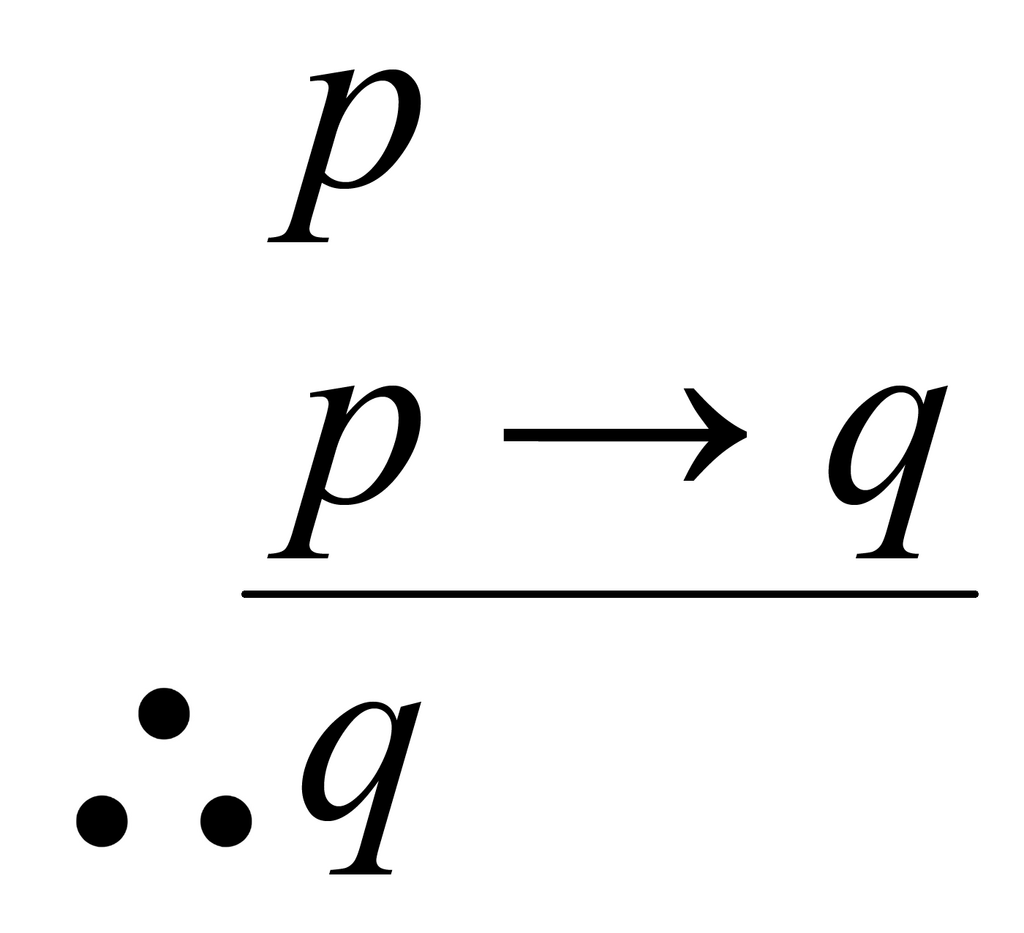
Let's look at a simple example: a basic derivation of Modus Ponens. Imagine we have two premises: (If it is raining, the ground is wet) and (It is raining). Our goal is to reach .
In a Fitch-style layout, it would look like this:
- (Premise)
- (Premise)
- --- (The horizontal separator)
- (From steps 1 and 2)
| Step | Formula | Justification |
|---|---|---|
| 1 | Premise | |
| 2 | Premise | |
| 3 | Modus Ponens (1, 2) |
The horizontal line you see at step 2.5 is just as important as the vertical scope line. It acts as a shelf, separating the 'given' information (everything above the line) from the 'derived' information (everything you figure out below the line). Every line below that horizontal bar must be stamped with a justification, citing exactly which previous lines and which logic rule you used to get there.
Mastering this layout is like learning the board and the legal moves of a chess game. You don't need to worry about winning the match just yet; you just need to understand where the pieces go and why the lines are drawn. Once the mechanics of the layout become second nature, we can move on to the actual 'moves'—the rules of inference—that will allow you to solve even the most complex logical puzzles with ease.