Forex Trading Essentials
Introduction to Forex Trading
What Is the Forex Market?
The foreign exchange market, or forex, is a global marketplace where national currencies are traded. It’s not a single building with a trading floor, like a stock exchange. Instead, it's a decentralized network of banks, brokers, and traders connected electronically. This makes it the largest and most active financial market in the world, with trillions of dollars changing hands every day.
Think about the last time you traveled to another country. You likely had to exchange your home currency for the local one. When you did that, you participated in the forex market. On a much larger scale, corporations do this to pay for goods in other countries, and investors do it to move capital across borders.
The Language of Currency Pairs
In the forex market, you don’t just buy a currency; you simultaneously buy one currency while selling another. This is why currencies are always quoted in pairs.
Each currency pair has a base currency (the first one) and a quote currency (the second one). The exchange rate tells you how much of the quote currency is needed to buy one unit of the base currency.
For the pair EUR/USD, the Euro (EUR) is the base currency and the US Dollar (USD) is the quote currency. If the exchange rate is 1.08, it means one euro costs 1.08 US dollars.
Currency pairs are grouped into three main categories based on how often they are traded.
| Category | Description | Examples |
|---|---|---|
| Major Pairs | The most traded pairs in the world. They always include the US dollar (USD) and another major currency. | EUR/USD, USD/JPY, GBP/USD |
| Minor Pairs | Also known as cross-currency pairs. They feature major currencies traded against each other, without involving the US dollar. | EUR/GBP, EUR/JPY, AUD/CAD |
| Exotic Pairs | A major currency paired with the currency of an emerging or smaller economy. They are less liquid and can be more volatile. | USD/MXN, EUR/TRY, JPY/NOK |
What Moves the Market?
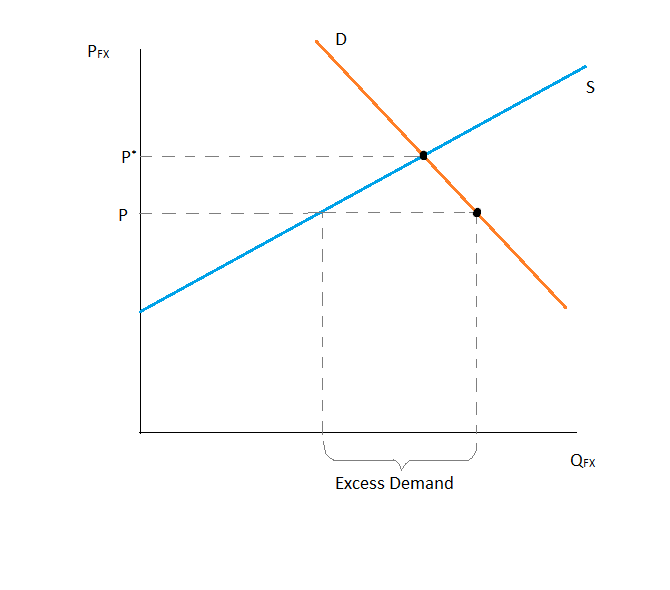
Exchange rates are constantly shifting. These movements are driven by supply and demand. If demand for a currency is high, its value rises. If demand is low, its value falls. Many factors influence this dynamic, but they generally fall into two categories: economic data and geopolitical events.
Economic indicators are regular reports that give clues about a country's economic health. A strong economy typically has a strong currency. Key indicators include:
- Interest Rates: Central banks set these. Higher interest rates tend to attract foreign investment, increasing demand for the currency.
- Inflation Reports: High inflation erodes purchasing power and can weaken a currency.
- Gross Domestic Product (GDP): This measures a country's total economic output. Strong GDP growth is usually good for a currency.
- Employment Data: High employment signals a healthy economy.
Geopolitical events can also have a huge impact. Elections, political instability, trade negotiations, and even natural disasters can create uncertainty. Investors prefer stability, so they often move their money away from countries experiencing turmoil, causing that country's currency to weaken.
Who Trades Forex?
The forex market is incredibly diverse. It isn't just for globetrotting tourists or professional traders. The main participants include:
- Central Banks: These government institutions (like the U.S. Federal Reserve) manage their country's currency, money supply, and interest rates. They can intervene directly in the market to influence their currency's value.
- Major Banks: The largest banks in the world handle a massive volume of forex transactions for themselves and their clients. Much of the market's activity flows through them.
- Corporations: Multinational companies trade forex to conduct business. For example, a European company buying parts from Japan needs to exchange euros for yen.
- Retail Traders: These are individuals who trade their own money to speculate on currency movements. Thanks to online brokers, this part of the market has grown significantly.
Now that you understand the key concepts of the forex market, you can start to see how global events and economic news connect to the currency values we see every day.