Fluid Transitions and Expressive Movement
Dynamic Weight Transitions
Beyond the Steps
You've mastered posture and alignment, the static foundations of dance. Now, we'll explore the dynamic side: how to move your weight with intention and fluidity. This isn't just about stepping from one foot to another. It's about using momentum, gravity, and the floor to create seamless, powerful transitions.
Think of it as controlled falling. Every time you take a step, you shift your centre of gravity outside your base of support and then catch yourself. Great dancers don't fight this fall; they harness it. By understanding how to initiate this 'fall' and recover with precision, you can turn simple movements into expressive and efficient choreography.
This controlled use of momentum is where kinetic energy comes into play. Instead of stopping and starting each movement, which consumes a lot of energy, fluid dancers conserve their kinetic energy. They let one movement flow into the next, using the force from a turn to initiate a leap, or the energy from a drop to rebound off the floor. This creates a continuous, connected quality that looks effortless.
Grounded vs. Lifted
How you use the floor dictates the style of your movement. Transitions can be 'grounded' or 'lifted'.
In styles like hip-hop, dancers have a grounded presence. Weight transitions are often low and heavy, driving energy down into the floor. Think of the solid, rooted feeling of a b-boy freeze or the deep plié used to power up into a jump. Here, the floor is a source of stability and power.
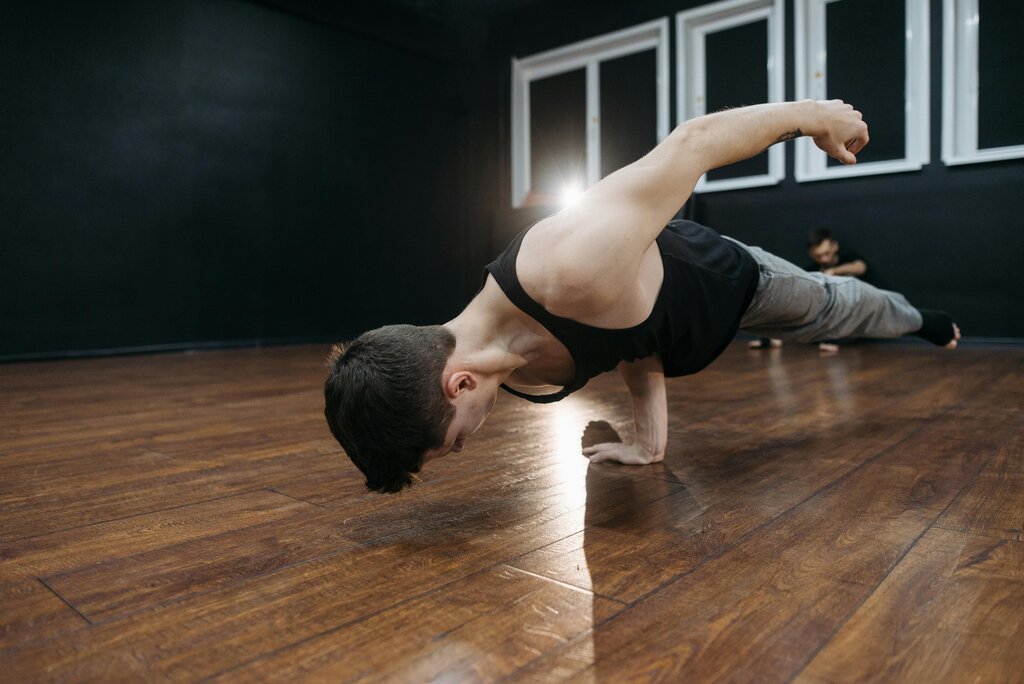
In contemporary or jazz, transitions are often 'lifted'. The goal is to appear light and defy gravity. Dancers use the floor as a springboard, pushing off it to create elevation and airtime. The focus is on suspending movement at its peak and controlling the descent. This requires a strong core and the use of counter-tension to create length and opposition in the body.
This leads to floorwork, a key component of modern dance. Instead of seeing the floor as just a surface to stand on, it becomes a partner. Smooth floorwork transitions aren't about collapsing; they're about guiding your weight through spirals, slides, and rolls, using the floor's surface to redirect your momentum seamlessly back to a standing position.
Applying the Principles
Let's put this into practice. For a grounded transition, try shifting your weight from side to side in a low squat. Feel how your connection to the floor gives you power. You're driving your energy down to move across.
For a lifted transition, practice a simple chainé turn. Feel how you rise onto the balls of your feet, keeping your centre of gravity high and consistent. You're pushing away from the floor to create a light, spinning motion. The key is to shift your weight from one foot to the other without any up-and-down bobbing, conserving that rotational energy.
During turns and complex transitions, the goal is to keep your weight over the ball of the supporting foot, maintaining an upright, stable core.
Now, let's test what you've learned about these dynamic principles.
According to the text, what is the most fundamental concept behind a dynamic weight transfer in dance?
A dancer performing a hip-hop routine wants to create a 'grounded' feel. Which approach should they take?
Mastering these transitions transforms your dancing from a series of steps into a continuous flow of motion. It’s the key to moving with both power and grace.