Fluid Statics and Dynamics
Fluid Properties
The Character of Fluids
What makes honey different from water? Or air from oil? While they are all fluids, meaning they can flow and take the shape of their container, they don't all behave the same way. Their unique actions come down to a few core properties that define their character. We'll explore three of the most important ones: density, viscosity, and compressibility.
How Much Stuff Is Packed In?
Imagine you have two identical boxes. You fill one to the brim with feathers and the other with rocks. They take up the same amount of space, but the box of rocks is obviously much heavier. That's density in a nutshell. It’s a measure of how much mass is crammed into a given volume.
Density
noun
The measure of mass per unit of volume.
In physics, we use the Greek letter rho, , to represent density. The formula is straightforward:
A fluid with high density has a lot of mass packed into a small space. One with low density has less mass in that same space. This property is why oil floats on water. Oil is less dense than water, so it rises to the top, forming a distinct layer.
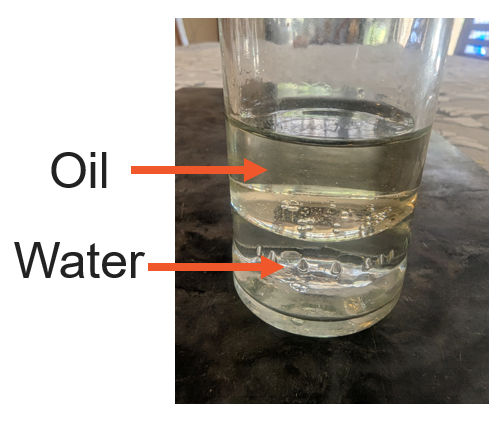
Density isn't always constant. For most fluids, density changes with temperature. When you heat a fluid, its molecules move faster and spread apart, causing its density to decrease. Conversely, cooling it down usually makes it denser.
A Fluid's Resistance to Flow
Think about pouring honey out of a jar. It flows slowly, in a thick, sluggish stream. Now picture pouring water. It splashes out quickly and easily. This difference in flow is due to viscosity. Viscosity is essentially a fluid's internal friction, or its resistance to being deformed.
Viscosity
noun
A measure of a fluid's resistance to flow. It describes the internal friction of a moving fluid.
A fluid with high viscosity, like honey, resists motion because its molecules are strongly attracted to each other. It takes more energy to get them to slide past one another. A fluid with low viscosity, like water, flows easily because its molecules move around more freely. To get a more technical feel, imagine a fluid trapped between two plates. If you slide the top plate, the fluid sticks to it and moves along. That layer of fluid then pulls on the layer below it, which pulls on the one below that, and so on. Viscosity determines how effectively that motion is transferred through the layers.
Like density, viscosity is also affected by temperature, but in opposite ways for liquids and gases. For liquids, viscosity decreases as temperature increases. Think of warming up maple syrup, it becomes runnier. For gases, viscosity increases as temperature rises because the gas molecules collide more frequently.
How Much Can It Be Squeezed?
Compressibility describes how much a fluid's volume changes when pressure is applied. Imagine you have a syringe full of water with the tip sealed. No matter how hard you push the plunger, you can barely change the water's volume. Now, if the syringe were filled with air, you could easily push the plunger down, squeezing the air into a smaller space.
Liquids are generally considered incompressible, while gases are highly compressible.
This difference comes down to the distance between molecules. In liquids, molecules are already packed closely together, leaving little empty space to reduce. In gases, molecules are far apart, with lots of room to be pushed closer. This is why you can store a large amount of a gas, like the air for a scuba tank, in a small, strong container by compressing it. For most everyday applications involving liquids like water, we can safely assume they are incompressible. This simplifies many calculations in fluid mechanics without introducing significant error.
Which of the following best describes the density of a fluid?
In physics, the Greek letter rho, , is used to represent which fluid property?
These three properties—density, viscosity, and compressibility—are the building blocks for understanding the complex and fascinating world of fluid behavior.