Fluid Mechanics for Civil Engineers
Fluid Mechanics in Civil
The Unseen Engineer
Civil engineering is often seen as the practice of building with solids: concrete, steel, and soil. But the silent partner in almost every project is a fluid. The properties of these fluids—water, wastewater, or even saturated soil—are not just abstract concepts. They are active forces that dictate design from the ground up.
Consider the specific weight of water. It's a simple property, but its consequences are massive. This constant, predictable force is why a dam must be incredibly thick at its base and why underground pipes must be strong enough to resist the weight of the saturated soil above them. Similarly, the viscosity of sludge in a wastewater treatment plant determines the power of the pumps needed to move it and the slope of the channels required to keep it flowing.
In civil engineering, you don't just build against the earth. You build against the immense, persistent forces exerted by fluids.
Structures Versus Water's Weight
When a fluid isn't moving, it's governed by the principles of fluid statics. The pressure it exerts is a direct result of its weight. This is the central challenge in designing structures that hold back water, like dams, reservoirs, and retaining walls.
The force on a dam isn't uniform. Because pressure increases with depth, the greatest force is at the very bottom. Engineers must account for this hydrostatic pressure distribution to prevent the structure from overturning or sliding. The same principle applies to underground water storage tanks, which must resist both the internal pressure of the stored water and the external pressure from the surrounding groundwater.
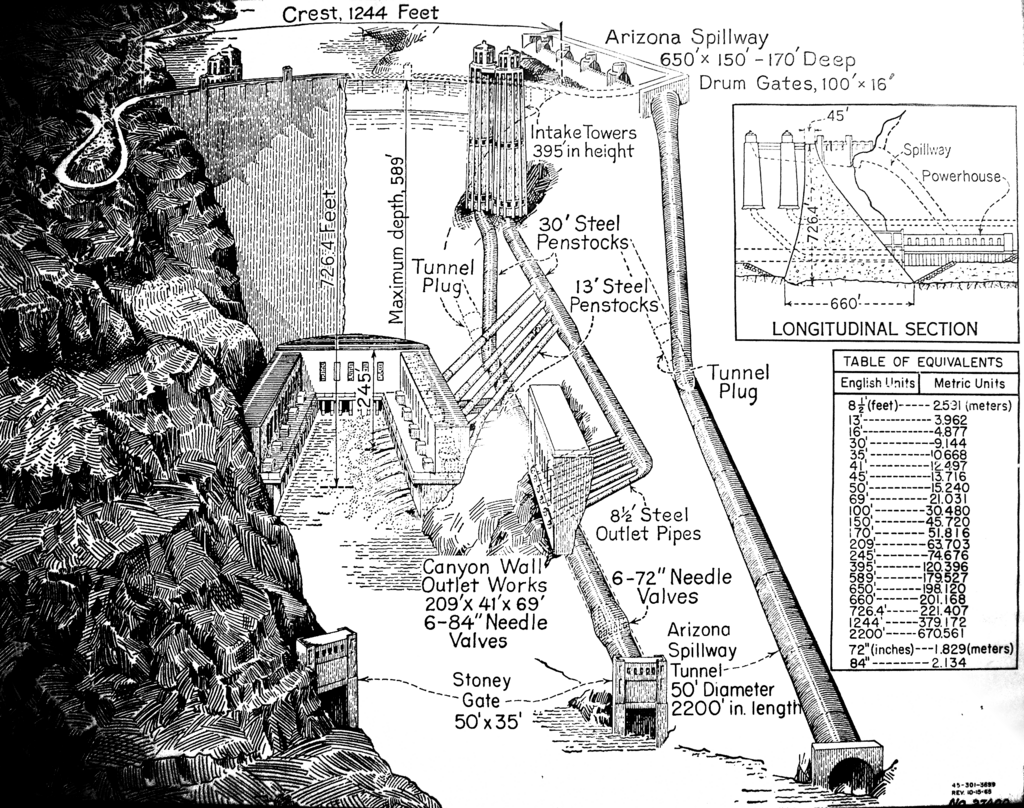
This constant battle against static fluid pressure is a foundational concept in structural and geotechnical engineering. It determines the shape of the structure, the materials used, and the design of its foundation.
Keeping Water Moving
Of course, much of civil engineering involves making fluids move. Fluid dynamics is essential for designing the vast networks that deliver clean water and remove wastewater. These conveyance systems fall into two main categories.
Pipe flow involves water moving under pressure, like in a city's water supply network. Engineers use principles of fluid dynamics to calculate friction losses, determine the required pipe sizes, and specify the pumping power needed to overcome elevation changes and deliver water at a sufficient pressure.
Open-channel flow describes fluids moving under the influence of gravity, with a free surface exposed to the atmosphere. This applies to rivers, canals, and most storm and sanitary sewer systems. Here, the design focuses on the channel's slope, shape, and roughness to ensure the water flows at a desired velocity—fast enough to prevent sediment from settling, but not so fast that it causes erosion.
These principles extend into broader water resources and environmental engineering. Managing river flooding involves analyzing open-channel flow on a massive scale. Designing wastewater treatment plants requires understanding how to control flow through various tanks and channels to allow for settling and chemical reactions. Even the dispersal of pollutants in a river is a fluid dynamics problem.
Water in the Ground
Fluid mechanics isn't just about water in pipes and rivers; it's also about water in soil. In geotechnical engineering, the water that fills the tiny spaces between soil particles—called —has a profound impact on the soil's behavior.
This internal water pressure pushes outward on the soil particles, reducing the friction between them. As pore water pressure increases, the soil's strength decreases. In extreme cases, like during an earthquake, a rapid increase in this pressure can cause a phenomenon called liquefaction, where saturated sandy soil behaves like a liquid, leading to catastrophic building foundation failures.
Engineers must analyze pore water pressure when designing foundations, assessing the stability of slopes, and building retaining walls. It's a critical factor that determines whether the ground beneath a structure will be stable or prone to failure.
Why must a dam be significantly thicker at its base than at its top?
In the context of geotechnical engineering, what is the direct effect of an increase in pore water pressure on soil?
From the grand scale of a dam to the microscopic interactions within soil, the principles of fluid mechanics are fundamental to the safety and function of civil infrastructure.