Flowering Plant Morphology
Introduction to Plant Morphology
The Shape of Life
Look closely at a plant. Any plant will do—a dandelion pushing through a sidewalk crack, a rose in a garden, or a towering oak tree. You'll notice they all have distinct parts: roots, stems, leaves, and maybe flowers. The study of these external structures is called plant morphology.
morphology
noun
The study of the form and structure of organisms and their specific structural features.
It's a way of understanding a plant's blueprint. By examining its form, we can learn how it survives, grows, and reproduces. It’s like being a detective, where the clues are the shapes, sizes, and arrangements of a plant's body parts. This field focuses on what we can see with the naked eye, from the tiniest seedling to the most complex flower.
The basic parts of a plant are as follows: roots, stems, leaves, flowers, fruits, and seeds.
Think of plant morphology as the
architecture of a plant. Just as a building has a foundation, walls, and a roof, a plant has structures designed for specific jobs.
Growth vs. Reproduction
To make sense of a plant's structure, botanists divide its parts into two main categories: vegetative and reproductive.
Vegetative parts are all about growth and survival. These are the workhorses of the plant, responsible for keeping it alive day to day. They include the roots, stems, and leaves.
- Roots anchor the plant and absorb water and nutrients from the soil.
- Stems provide support and act as a highway, transporting water and food between the roots and leaves.
- Leaves are the primary sites for photosynthesis, the process of converting sunlight into energy.
Vegetative parts are the plant's life-support system. They handle the daily business of living.
Reproductive parts have a different, more glamorous job: creating the next generation. In flowering plants, these are the flowers, fruits, and seeds.
- Flowers are the main reproductive organs, designed to attract pollinators and facilitate fertilization.
- Fruits develop from the flower to protect the seeds and help them spread.
- Seeds contain the embryo of a new plant, ready to start the cycle all over again.
This division helps us understand a plant's life strategy. Some plants invest heavily in their vegetative parts, growing large and strong before ever attempting to reproduce. Others might flower quickly, prioritizing making seeds over their own long-term survival.
Why Study Plant Shapes?
Understanding plant morphology is more than just academic. It has practical uses in agriculture, conservation, and even our own backyards. When we can identify a plant's structures, we can better understand what it needs to thrive.
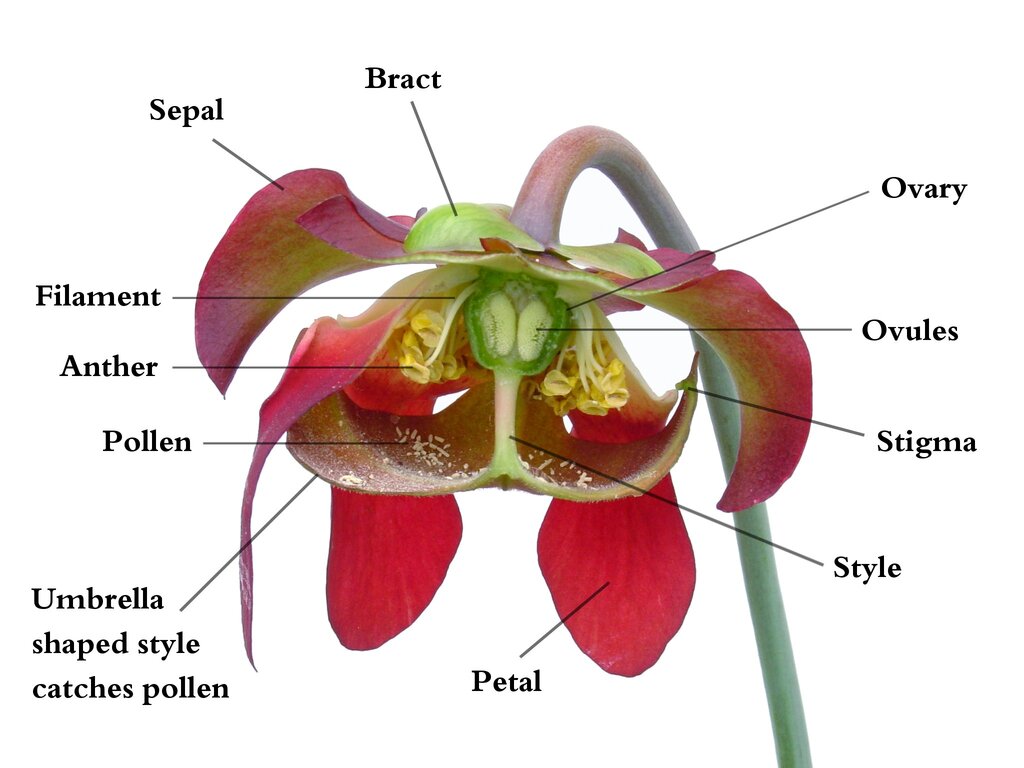
For a farmer, knowing the difference between a vegetative bud and a flower bud is crucial for predicting crop yields. For a conservationist, the unique shape of a rare flower might be the key to identifying and protecting it. For a gardener, recognizing that a plant's yellow leaves (a vegetative part) signal a problem can help save it before it's too late.
Studying morphology allows us to classify plants, understand their evolutionary relationships, and appreciate the incredible diversity of forms that have evolved to solve the same basic problems: how to find light, water, and a way to pass on your genes.
Let's review the key ideas before moving on.
Ready to check your understanding?
Plant morphology is the study of which aspect of plants?
Which of the following lists contains only vegetative parts of a plant?
By looking closely at the form of plants, we open up a new way of seeing the green world around us. Each leaf, stem, and flower tells a story of adaptation and survival.