Flask API Development
Introduction to RESTful APIs
What Are RESTful APIs?
Think about ordering food at a restaurant. You don't go into the kitchen to cook your meal. Instead, you talk to a waiter. You look at a menu (the interface), give your order to the waiter (the request), and the waiter brings you your food from the kitchen (the response). The waiter is the intermediary that lets you communicate with the kitchen without needing to know how it works.
An Application Programming Interface, or API, is like that waiter. It's a set of rules that allows different software applications to talk to each other. One application (the client) sends a request for data or an action, and another application (the server) responds. The API defines how those requests and responses should be structured.
An API is the messenger that takes requests and tells a system what you want to do, then returns the response back to you.
So what makes an API "RESTful"? REST, which stands for Representational State Transfer, isn't a technology itself but a style of architecture. It's a set of principles that, when applied to an API, make it simple, scalable, and easy to work with. Most modern web services you use every day, from social media apps to weather services, use RESTful APIs to function.
The Core Principles of REST
REST isn't a strict protocol, but it follows a few key guidelines. Two of the most important are statelessness and a resource-based structure.
Statelessness
noun
The server does not store any information about the client's past requests. Every request from a client must contain all the information needed to understand and process it.
Imagine a vending machine. Each time you want a snack, you insert money and make a selection. The machine doesn't remember what you bought last time. That's a stateless interaction. The opposite would be ordering coffee from a barista who remembers your usual. With a REST API, every request is like using the vending machine—it's self-contained and independent.
REST also treats all information as resources. A resource is any piece of data the API can provide. If you were building a blog API, your resources might include users, blog posts, and comments. Each resource is identified by a unique URL (Uniform Resource Locator), like /users/123 to identify a specific user or /posts to represent the collection of all posts.
How REST APIs Communicate
REST APIs communicate over HTTP, the same protocol your web browser uses to fetch websites. A client sends an HTTP request to a specific URL, and the server sends back an HTTP response, usually in a format like JSON (JavaScript Object Notation).
The request specifies two key things: the resource it wants to interact with (the URL) and what it wants to do with that resource (the HTTP method).
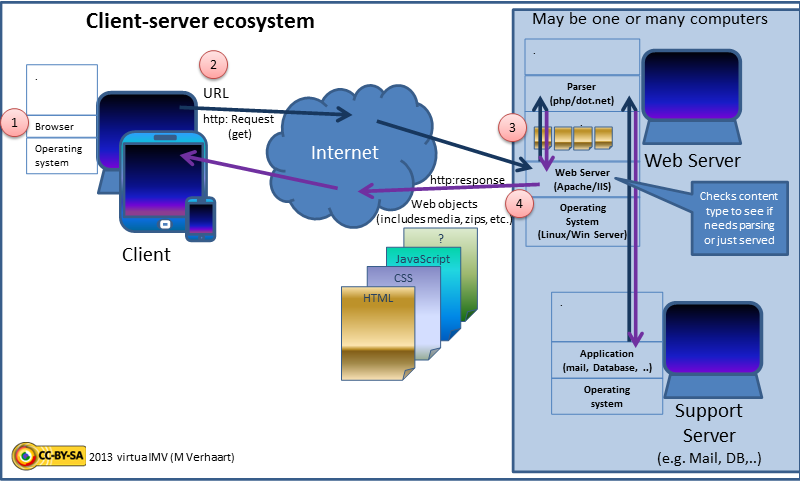
There are several HTTP methods, but four are central to most RESTful APIs. These methods correspond directly to the basic operations you'd want to perform on data: Create, Read, Update, and Delete (CRUD).
| HTTP Method | Action | Description |
|---|---|---|
GET | Read | Retrieves a resource or a list of resources. |
POST | Create | Creates a new resource. |
PUT | Update | Updates an existing resource completely. |
DELETE | Delete | Removes a resource. |
For example, to get a list of all blog posts, a client would send a GET request to the /posts URL. To create a new post, it would send a POST request to /posts with the new post's data in the request body. To delete the post with ID 42, it would send a DELETE request to /posts/42.
This combination of resource-based URLs and standard HTTP methods makes RESTful APIs predictable and easy to understand. Developers can quickly grasp how to interact with an API just by looking at its structure, which is a huge benefit in modern web development where systems constantly need to connect and share data.
Ready to check your understanding? Let's see what you've learned about RESTful APIs.
In the restaurant analogy for how an API works, what does the waiter represent?
What does the acronym REST stand for?
Understanding these core concepts is the first step. Now you have the foundation needed to start building your own APIs.