FlashAttention Explained
Introduction to Attention Mechanisms
The Memory Problem
Imagine reading a long, dense paragraph and then being asked to summarize it. You’d probably reread parts of it, focusing on the key sentences that hold the main idea. Your brain naturally pays attention to the most relevant information and filters out the rest.
Early neural networks, especially those designed for sequences like sentences or time-series data, couldn't do this. Models like Recurrent Neural Networks (RNNs) processed information one piece at a time, trying to hold everything in their limited memory. For short sentences, this worked fine. But for longer ones, they suffered from a kind of amnesia. By the time the model reached the end of a paragraph, it had often forgotten what was said at the beginning. This made tasks like translating long sentences or answering complex questions very difficult.
This limitation was a major bottleneck. The model's ability to understand context was confined to a small, recent window of information.
To solve this, researchers took a cue from human cognition. What if, instead of trying to cram an entire sequence into a fixed-size memory, a model could learn to look back at the input and decide which parts are most important for the task at hand? This is the core idea behind the attention mechanism.
How Attention Works
An attention mechanism allows a model to weigh the importance of different parts of the input data. Instead of giving equal consideration to every word in a sentence, it assigns a score to each word. Words with higher scores get more "attention."
To do this, the mechanism uses three key components for each input element (like a word in a sentence):
- Query (Q): This represents the current focus or the question being asked. For example, when translating a word, the query is essentially asking, "Which part of the original sentence is most relevant to this specific word?"
- Key (K): This is like a label or an index for each input element. It's compared against the query to find a match.
- Value (V): This is the actual substance or content of the input element. Once a key is matched with a query, its corresponding value is what gets used.
Think of it like searching for a video online. Your search term is the Query. The video titles and descriptions are the Keys. When your query matches a key, you click on the video to watch its content, which is the Value.
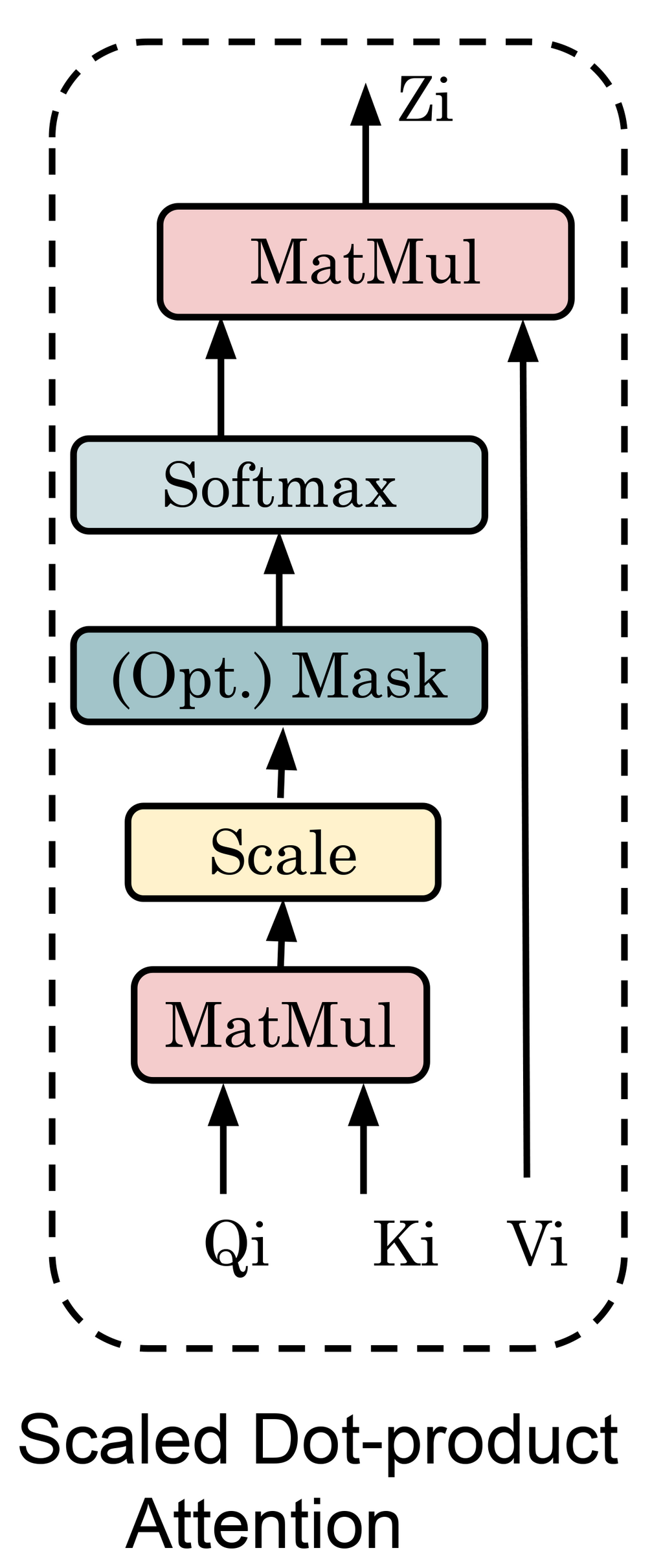
The model calculates attention scores by comparing the query with all the keys. A high score means the key (and its associated value) is highly relevant to the query. These scores are then converted into weights that sum to one using a function called softmax. Finally, the values are multiplied by their weights and summed up to produce the final output. This output is a blend of the inputs, with the most relevant parts amplified.
Types of Attention
While the Query-Key-Value model is common now, especially in Transformer architectures, attention mechanisms evolved through several forms. The two foundational types are Additive and Multiplicative attention.
Additive Attention, also known as Bahdanau attention, uses a small neural network to calculate the alignment score between the query and keys. It's effective but can be computationally slower.
Multiplicative Attention, or Luong attention, is simpler and often faster. It calculates the score by performing a dot product between the query and key vectors. This is the approach that scaled dot-product attention builds upon.
| Attention Type | Calculation Method | Typical Use Case |
|---|---|---|
| Additive (Bahdanau) | Uses a feed-forward network | Early sequence-to-sequence models |
| Multiplicative (Luong) | Uses dot-product operations | Faster, more efficient models |
Attention in Action
The impact of attention was transformative. In Natural Language Processing (NLP), it revolutionized machine translation. When translating the sentence "The black cat sat on the mat," an attention-based model can learn that the French word "chat" (cat) should pay most attention to the English word "cat," while "noir" (black) should focus on "black."
This ability to create direct links between different parts of the input and output sequences solved the long-range dependency problem that plagued older models.
In computer vision, attention helps models focus on the most salient parts of an image. For an image captioning task, when the model generates the word "dog," the attention mechanism can highlight the pixels in the image that actually contain the dog. This makes the generated captions more accurate and contextually aware.
By allowing models to dynamically focus on relevant information, attention mechanisms paved the way for more powerful and capable neural network architectures, most notably the Transformer, which is built entirely around this concept.
Ready to check your understanding? Let's see what you've learned about attention mechanisms.
What primary problem in early sequence models like Recurrent Neural Networks (RNNs) was the attention mechanism designed to solve?
In the Query-Key-Value model of attention, what is the role of the 'Key'?
Attention was a critical breakthrough, solving the memory bottleneck of earlier models and enabling networks to handle long, complex sequences with far greater accuracy.