First Transition Metal Series Electronic Configurations
Atomic Structure
The Atom's Architecture
At the heart of every atom is a dense nucleus, but the action really happens in the cloud of electrons surrounding it. These electrons don't just circle the nucleus like tiny planets. Instead, they exist in specific regions of space called orbitals, which are defined by probability. Think of an orbital as a 3D map showing where an electron is most likely to be found.
To keep things organized, these orbitals are grouped into layers. The main layers are called electron shells, and within those shells are subshells. You can think of it like an address: the shell is the city, the subshell is the neighborhood, and the orbital is the specific house where an electron lives.
Quantum Numbers: An Electron's Address
To pinpoint an electron's state within an atom, we use a set of four quantum numbers. Each electron has a unique set, like a personal identification code. These numbers describe the electron's energy and location.
Principal Quantum Number (n)
adjective
This number describes the main energy level, or shell, an electron occupies. It indicates the size of the orbital and its distance from the nucleus.
Next, we have the subshell, which defines the shape of the orbital.
Angular Momentum Quantum Number (l)
adjective
This number specifies the shape of an orbital within a shell. It's also known as the azimuthal quantum number.
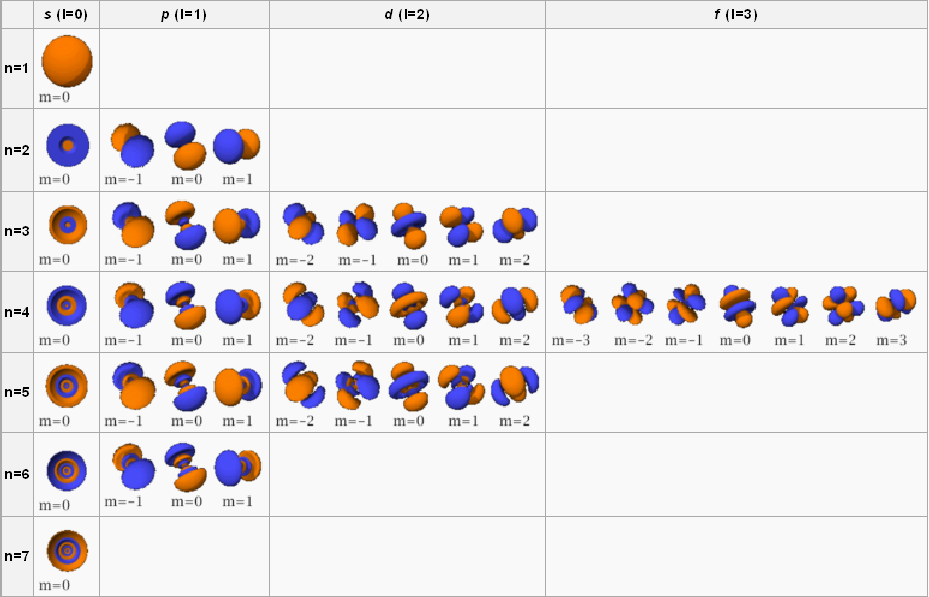
Within each subshell, there can be one or more orbitals, each with a specific orientation in space.
Magnetic Quantum Number (m_l)
adjective
This number describes the orientation of an orbital in space. The number of possible orientations depends on the orbital's shape (the l value).
Finally, each electron has an intrinsic property called spin.
Spin Quantum Number (m_s)
noun
This number describes the intrinsic angular momentum of an electron, which behaves as if the electron were spinning. This spin creates a tiny magnetic field.
Rules for Filling Orbitals
So how do electrons decide which orbitals to occupy? They follow a few fundamental rules that govern how they fill the available energy levels in an atom. This arrangement is called an atom's electron configuration.
The Aufbau principle states that electrons fill the lowest-energy orbitals available before moving to higher-energy orbitals.
Think of it like pouring water into a container; it fills the bottom first. The order of filling doesn't strictly follow the numerical shell number. For instance, the 4s orbital is actually lower in energy than the 3d orbital, so it gets filled first.
Next is a rule about sharing space.
The Pauli exclusion principle says that no two electrons in the same atom can have the exact same set of four quantum numbers. Since an orbital is defined by , , and , this means an orbital can hold a maximum of two electrons, and they must have opposite spins ( of +1/2 and -1/2).
This principle is the reason electron shells have a limited capacity. Once an orbital has two electrons with opposite spins, it's full.
Hund's rule applies when filling subshells that have more than one orbital of the same energy, like the three p orbitals or the five d orbitals. It states that electrons will occupy empty orbitals first before pairing up.
Imagine people getting on an empty bus. Most would take an empty row of seats before sitting next to a stranger. Electrons do the same thing. They spread out among orbitals of equal energy, and they all have the same spin (spin up) until each orbital has one electron. Only then do they start pairing up with spin-down electrons.
These three rules—the Aufbau principle, the Pauli exclusion principle, and Hund's rule—provide the foundation for determining the electron configuration of any element. Understanding them is the first step to predicting how an atom will behave and interact with others.
Ready to check your understanding? Let's try a few questions.
Which of the following best describes an electron orbital?
According to the Aufbau principle, which orbital is filled after the 3p orbital?
By mastering these fundamental concepts of atomic structure, you've built the framework needed to understand the organization of the periodic table and the chemical behavior of all elements.