First Quantum Data Centers
Quantum Computing Basics
Beyond the Light Switch
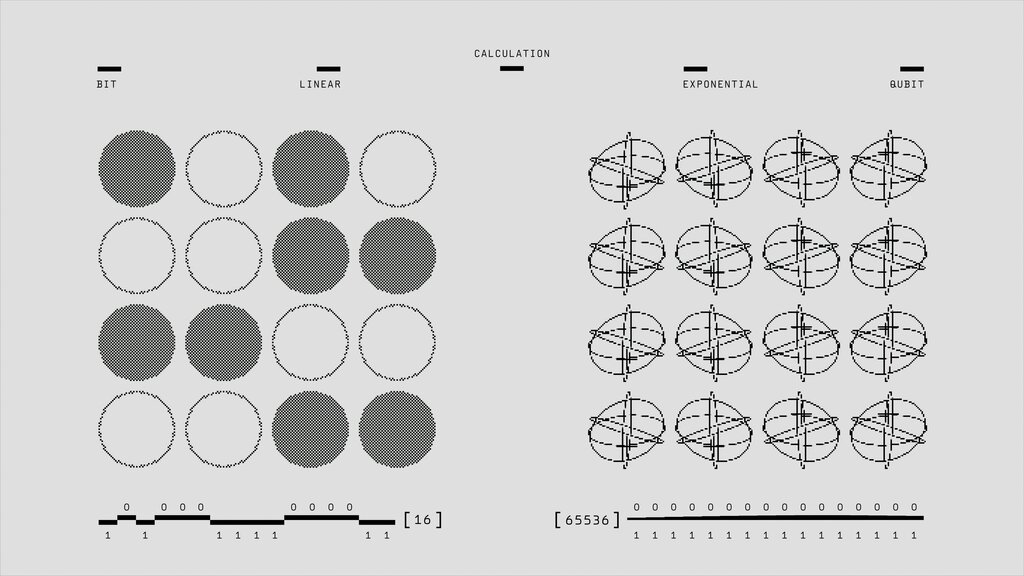
Your computer, phone, and even your digital watch work on a simple principle. They are filled with billions of tiny electronic switches. Each switch can be either on or off, which we represent as a 1 or a 0. This is called a 'bit,' and it's the fundamental piece of information in all of classical computing. Think of it like a light switch: it's either on, or it's off. There's no in-between.
Quantum computers use something different, called a ''. A qubit can be a 0, a 1, or both at the same time. This strange 'both-at-once' state is a core principle of quantum mechanics called superposition.
Imagine a spinning coin. While it's in the air, it’s not definitively heads or tails—it’s a blur of both possibilities. Only when it lands and you look at it does it settle into one clear state. A qubit is like that spinning coin, holding multiple potential values simultaneously.
Quantum Twins
Another quantum property is even stranger: s. Imagine you have two of those special spinning coins. You link them together in a quantum way and give one to a friend. Your friend could travel to the other side of the world. The moment your coin lands on heads, you instantly know your friend's coin has landed on tails. There's no message sent between them; their fates are linked, regardless of distance.
This is entanglement. When two or more qubits are entangled, their states are connected. Measuring one qubit gives you immediate information about the others it's linked to. This interconnectedness allows for complex information processing that isn't possible with independent bits.
The Quantum Advantage
So why is this useful? Because superposition and entanglement let quantum computers explore a vast number of possibilities all at once. A classical computer checks solutions one by one, like a person trying every key on a keychain until one works. A quantum computer, by using qubits that are both 0 and 1, can essentially try many keys at the same time.
This ability to perform many calculations in parallel is what gives quantum computers their potential power, often called the 'quantum advantage.'
This doesn't mean a quantum computer will replace your laptop for browsing the web or writing emails. Classical computers are great at those tasks. But for certain types of problems—like discovering new medicines by simulating molecules, creating new materials, or breaking complex codes—the number of possibilities is enormous. A classical computer would take thousands of years to solve them, while a quantum computer could potentially find an answer in hours or days.
Harnessing these delicate quantum states requires an extreme environment. Qubits are incredibly fragile. The slightest vibration or change in temperature can disrupt their superposition and cause errors in the calculation. This is why quantum data centers look like complex science experiments, with massive cooling systems and physical isolation to protect the qubits from the outside world.
What is the fundamental unit of information in a quantum computer?
The principle of superposition in a qubit is most similar to which of the following scenarios?