First Ionization Energy of Transition Metals
Atomic Structure
Inside the Atom
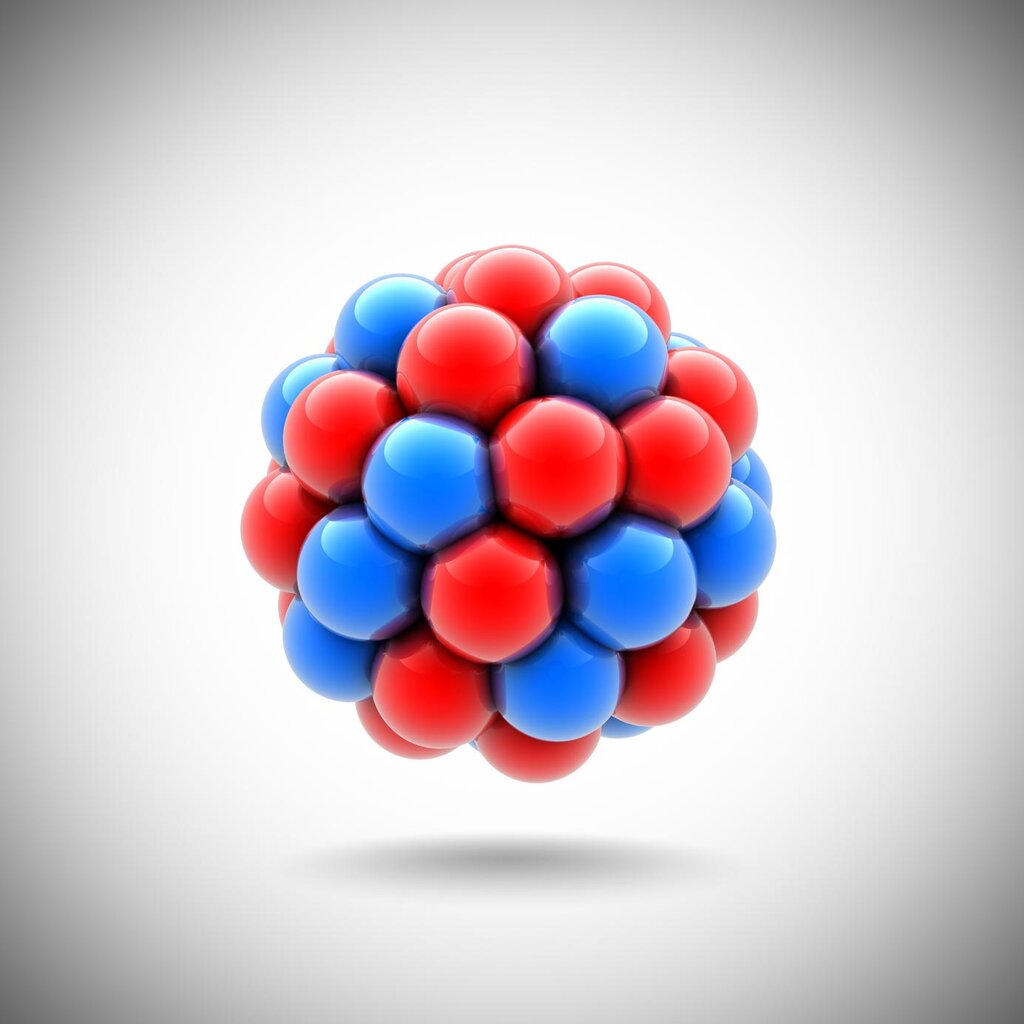
Everything around us is made of atoms, the basic building blocks of matter. At the very center of every atom is a tiny, dense core called the nucleus. This is where you'll find two types of particles packed tightly together: protons and neutrons.
Proton
noun
A subatomic particle found in the nucleus of every atom, with a positive electric charge.
Protons determine an element's identity. For example, an atom with one proton is always hydrogen, while an atom with six protons is always carbon. Neutrons, on the other hand, have no charge.
Neutron
noun
A subatomic particle of about the same mass as a proton but without an electric charge, present in all atomic nuclei except those of ordinary hydrogen.
Together, protons and neutrons make up almost all of an atom's mass. The nucleus itself is incredibly small compared to the rest of the atom. If an atom were the size of a sports stadium, the nucleus would be like a marble in the center.
Electrons in Motion
Whizzing around the nucleus are the third type of particle: electrons. They are much smaller than protons and neutrons and carry a negative charge.
Electron
noun
A stable subatomic particle with a charge of negative electricity, found in all atoms.
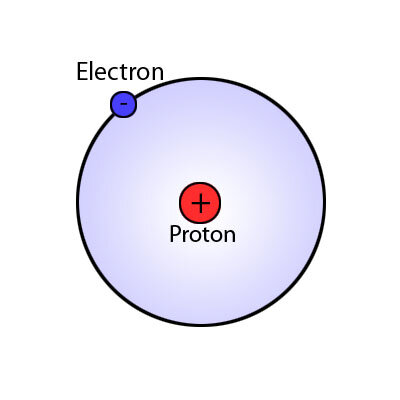
The positive charge of the protons in the nucleus attracts the negatively charged electrons, keeping them in orbit. In a neutral atom, the number of electrons is equal to the number of protons, so the overall charge is zero.
One of the earliest ways we visualized this structure was the Bohr model. It pictures the atom as a mini solar system, with electrons orbiting the nucleus like planets around the sun. While it's a simplification, it’s a great starting point for understanding where electrons live.
Electron Neighborhoods
Electrons don't orbit randomly. They are confined to specific energy levels called electron shells. Think of these shells as floors in a building. An electron can be on the first floor or the second floor, but never in between. The shell closest to the nucleus () has the lowest energy. The farther a shell is from the nucleus, the higher its energy.
Each shell can only hold a certain number of electrons. The first shell can hold up to 2, the second up to 8, the third up to 18, and so on.
But it gets a little more detailed. Just as a floor in a building can have different rooms, electron shells are divided into subshells. These are designated by the letters s, p, d, and f. Each subshell has a unique shape and can hold a specific number of electrons.
- s subshell: holds up to 2 electrons
- p subshell: holds up to 6 electrons
- d subshell: holds up to 10 electrons
- f subshell: holds up to 14 electrons
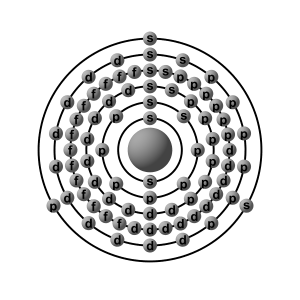
The first shell () only has an s subshell. The second shell () has an s and a p subshell. The third shell () has s, p, and d subshells. This structured arrangement of electrons dictates how an atom behaves and interacts with other atoms.