First Ionization Energy Explained
Atomic Structure
The Atom's Core
At the center of every atom is a tiny, dense region called the nucleus. It's packed with two types of particles: protons and neutrons. Protons carry a positive electrical charge, while neutrons, as their name suggests, are neutral and have no charge at all. These two particles are responsible for almost all of an atom's mass.
proton
noun
A subatomic particle found in the nucleus of every atom, with a positive electric charge.
Because protons are positive, they repel each other. So what holds the nucleus together? The strong nuclear force, one of the four fundamental forces of nature, overcomes this repulsion and binds protons and neutrons together.
neutron
noun
A subatomic particle of about the same mass as a proton but without an electric charge, present in all atomic nuclei except those of ordinary hydrogen.
An atom's identity comes from the number of protons it has. This is called the atomic number, represented by the symbol . Every carbon atom in the universe has 6 protons, so its atomic number is 6. If it had 7 protons, it would be nitrogen.
The total number of protons and neutrons in the nucleus is the mass number, symbolized as . A typical carbon atom has 6 protons and 6 neutrons, giving it a mass number of 12. We can write this as .
The Electron Cloud
Whizzing around the nucleus are the electrons. These particles are much, much smaller than protons or neutrons and carry a negative electrical charge. In a neutral atom, the number of electrons is equal to the number of protons, so their charges cancel each other out.
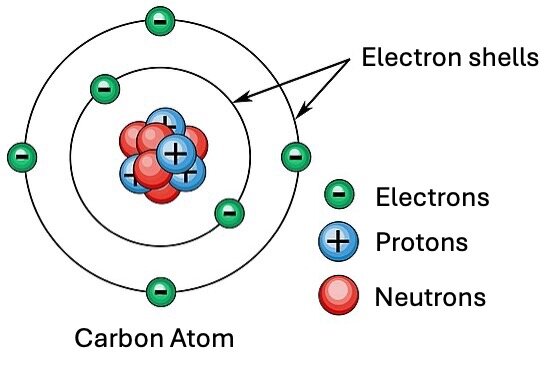
It's tempting to picture electrons orbiting the nucleus like planets around the sun, but that's not quite right. Instead, they exist in a sort of haze of probability around the nucleus, often called an electron cloud. We can't know exactly where an electron is at any given moment, only the region where it's most likely to be found.
electron
noun
A stable subatomic particle with a charge of negative electricity, found in all atoms.
Where Electrons Live
Electrons don't just swarm around the nucleus randomly. They are organized into specific energy levels called electron shells. Think of these shells like floors in a building. Electrons on the first floor (the shell closest to the nucleus) have the lowest energy, and those on higher floors have more energy. Each shell can only hold a certain number of electrons.
Shells are numbered starting from 1, the closest to the nucleus. The first shell can hold 2 electrons, the second can hold 8, and the third can hold 18.
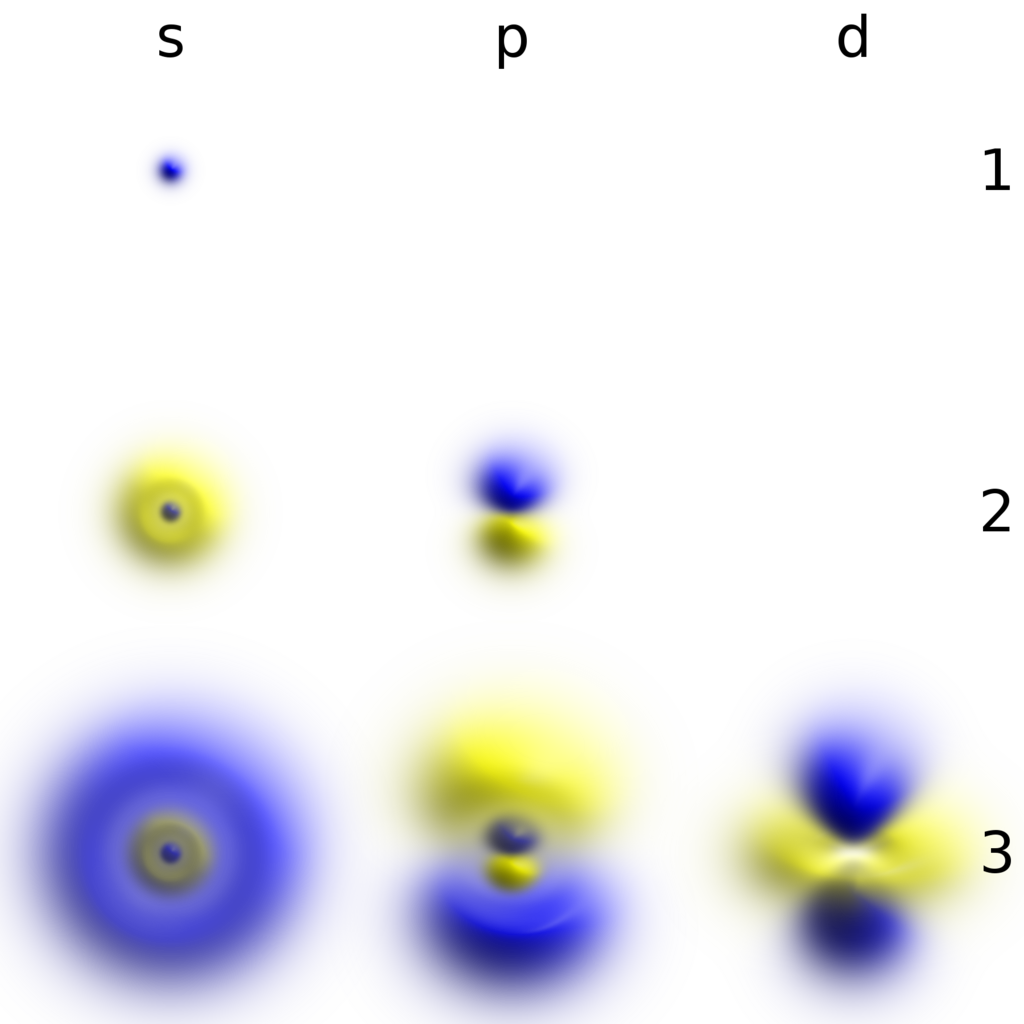
Within each shell, there are sub-levels called orbitals. Orbitals are the specific regions where an electron has the highest probability of being found. You can think of these as the individual rooms on each floor of our building analogy. These orbitals have different shapes and are labeled with letters: s, p, d, and f.
| Shell (n) | Max Electrons | Orbitals Present |
|---|---|---|
| 1 | 2 | 1s |
| 2 | 8 | 2s, 2p |
| 3 | 18 | 3s, 3p, 3d |
An 's' orbital is spherical, like a ball. A 'p' orbital is shaped like a dumbbell. The d and f orbitals have more complex shapes. The arrangement of electrons within these shells and orbitals determines an atom's chemical behavior, including how it bonds with other atoms.
Time to check your understanding of the atom's basic components.
What two types of particles are found within the nucleus of an atom?
The number of which particle determines the chemical identity of an atom?
This fundamental structure of protons, neutrons, and electrons is the basis for all matter and chemistry.