First Grade 3D Shape Adventures
Introduction to 3D Shapes
Entering the Third Dimension
So far, we’ve talked about shapes that are flat, like squares and circles. You can draw them on a piece of paper. But the world around us isn’t flat. It’s filled with objects that have height, width, and depth. These are three-dimensional, or 3D, shapes.
A 3D shape is a solid object that takes up space. Think about a book, a ball, or a can of soup. You can hold them, turn them over, and see them from different sides. They have an inside and an outside. Let’s explore the basic language we use to describe them.

The Parts of a Shape
To understand 3D shapes, we need to know their three main parts: faces, edges, and vertices. These features help us tell one shape from another.
Face
noun
A flat or curved surface on a 3D shape.
Think of a face as any side of the object. For a cardboard box, the faces are the flat sides you can lay your hand on.
Edge
noun
The line where two faces meet.
If you run your finger along the side of a box where two flat parts come together, you’re tracing an edge.
Vertex
noun
A point where three or more edges meet. The plural of vertex is vertices.
A vertex is just a corner. It's the sharp point on many 3D shapes.
Meet the Common Shapes
Now that we have the vocabulary, let's meet some of the most common 3D shapes and break down their parts.
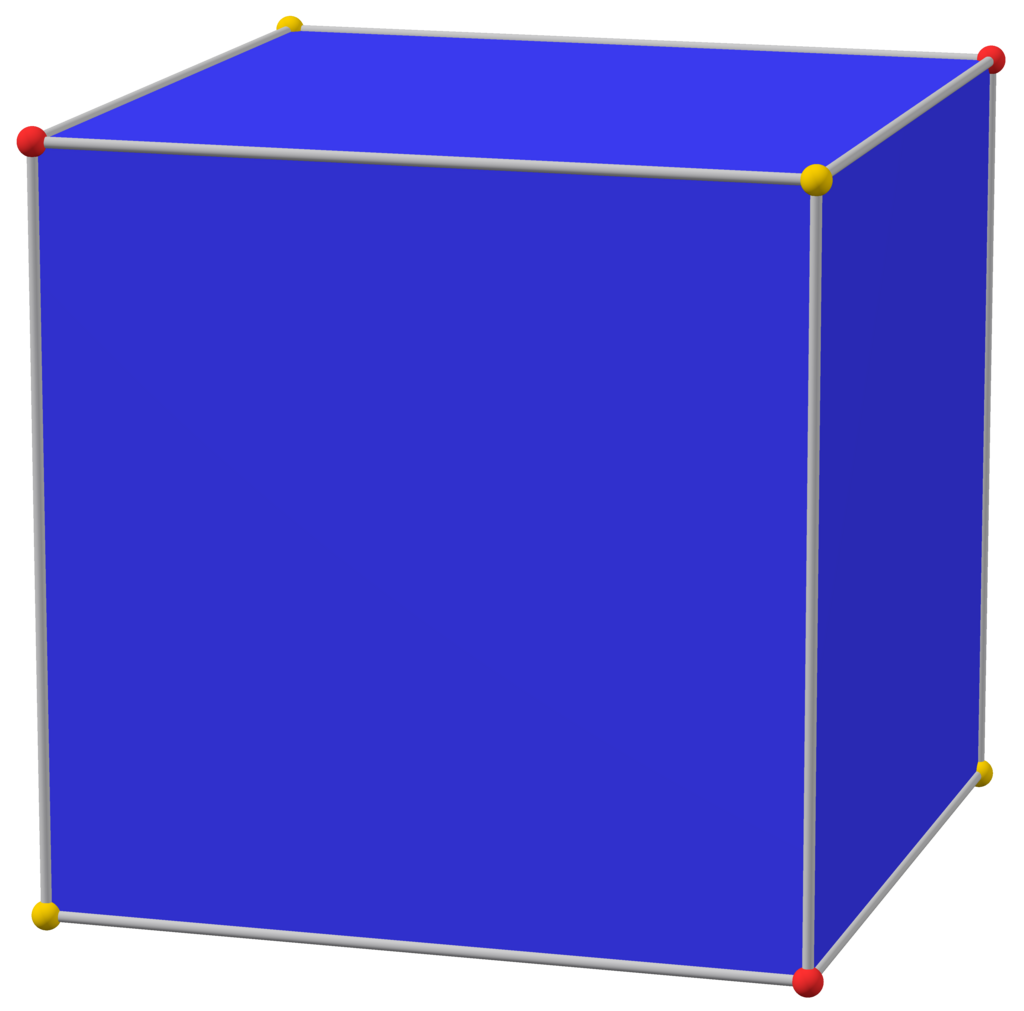
Cube A cube is a familiar shape with six identical square faces. Think of a standard die used in a board game or a sugar cube.
| Part | Count |
|---|---|
| Faces | 6 |
| Edges | 12 |
| Vertices | 8 |
Next up is the sphere. A sphere is a perfectly round 3D object, like a basketball or a marble. It's unique because it doesn't have any flat faces, straight edges, or sharp corners. It has just one continuous curved surface.
| Part | Count |
|---|---|
| Faces | 1 (curved) |
| Edges | 0 |
| Vertices | 0 |
A cylinder has two identical flat, circular ends and one curved side. Cans, pipes, and candles are often cylinders.
Cylinders have two flat faces (the circles on top and bottom) and one curved face (the side). The two edges are the circular lines where the curved face meets the flat faces. It has no vertices.
A cone is a shape with a flat, circular base that tapers to a single point at the top, called the apex. Ice cream cones and traffic cones are classic examples.
| Part | Count |
|---|---|
| Faces | 2 (1 flat, 1 curved) |
| Edges | 1 (circular) |
| Vertices | 1 (the apex) |
Finally, we have the pyramid. A pyramid has a flat base and triangular faces that meet at a common point at the top (the apex). The base can be any polygon, like a square or a triangle. The famous pyramids in Egypt have square bases.
For a square-based pyramid, the counts are as follows:
| Part | Count |
|---|---|
| Faces | 5 (1 square, 4 triangles) |
| Edges | 8 |
| Vertices | 5 |
Now that you've been introduced to these shapes and their parts, let's see what you remember.
What are the three main parts used to describe most 3D shapes?
Which 3D shape is unique because it has no flat faces, straight edges, or vertices?
Learning to see the world in 3D helps us understand the objects we interact with every day. By knowing their basic parts, you can describe them accurately and tell them apart.