First German Words
Greetings and Introductions
First Words
Let's start with the most common ways to say hello. The simplest and most versatile greeting is Hallo. You can use it anytime, anywhere, with almost anyone. It's friendly and universal.
Hello
For a bit more formality, you can greet people based on the time of day. Guten Tag is a standard, polite way to say hello during the daytime.
Good day
This pattern extends to other times of day as well. In the morning, you'd say Guten Morgen. In the evening, it's Guten Abend.
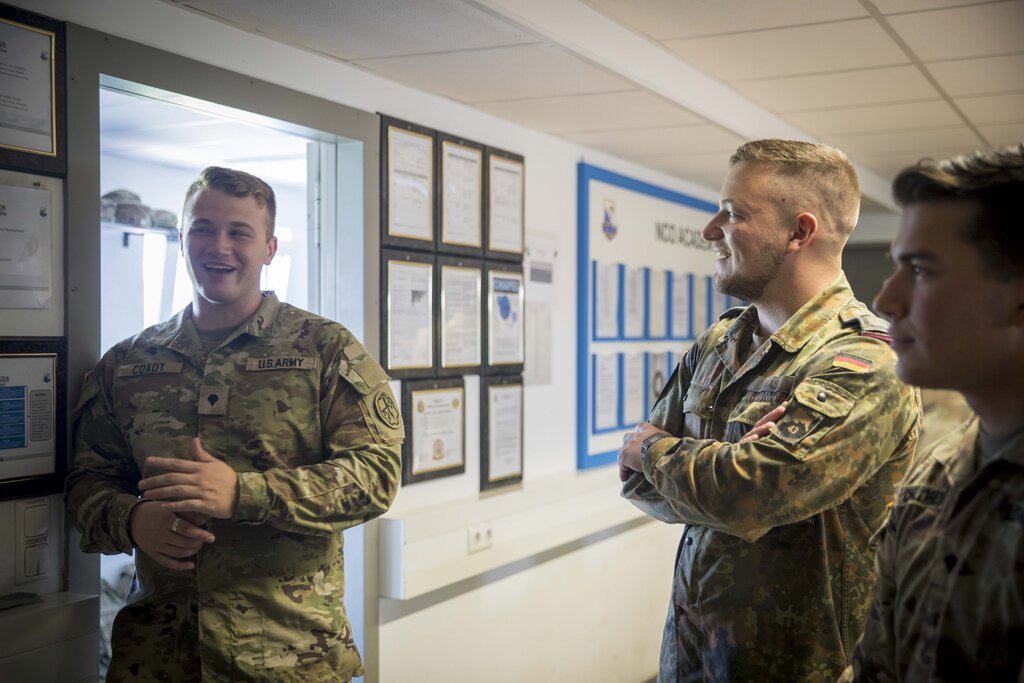
When saying goodbye, a common and friendly option is Tschüss. For a more formal departure, especially at the end of a business meeting, you might use Auf Wiedersehen.
Bye
Goodbye (literally, until we see again)
Making Introductions
After greeting someone, you'll want to introduce yourself. The most direct way is to use the verb heißen, which means "to be called."
heißen
verb
To be called or named.
To state your name, you simply say Ich heiße... followed by your name. Another common phrase is Mein Name ist..., which is just like saying "My name is..." in English.
Ich heiße Paul. Mein Name ist Anna.
Now, how do you ask for someone else's name? This is where German's distinction between formal and informal speech becomes important. You use different pronouns for different situations.
Du is the informal "you," used with friends, family, and children. Sie is the formal "you," used with strangers, in business settings, and to show respect. Notice that the formal Sie is always capitalized.
To ask someone's name informally, you say:
What is your name? (informal)
To ask formally, you say:
What is your name? (formal)
When in doubt, it's always safer to use the formal Sie.
Polite Expressions
Politeness is key in any language. The two most important words you'll learn are bitte and danke.
Thank you
Bitte is an incredibly useful word. It can mean "please," "you're welcome," or even "here you go" when handing something to someone.
Please / You're welcome
If someone says danke to you, a simple and polite response is bitte. Another way to respond is gern geschehen, which means "my pleasure."
A simple exchange:
Person A: Hier ist dein Kaffee. (Here is your coffee.) Person B: Danke! Person A: Bitte.
Let's review the key terms we've covered.
Now, let's see how well you can use these new phrases.
You are meeting a group of new colleagues for the first time in a professional setting. Which greeting is the most appropriate for the middle of the afternoon?
If you want to ask a new acquaintance their name respectfully in a formal situation, what would you say?
With these essential phrases, you're ready to start your first simple conversations in German.