Firefighting Pump Operations and Calculations
Introduction to Fluid Dynamics
How Water Moves
To understand how water behaves in a fire hose, we first need to look at its basic properties. Water is a fluid, which means it can flow and change its shape. Two key properties for firefighting are its density and weight. A gallon of water has a specific weight, and this weight is what creates pressure when the water is contained in a hose or a tank.
Density
noun
The mass of a substance per unit of volume. For water, this is about 62.4 pounds per cubic foot.
Pressure is simply the amount of force applied over a certain area. Imagine the water inside a fire hose. It's pushing outwards against the walls of the hose in all directions. This push is pressure. The higher the pressure, the more forcefully the water is pushing.
Flow, on the other hand, is the volume of water that moves past a certain point over a period of time. It's usually measured in gallons per minute (GPM). While pressure is the force behind the water, flow is the amount of water being delivered to the fire.
Think of it this way: Pressure gets the water to the fire, but flow is what actually puts the fire out.
Pressure and Speed
Pressure and flow have an interesting relationship, which is described by Bernoulli's principle. This principle states that for a fluid like water, as its speed increases, its pressure decreases. This might seem counterintuitive, but it's exactly what happens at the end of a fire hose.
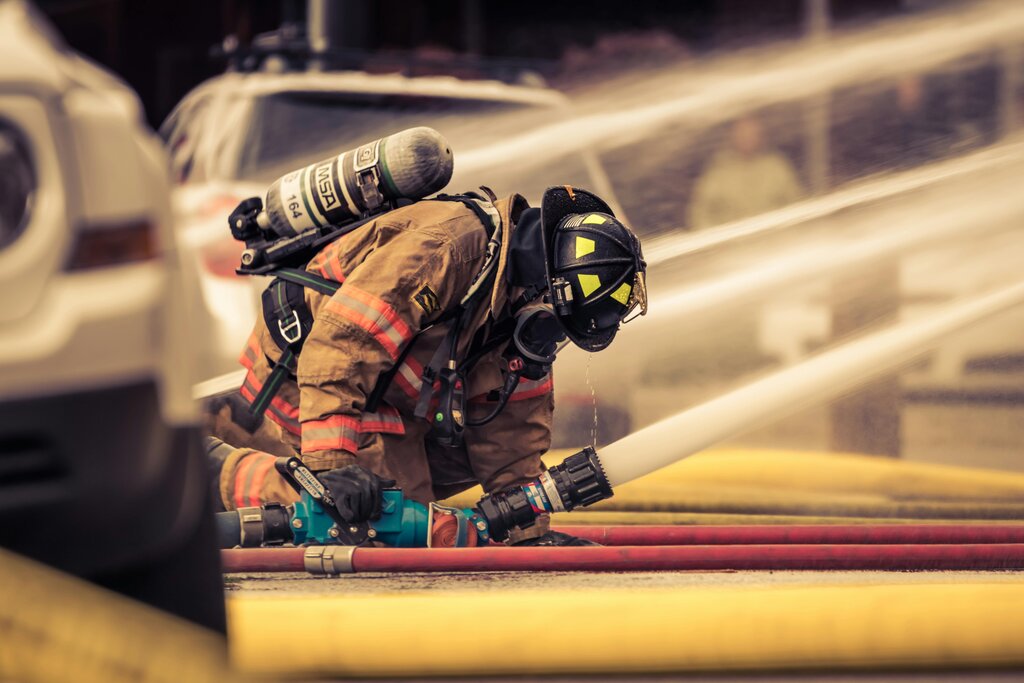
When water flows through a wide hose and then reaches a narrow nozzle, the water has to speed up to get the same volume through the smaller opening. According to Bernoulli's principle, this increase in speed causes a drop in the water's internal pressure right at the nozzle.
This principle is captured in the Bernoulli equation, which connects pressure, velocity, and height for a fluid in motion.
For a horizontal fire hose on the ground, the height ( and ) doesn't change much, so we can ignore that part. The equation then simplifies to show that if velocity () goes up, pressure () must go down to keep the total constant. This relationship is fundamental to how firefighting equipment is designed and used.
In the context of firefighting, what does 'flow' measure?
According to Bernoulli's principle, what happens to the internal pressure of water as it accelerates through the narrow nozzle of a fire hose?