Firearm Proficiency and Technical Mastery
Action Mechanics Deep Dive
The Cycle of Operation
Every time a firearm is fired, it completes a precise, high-speed sequence of events. This isn't just one action, but a coordinated dance of eight distinct steps known as the cycle of operation. Understanding this cycle is the key to diagnosing malfunctions and truly comprehending how any firearm, from a simple pump-action shotgun to a modern rifle, actually works.
While this entire sequence happens in a fraction of a second in a semi-automatic, the steps are the same in manually operated firearms. The user's actions—pumping the slide, working the lever, or throwing the bolt—are what drive the cycle forward through each of these phases. Now, let's look at how semi-automatics harness the energy of the fired cartridge to do this work automatically.
Harnessing the Gas
Gas-operated firearms tap into the high-pressure gas created by the burning propellant to cycle the action. Two main designs dominate this field: direct impingement and the short-stroke gas piston. The most famous example of direct impingement is the AR-15 platform. In this system, gas is siphoned from the barrel through a small port and travels down a thin tube directly into the bolt carrier group. This gas acts like a pneumatic ram, pushing the carrier backward to unlock the bolt and begin the cycle of operation. It’s a simple, lightweight system with fewer moving parts.
The alternative is a piston system. In a short-stroke gas piston design, the gas hits a small piston located in a gas block near the barrel port. This piston moves a short distance, striking an operating rod that then pushes the bolt carrier rearward. The key difference is that the hot, dirty gases from firing never enter the receiver. This generally results in a cleaner, cooler-running firearm, though it adds a bit of weight and mechanical complexity. Many modern military rifles have adopted piston systems for their perceived reliability in harsh conditions.
Locking and Unlocking
Not all self-loading firearms use gas. Some rely on the direct rearward force, or blowback, from the cartridge firing. However, for higher-powered cartridges, this force is too great and would slam the bolt open too quickly. To solve this, engineers developed systems to keep the action closed, or locked, until pressure has dropped to a safe level.
A locked breech system physically locks the bolt to the barrel at the moment of firing. They remain locked together for a short period of rearward travel before a mechanism unlocks them, allowing the bolt to continue its travel and cycle the action. This is the standard for virtually all high-powered rifles and most modern semi-automatic handguns.
In contrast, a delayed-blowback system doesn't have a rigid lock. Instead, it uses mechanical leverage to slow down the bolt's rearward opening. Systems might use rollers, levers, or gas pressure to create a mechanical disadvantage against the bolt's initial movement. This ensures the breech stays closed just long enough for the bullet to leave the barrel before the extraction and ejection process begins. It's a clever middle ground between a simple blowback and a true locked breech.
The timing of these events—locking, firing, unlocking—is critical. It's all controlled by the precise interaction of springs, levers, and cams. At the heart of the firing mechanism is the relationship between the trigger and the sear.
Sear
noun
The part of a trigger mechanism that holds the hammer or striker in a cocked position until the trigger is pulled.
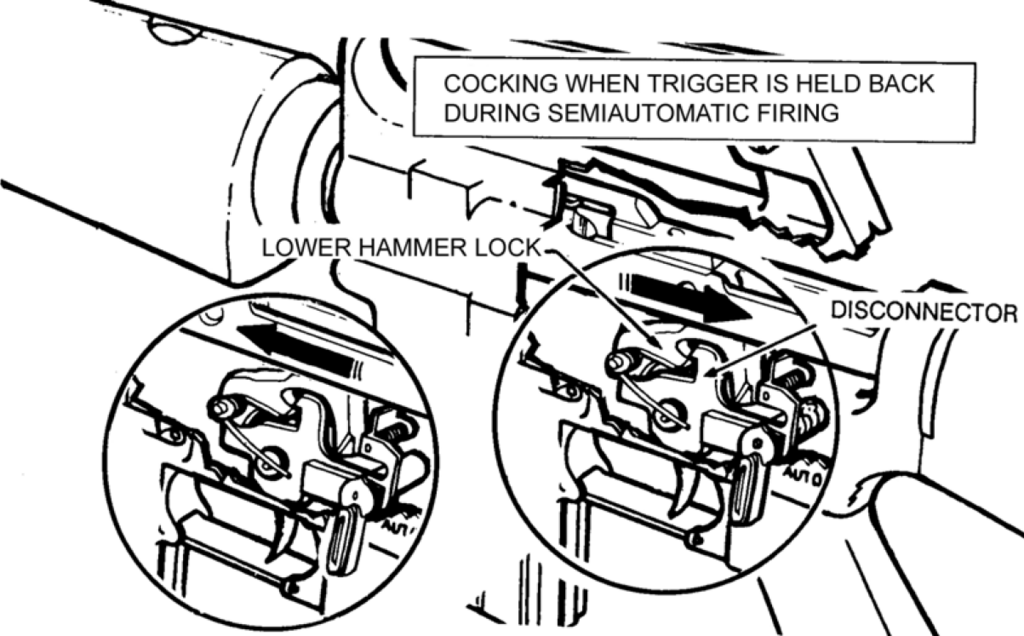
When you pull the trigger, it moves the sear, releasing the hammer to strike the firing pin. In a semi-automatic, as the bolt cycles to the rear, it pushes the hammer back down, where it's caught by a secondary sear called the disconnector. When you release the trigger, the disconnector hands the hammer off to the primary sear, readying the firearm for the next shot. This delicate handoff is what prevents the firearm from firing automatically and ensures one shot per trigger pull.
The Human Element
Manual actions use the same cycle of operation, but the shooter's muscle provides the energy. The design of their locking mechanisms is a study in mechanical advantage.
Bolt-Action: Offers the strongest lock-up. Turning the bolt handle rotates the bolt head, engaging multiple locking lugs directly into the receiver or barrel extension. This strength makes it ideal for the most powerful rifle cartridges.
Lever-Action: Typically uses a rising block or tilting bolt that is lifted into place behind the bolt by the action of the lever, sealing the breech.
Pump-Action: A sliding block or lug on the bolt drops into a recess in the receiver when the slide is pushed forward, locking the action shut.
| Action Type | Locking Mechanism | Common Use |
|---|---|---|
| Bolt-Action | Rotating bolt with locking lugs | Precision & hunting rifles |
| Lever-Action | Rising or tilting locking block | Ranch & brush guns |
| Pump-Action | Sliding locking block or lug | Shotguns, some rifles |
Understanding these internal mechanics moves you beyond simply being a shooter to being a proficient firearm user. You can start to understand why a malfunction is happening, not just that it happened, and appreciate the incredible engineering that occurs every time you pull the trigger.
Now, let's test what you've learned about how these actions work.
What is the primary advantage of a short-stroke gas piston system compared to a direct impingement system?
In a semi-automatic firearm, what is the function of the disconnector?