Firearm Mastery and Technical Marksmanship
Action Mechanics and Interactions
The Cycle of Operations
Every time a semi-automatic firearm fires, it executes a rapid, precisely timed sequence of mechanical events. This isn't a single action, but a chain reaction where one step perfectly sets up the next. This entire sequence is known as the cycle of operations.
Think of it as an eight-stage mechanical dance that happens in a fraction of a second. Understanding this cycle is the key to grasping how different firearm actions work and why they have distinct advantages and disadvantages.
The energy to power this cycle comes from the controlled explosion of the cartridge itself. A portion of the expanding gas or the rearward momentum is harnessed to unlock the action and begin the process of ejecting the spent casing and loading a fresh round. The timing of these events is critical for reliability and safety.
Ignition Systems
The "firing" stage of the cycle is where ignition systems come into play. There are two primary mechanisms in modern handguns: hammer-fired and striker-fired.
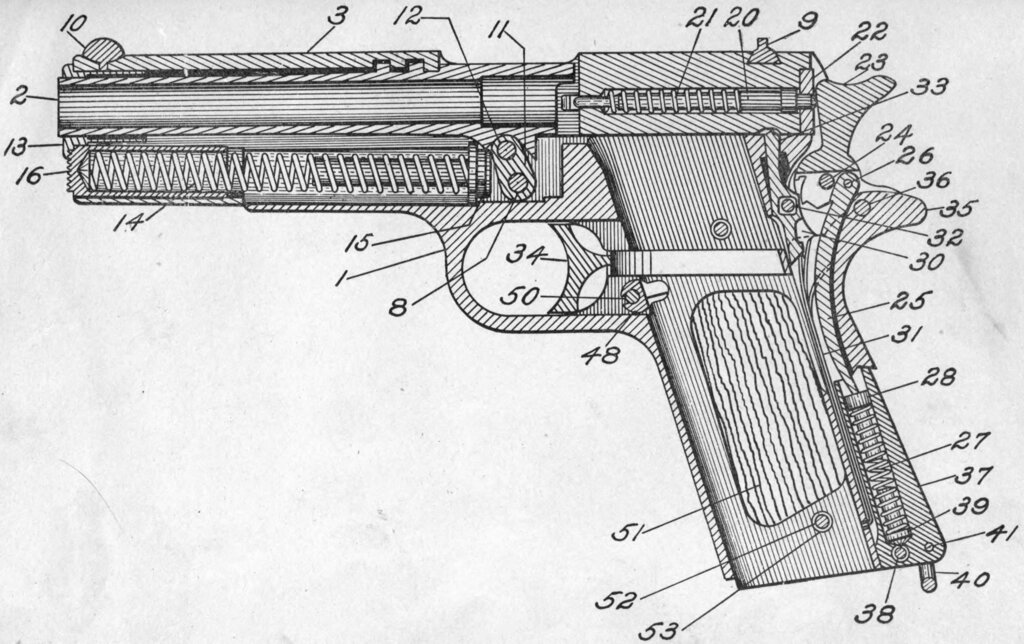
In a hammer-fired system, pulling the trigger releases a spring-loaded hammer, which pivots and strikes a firing pin. The firing pin then impacts the cartridge's primer. This system can be further divided:
- Single-Action (SA): The trigger only performs one function: releasing the hammer. The hammer must be manually cocked first, either by the user's thumb or by the cycling of the slide. This results in a short, light trigger pull, prized for accuracy.
- Double-Action (DA): The trigger performs two functions: it cocks the hammer and then releases it. This leads to a longer, heavier trigger pull for the first shot. On many DA/SA pistols, the first shot is double-action, and subsequent shots are single-action because the slide's movement cocks the hammer automatically.
Striker-fired systems, common in many modern pistols, eliminate the external hammer. Instead, a spring-loaded striker (essentially a firing pin with its own integrated spring) is partially or fully cocked by the slide's movement. Pulling the trigger finishes cocking the striker (if necessary) and then releases it to fire the round. This design often provides a consistent trigger pull for every shot and allows for a simpler internal mechanism and a lower , which can help manage recoil.
The tradeoff is often trigger feel. Many shooters prefer the crisp break of a single-action hammer, while others value the consistent simplicity of a striker system.
Rifle Operating Systems
While handguns often use the recoil of the slide to cycle the action, modern semi-automatic rifles typically use the expanding gases from the fired cartridge. The two dominant methods are direct impingement and gas piston systems.
Impingement
noun
The act of striking or colliding.
In a direct impingement (DI) system, a small port in the barrel siphons off hot propellant gas. This gas travels through a thin tube and is vented directly into the bolt carrier group, pushing it rearward to cycle the action. The advantage is simplicity and light weight, as there are fewer moving parts. The primary trade-off is that hot, carbon-fouled gases are vented directly into the firearm's receiver, which can increase heat and require more frequent cleaning to maintain reliability.
A gas piston system also uses a gas port in the barrel, but the gas doesn't travel all the way to the bolt. Instead, it pushes against a piston, which is connected to an operating rod. It's this rod that pushes the bolt carrier group to the rear. This keeps hot, dirty gases away from the critical components in the receiver, resulting in a cooler and cleaner-running firearm. These systems are themselves divided into two main types:
| System | Description | Pro | Con |
|---|---|---|---|
| Short-Stroke Piston | The piston moves a short distance to strike the operating rod, then returns. | Lighter than long-stroke, less impact on barrel harmonics. | More complex than DI, more moving parts. |
| Long-Stroke Piston | The piston is attached to the operating rod and moves the full length of the bolt carrier's travel. | Very robust and reliable, fewer small parts to break. | Heavier, more reciprocating mass can affect recoil impulse. |
Locking Mechanisms
For a firearm to operate safely, the breech must be securely locked at the moment of firing. This prevents the high-pressure gases from escaping rearward. After firing, the breech must unlock at the right moment to allow the cycle of operations to continue. Two common designs for this in handguns are the tilting barrel and the locking block.
The most common system in modern semi-automatic pistols is the design, pioneered by John Browning. When the gun is in battery (ready to fire), locking lugs on the top of the barrel are engaged with recesses inside the slide. Upon firing, the barrel and slide recoil together for a short distance. Then, a cam or link system pulls the rear of the barrel downward, disengaging the lugs and allowing the slide to continue its rearward travel alone.
Other systems, such as a falling or rising locking block, use a separate piece of steel that is wedged between the bolt/slide and the frame to lock the action. As the action recoils, a mechanical feature in the frame forces the block down and out of the way, unlocking the bolt. This design is often found in firearms with fixed barrels, which can contribute to greater potential accuracy since the barrel doesn't move during the firing cycle.
Now, let's test your understanding of these mechanical interactions.
What is the complete sequence of mechanical events that a semi-automatic firearm executes each time it is fired called?
In a hammer-fired pistol, what is the primary functional difference between a single-action (SA) trigger and a double-action (DA) trigger?
Each of these systems represents a different solution to the same set of engineering problems: how to safely contain pressure, use that pressure to cycle the action, and do it all reliably in a compact package.