Finding Geology Textbooks Online
Understanding Geology
What Is Geology?
Geology is the story of our planet. It’s the science of the Earth, from its fiery core to the highest mountains. Geologists study the materials that make up our world, the processes that shape it, and its long, dramatic history.
The field has two main branches. Physical geology focuses on what the Earth is made of and how it works today. It examines rocks, minerals, volcanoes, and earthquakes. Historical geology looks at the past, piecing together the planet's 4.5-billion-year history, from the first continents to the age of dinosaurs and beyond.
Inside Our Planet
The ground beneath our feet is just the beginning. Earth is made of several distinct layers, like a giant onion. Each layer has its own unique properties.
Crust: This is the thin, rocky shell we live on. It's broken into two types: the thicker continental crust that makes up landmasses, and the thinner, denser oceanic crust under the oceans.
Mantle: Below the crust is the mantle, a thick layer of hot, dense rock. It's mostly solid, but over millions of years, it can flow like very thick tar. This movement drives the action of tectonic plates on the surface.
Outer Core: This layer is made of liquid iron and nickel. The constant churning of this metallic fluid generates Earth's magnetic field, which protects us from harmful solar radiation.
Inner Core: At the very center is the inner core. It’s also made of iron and nickel, but despite being even hotter than the outer core, the immense pressure keeps it a solid ball.
The Never-Ending Rock Cycle
Rocks may seem permanent, but they are part of a dynamic, continuous process. The rock cycle describes how rocks are created, changed, and destroyed over millions of years. It’s one of the most fundamental concepts in geology.
There are three main types of rocks:
- Igneous rocks are born from fire. They form when molten rock, called magma (below ground) or lava (above ground), cools and solidifies.
- Sedimentary rocks are made from pieces of other things. Over time, wind and water break down existing rocks into small particles called sediments. These particles settle in layers, and eventually, the pressure from overlying layers compacts them into solid rock.
- Metamorphic rocks are rocks that have changed. When any type of rock is subjected to intense heat and pressure deep within the Earth, it transforms. Its minerals recrystallize and its texture changes, creating a new metamorphic rock.
A Journey Through Time
To understand geology, you have to think on a completely different timescale. Human history spans thousands of years, but geological history spans billions. Geologists have divided Earth's history into a timeline called the geological time scale, which organizes the planet’s past into eons, eras, periods, and epochs.
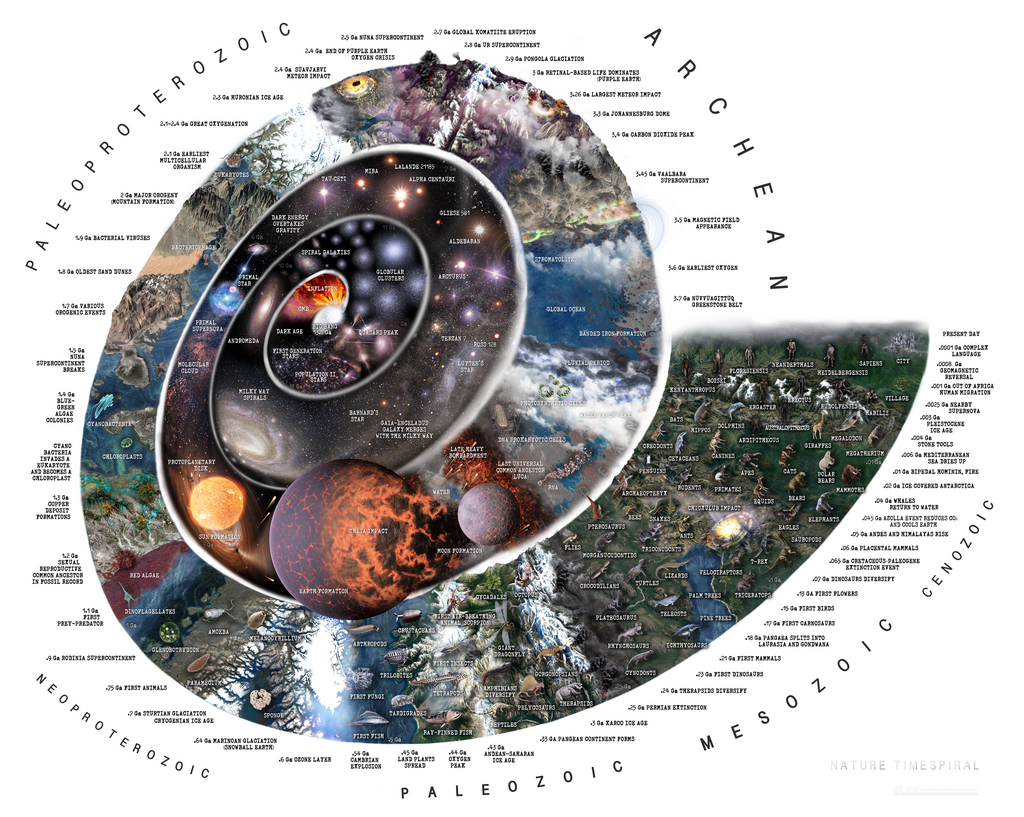
This timeline helps geologists place rocks and fossils in the correct order and understand the major events in Earth's evolution, like the rise and fall of the dinosaurs or the formation of major mountain ranges. It’s a calendar for the Earth itself.
Now let's test your knowledge of these core concepts.
Which branch of geology focuses on the materials that make up the Earth and the processes that are active today?
Which layer of the Earth is a liquid metal that generates the planet's protective magnetic field?
Understanding these basics—the Earth's structure, the rock cycle, and the immensity of geologic time—is the first step in reading the planet's incredible story.