Financial Statement Fundamentals
Cash Flow Statement
The Story of Cash
While the income statement tells you if a company is profitable, the cash flow statement tells you if it can actually pay its bills. It tracks the real money moving in and out of a business over a period of time. Think of it like your personal bank account. Your paycheck shows your income, but your bank statement shows exactly where your money came from and where it went—rent, groceries, savings, and so on. That's what the cash flow statement does for a company.
The purpose of a cash flow statement is to provide insight into the company’s liquidity and its ability to generate cash to meet obligations.
A company can look profitable on its income statement but still go bankrupt if it doesn't have enough cash to cover its short-term expenses. This statement reveals the real story behind the numbers, breaking down a company's cash movements into three main categories.
Three Core Activities
The cash flow statement is organized into three sections, each telling a different part of the company's financial story.
1. Operating Activities This is the cash generated from a company's main business operations. For a coffee shop, it’s the cash from selling lattes and pastries, minus the cash paid for beans, milk, and employee wages. This section starts with the net income from the income statement and then adjusts for any non-cash expenses, like depreciation. It’s the best indicator of a company's ability to generate cash from its core business.
2. Investing Activities This section tracks cash used for investments to grow the business. It includes buying or selling long-term assets like property, equipment, or even other companies. If our coffee shop buys a new espresso machine, that cash outflow appears here. If it sells an old delivery van, the cash inflow is recorded here.
3. Financing Activities This part shows how a company raises money and pays it back to investors and lenders. It includes cash from issuing stock, taking out loans, or repaying debt. If the coffee shop takes out a loan to open a new location, that’s a cash inflow. When it pays dividends to its shareholders, that’s a cash outflow.
These three sections add up to the net increase or decrease in cash for the period. When you add this number to the cash balance at the beginning of the period, you get the final cash balance. This ending cash balance must match the cash amount shown on the balance sheet for the same period. It's how all three statements connect.
A common saying in finance is, "Profit is an opinion, but cash is a fact." An income statement can be influenced by accounting rules, but the cash flow statement shows the hard reality of a company's cash position.
Reading a Real Statement
Let's look at an example. This document shows the cash flows for a municipality's trust fund. Even though it's a government entity, the principles are the same. You can see the main sections outlined, showing cash inflows and outflows.
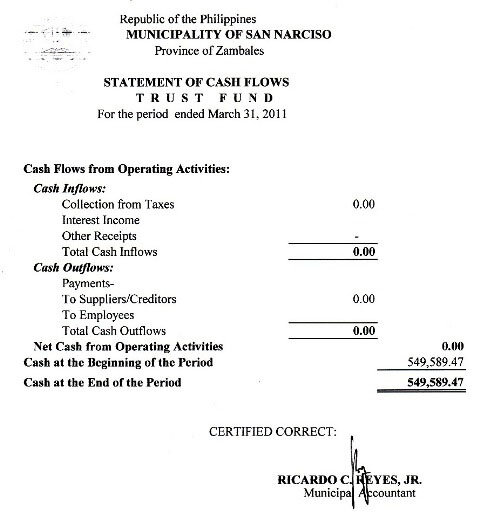
Notice how the statement is structured to first show cash from operations, followed by any investing or financing activities. It ends by calculating the net change in cash and showing the beginning and ending cash balances. By analyzing these flows, you can assess whether a company is generating enough cash from its operations to fund its growth without relying too heavily on borrowing.
Ready to test your knowledge? Let's see what you've learned about the cash flow statement.
A company that is profitable on its income statement can never go bankrupt due to cash flow issues.
Which section of the cash flow statement is considered the best indicator of a company's ability to generate cash from its main business activities?
The cash flow statement completes the picture painted by the income statement and balance sheet. Together, these three documents provide a comprehensive view of a company's financial health.