Financial Modeling Fundamentals
Introduction to Financial Modeling
What Is a Financial Model?
A financial model is a tool, most often a spreadsheet, that shows a company's financial story. It takes past performance and a set of assumptions about the future to project how a business might perform over time. Think of it as a financial simulator for a business. It lets you test ideas and see potential outcomes without risking real money.
The main goal is to translate a company's strategy and plans into numbers. If you plan to launch a new product or expand into a new market, a financial model can help you estimate the costs and potential profits. It answers critical "what if" questions, like "What happens to our profit if sales grow by 10% instead of 20%?"
A financial model is a spreadsheet-based abstraction of a real company that helps you estimate the company’s future cash flows, financing requirements, valuation, and whether or not you should invest in the company; models are also used to assess the viability of acquisitions and the development of new assets.
Why Bother Building One?
Financial models are essential for making informed decisions. One of their primary uses is forecasting. By projecting revenue, expenses, and cash flow, businesses can create budgets, manage resources, and plan for future growth. A startup, for example, can use a model to figure out how much funding it needs to reach profitability.
Another key application is valuation. When a company wants to raise money from investors, get acquired, or even go public, a financial model is used to estimate its worth. It provides a structured way to justify a price based on expected future performance.
Beyond forecasting and valuation, models help with strategic planning, such as analyzing the financial impact of a new pricing strategy or deciding whether to build a new factory.
The Building Blocks
Every financial model is built on a few core components, regardless of its complexity.
| Component | Description |
|---|---|
| Assumptions | The inputs that drive the model. These are educated guesses about the future, like sales growth rates, cost of goods, or tax rates. |
| Calculations | The engine of the model. This section contains the formulas that link the assumptions to the outputs, creating the financial forecast. |
| Outputs | The results. These are typically projected financial statements (Income Statement, Balance Sheet, Cash Flow Statement) and key performance metrics. |
The quality of your assumptions determines the quality of your model. A model with flawed assumptions will produce unreliable results, no matter how complex its formulas are.
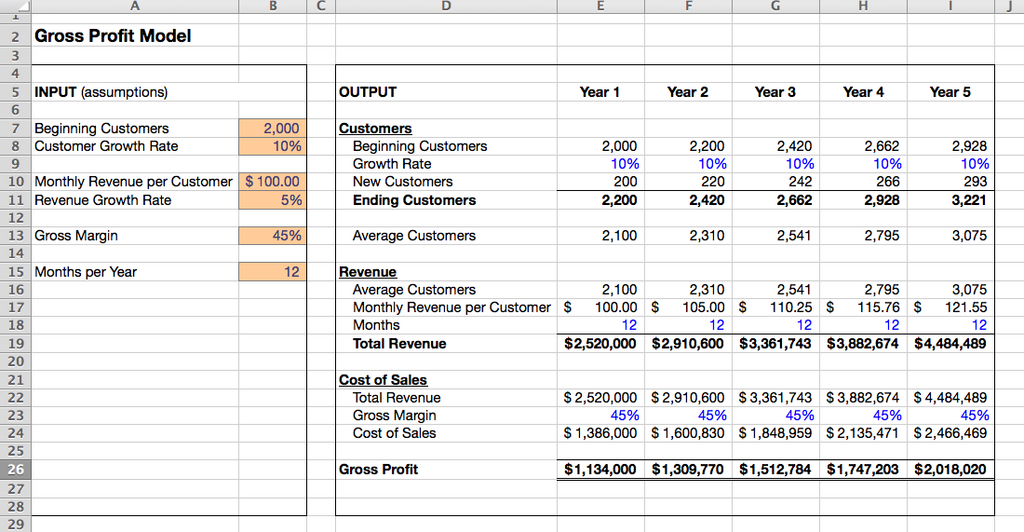
Accuracy and consistency are vital. A small error in a single formula can have a ripple effect, leading to completely wrong conclusions. That's why financial models must be transparent and easy to understand, allowing others to follow the logic and check for mistakes.
What is the primary purpose of a financial model?
A key benefit of a financial model is its ability to answer "what if" questions, like exploring the impact of different sales growth scenarios.
Building a financial model is a fundamental skill in finance, helping to bring clarity to complex business decisions. It’s the process of turning a story into a structured, numerical forecast.